

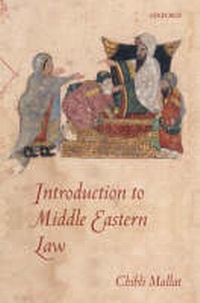
Introduction to Middle Eastern Law
Published in 2007
Book
Hardback
496 pages
978-0-19-923049-5 (ISBN)
Description
This book provides an introduction to the laws of the Middle East, defining the contours of a field of study that deserves to be called 'Middle Eastern law'. It introduces Middle Eastern law as a reflection of legal styles, many of which are shared by Islamic law and the laws of Christian and Jewish Near Eastern communities. It offers a detailed survey of the foundations of Middle Eastern law, using court archives and an array of legal sources from the earliest records of Hammurabi to the massive compendia of law in the Islamic classical age through to the latest decisions of Middle Eastern high courts. It focuses on the way legislators and courts conceive of law and apply it in the Middle East. It builds on the author's extensive legal practice, with the aim of introducing the Middle Eastern law's main sources and concepts in a manner accessible to non-specialist legal scholars and practitioners alike.
The book begins with an exploration of the depth and variety of Middle Eastern law, introducing the concepts of shari'a , fiqh , and qanun , (which all mean 'law'), and dwelling on Islamic law as the 'common law' of the Middle East. It provides a historical introduction to the contemporary Middle East, exploring political systems, constitutional law, judicial review, the laws of tort and obligations, commercial law (including Islamic banking, company law, capital markets, and commercial arbitration); and examines legislative reform in family law and the position of women in the legal system. The author considers the interaction between Islamic and Western laws and includes a bibliography designed for further research into the jurisdictions and themes explored throughout the book.
Contents:
1.From Islamic to Middle Eastern Law:a Restatement of the Field
I History
2. The Formation of Middle Eastern law
II Public Law
3. Introduction to the Contemporary Middle East
4. Constitutional Law: the Specificity of Middle Eastern Constitutionalism
5. Constitutional Review: the Spread of Constitutional Councils and Courts
6. Judicial Review
III Private Law
7. Introduction to the Age of Codification
8. Civil law: on Style and Substance
9. Commercial Law: Modernity and its Hiccups
10. Family Law: the Search for Gender Equality
11. Epilogue: Justice and Lawyering in the Middle East
Bibliography
Tables of Cases, legislation, Verses and Hadiths
Readership: Legal scholars, students and practitioners seeking an introduction to the legal systems of the middle east, including the Islamic, Jewish, and Christian legal traditions.
The author:
Chibli Mallat, EU Jean Monnet Professor of Law, Université Saint-Joseph, Beirut, and Visiting Professor, Princeton University
The book begins with an exploration of the depth and variety of Middle Eastern law, introducing the concepts of shari'a , fiqh , and qanun , (which all mean 'law'), and dwelling on Islamic law as the 'common law' of the Middle East. It provides a historical introduction to the contemporary Middle East, exploring political systems, constitutional law, judicial review, the laws of tort and obligations, commercial law (including Islamic banking, company law, capital markets, and commercial arbitration); and examines legislative reform in family law and the position of women in the legal system. The author considers the interaction between Islamic and Western laws and includes a bibliography designed for further research into the jurisdictions and themes explored throughout the book.
Contents:
1.From Islamic to Middle Eastern Law:a Restatement of the Field
I History
2. The Formation of Middle Eastern law
II Public Law
3. Introduction to the Contemporary Middle East
4. Constitutional Law: the Specificity of Middle Eastern Constitutionalism
5. Constitutional Review: the Spread of Constitutional Councils and Courts
6. Judicial Review
III Private Law
7. Introduction to the Age of Codification
8. Civil law: on Style and Substance
9. Commercial Law: Modernity and its Hiccups
10. Family Law: the Search for Gender Equality
11. Epilogue: Justice and Lawyering in the Middle East
Bibliography
Tables of Cases, legislation, Verses and Hadiths
Readership: Legal scholars, students and practitioners seeking an introduction to the legal systems of the middle east, including the Islamic, Jewish, and Christian legal traditions.
The author:
Chibli Mallat, EU Jean Monnet Professor of Law, Université Saint-Joseph, Beirut, and Visiting Professor, Princeton University
More details
Language
English
Place of publication
Oxford
United Kingdom
Target group
Legal scholars, students and practitioners seeking an introduction to the legal systems of the middle east, including the Islamic, Jewish, and Christian legal traditions.
Illustrations
black & white illustrations
ISBN-13
978-0-19-923049-5 (9780199230495)
Schweitzer Classification
Other editions
Additional editions
Chibli Mallat
Introduction to Middle Eastern Law
Book
03/2009
Oxford University Press
€81.84
Shipment within 15-20 days
Chibli Mallat
Introduction to Middle Eastern Law
E-Book
07/2007
OUP eBook
€40.49
Available for download
Person
Chibli Mallat is the EU Jean Monnet Professor of Law at the Universite Saint-Joseph, Beirut, and a Visiting Professor at Princeton University. In addition to his work in European law, he is a leading scholar of Islamic and Middle Eastern law, a legal practitioner, and a Former Director of the Centre of Islamic and Middle Eastern law at the School of Oriental and African Studies of the University of London."
Content
Preface; 1. From Islamic to Middle Eastern Law:a Restatement of the Field; I HISTORY; 2. The Formation of Middle Eastern law; II PUBLIC LAW; 3. Introduction to the Contemporary Middle East; 4. Constitutional Law: the Specificity of Middle Eastern Constitutionalism; 5. Constitutional Review: the Spread of Constitutional Councils and Courts; 6. Judicial Review; III PRIVATE LAW; 7. Introduction to the Age of Codification; 8. Civil law: on Style and Substance; 9. Commercial Law: Modernity and its Hiccups; 10. Family Law: the Search for Gender Equality; 11. Epilogue: Justice and Lawyering in the Middle East; Bibliography; Tables of Cases, legislation, Verses and Hadiths