

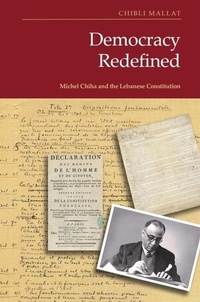
Democracy Redefined
Michel Chiha and the Lebanese Constitution
Published on 31. October 2025
Book
Hardback
416 pages
978-1-3995-5270-7 (ISBN)
Description
At a time when democratic government is under attack, Chibli Mallat offers a new definition of democracy: the necessary representation in government of citizens as 'members of historically subordinate groups', a concept first opened up by Michel Chiha (1891-1954) during his drafting of the Lebanese Constitution of 1926.
The book rests on two main research pillars: the first is a detailed historical and institutional examination of Levantine and Lebanese institutions, drawing on dozens of 19th and 20th century documents, including Chiha's constitutional papers. With unprecedented access to the Chiha Archive, Mallat constructs a world vision of Chiha through his writings and political positions which act as the background to his constitutional contributions. The second pillar examines the success and failures of an enduring Lebanese Constitution to advance this radically new view of majoritarian democracy, based on extensive research in political science and in constitutional law.
The book rests on two main research pillars: the first is a detailed historical and institutional examination of Levantine and Lebanese institutions, drawing on dozens of 19th and 20th century documents, including Chiha's constitutional papers. With unprecedented access to the Chiha Archive, Mallat constructs a world vision of Chiha through his writings and political positions which act as the background to his constitutional contributions. The second pillar examines the success and failures of an enduring Lebanese Constitution to advance this radically new view of majoritarian democracy, based on extensive research in political science and in constitutional law.
Reviews / Votes
The coverage of this book is way more than adequate; it is extraordinary. The author deftly organises a depth of historical detail into a gripping narrative with an exciting point: the evolution of communal (religious) representation to a "best practice" model in Lebanon, with pros and cons. It then offers an entirely original contribution to contemporary democratic theory: an argument for the conscious, communal representation of subordinate groups. It is rare to be taken out of one's intellectual ruts and thrown into a new and convincing way of looking at the world. This book does that. I found it hard to put down. -- Jane Mansbridge, Harvard University The author is perhaps today's leading theorist on democracy in the Middle East and Arab societies, having worked consistently on the problem for over 30 years. In this very erudite book, Mallat's major contribution is to raise the Lebanese paradigm of consociational democracy to a general theoretical question about how to structure political power without a numerical majority where it must be shared by different minorities. -- John W. Borneman, Princeton UniversityMore details
Language
English
Place of publication
Edinburgh
United Kingdom
Target group
College/higher education
Illustrations
5 b/w tables
Dimensions
Height: 241 mm
Width: 162 mm
Thickness: 143 mm
Weight
754 gr
ISBN-13
978-1-3995-5270-7 (9781399552707)
Copyright in bibliographic data and cover images is held by Nielsen Book Services Limited or by the publishers or by their respective licensors: all rights reserved.
Schweitzer Classification
Person
Chibli Mallat is Emeritus Presidential Professor of Law at the University of Utah and has taught inter alia at Harvard, Yale, Princeton, SOAS London University and Saint Joseph's University in Lebanon. He has published more than 40 books on law, philosophy, and politics, including The Normalization of Saudi Law (OUP 2022), Philosophy of Nonviolence (OUP 2015) and Introduction to Middle Eastern Law (OUP 2007). A practising lawyer and the principal of Mallat Law Offices in Beirut, he has advised governments, business and nonprofit organizations and litigated major cases in several jurisdictions across the world.
Content
Expanded Table of Contents
List of Tables
Preface
Acknowledgments
Transliteration
Abbreviations and Chiha-related Primary Sources
1. Orientation: Two Centuries of Institutional Communalism in Lebanon
Part I. Communalism and the Birth of Elections
2. The Birth of Representative Communalism - From Simqaniyya (1697) to the Beirut Consultative Council (1834)
3. The Entrenchment of Communalism and the Birth of the Electoral Principle (1840-1920)
Part II. The Lebanese Constitution of 1926
4. The Constitution of 1926: Reconstructing the Timeline
5. The Constitution of 1926: Structure and Inspiration
6. Building Constitutional Blocks: The Communitarian Straitjacket
7. Building Constitutional Blocks: Modern Constitutionalism
Part III. Chiha after the Constitution
8. Constitutional Developments
9. Chiha's Worldview
10. Chiha's Nation
Part IV. Constitutionalism and Group Representation
11. Lebanese Constitutionalism and the Political-Theological Middle East
12. Constitutional Frontiers: The Lebanese Constitution and the World
13. Democracy Redefined
14. Epilogue
General Bibliography
Index
List of Tables
Preface
Acknowledgments
Transliteration
Abbreviations and Chiha-related Primary Sources
1. Orientation: Two Centuries of Institutional Communalism in Lebanon
Part I. Communalism and the Birth of Elections
2. The Birth of Representative Communalism - From Simqaniyya (1697) to the Beirut Consultative Council (1834)
3. The Entrenchment of Communalism and the Birth of the Electoral Principle (1840-1920)
Part II. The Lebanese Constitution of 1926
4. The Constitution of 1926: Reconstructing the Timeline
5. The Constitution of 1926: Structure and Inspiration
6. Building Constitutional Blocks: The Communitarian Straitjacket
7. Building Constitutional Blocks: Modern Constitutionalism
Part III. Chiha after the Constitution
8. Constitutional Developments
9. Chiha's Worldview
10. Chiha's Nation
Part IV. Constitutionalism and Group Representation
11. Lebanese Constitutionalism and the Political-Theological Middle East
12. Constitutional Frontiers: The Lebanese Constitution and the World
13. Democracy Redefined
14. Epilogue
General Bibliography
Index