

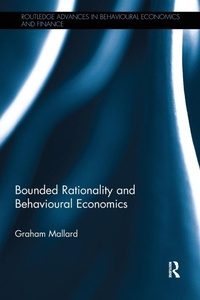
Bounded Rationality and Behavioural Economics
1st Edition
Published on 12. February 2018
Book
Paperback/Softback
140 pages
978-1-138-49974-4 (ISBN)
Description
Economics Nobel Laureate Herbert Simon developed the concept of bounded rationality in the 1950s. This asserts that the cognitive abilities of human decision-makers are not always sufficient to find optimal solutions to complex real-life problems, leading decision-makers to find satisfactory, sub-optimal outcomes. This was a foundational component of the development of Behavioural Economics but in recent years the two fields have diverged, each with its own literature, its own approach and its own proponents. Behavioural Economics explores the areas of commonality between Economics and Psychology, in terms of its focus and its approach, whereas the bounded rationality literature largely analyses the implications of sub-optimal decision-making through the mathematically sophisticated methodology of mainstream Economics.
This book examines the nature and consequences of this divergence and questions whether this is a case of beneficial specialisation or whether it is unhelpful, potentially stunting the development of some aspects of Economics. It has been suggested that the major deficiency of Behavioural Economics is that it has failed to produce a single, widely applicable alternative to constrained optimisation. This book evaluates the extent to which this is the true and, if it is, the extent to which it is a product of the divergence between the two literatures. It also seeks to identify commonalities between the two subjects and suggests avenues of research in Economics that would benefit from a re-fusion of these two fields.
This book examines the nature and consequences of this divergence and questions whether this is a case of beneficial specialisation or whether it is unhelpful, potentially stunting the development of some aspects of Economics. It has been suggested that the major deficiency of Behavioural Economics is that it has failed to produce a single, widely applicable alternative to constrained optimisation. This book evaluates the extent to which this is the true and, if it is, the extent to which it is a product of the divergence between the two literatures. It also seeks to identify commonalities between the two subjects and suggests avenues of research in Economics that would benefit from a re-fusion of these two fields.
More details
Series
Language
English
Place of publication
London
United Kingdom
Publishing group
Taylor & Francis Ltd
Target group
College/higher education
Illustrations
23 s/w Zeichnungen, 2 s/w Tabellen
2 Tables, black and white; 23 Line drawings, black and white
Dimensions
Height: 234 mm
Width: 156 mm
Thickness: 8 mm
Weight
228 gr
ISBN-13
978-1-138-49974-4 (9781138499744)
Copyright in bibliographic data and cover images is held by Nielsen Book Services Limited or by the publishers or by their respective licensors: all rights reserved.
Schweitzer Classification
Other editions
Additional editions
Graham Mallard
Bounded Rationality and Behavioural Economics
Book
08/2015
1st Edition
Routledge
€231.00
Shipment within 10-20 days
Graham Mallard
Bounded Rationality and Behavioural Economics
E-Book
08/2015
Routledge
€67.49
Available for download
Person
Graham Mallard is the Head of Economics at Cheltenham College and a Visiting Research Fellow at the University of Bath, UK.
Content
1. Behavioural economics and bounded rationality Chapter 2. Recent developments in the behavioural economics literature: a survey 3. Recent developments in the bounded rationality literature: a survey 4. Audiences and impact 5. Commonality and differentiation: examined and evaluated 6. Towards an abstract behavioural framework 7. Concluding thoughts