

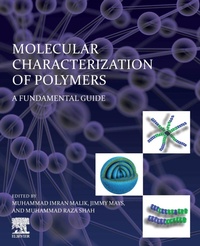
Molecular Characterization of Polymers
A Fundamental Guide
Published on 12. March 2021
Book
Paperback/Softback
668 pages
978-0-12-819768-4 (ISBN)
Description
Molecular Characterization of Polymers presents a range of advanced and cutting-edge methods for the characterization of polymers at the molecular level, guiding the reader through theory, fundamentals, instrumentation, and applications, and supporting the end goal of efficient material selection and improved material performance.
Each chapter focuses on a specific technique or family of techniques, including the different areas of chromatography, field flow fractionation, long chain branching, static and dynamic light scattering, mass spectrometry, NMR, X-Ray and neutron scattering, polymer dilute solution viscometry, microscopy, and vibrational spectroscopy. In each case, in-depth coverage explains how to successfully implement and utilize the technique.
This practical resource is highly valuable to researchers and advanced students in polymer science, materials science, and engineering, and to those from other disciplines and industries who are unfamiliar with polymer characterization techniques.
Each chapter focuses on a specific technique or family of techniques, including the different areas of chromatography, field flow fractionation, long chain branching, static and dynamic light scattering, mass spectrometry, NMR, X-Ray and neutron scattering, polymer dilute solution viscometry, microscopy, and vibrational spectroscopy. In each case, in-depth coverage explains how to successfully implement and utilize the technique.
This practical resource is highly valuable to researchers and advanced students in polymer science, materials science, and engineering, and to those from other disciplines and industries who are unfamiliar with polymer characterization techniques.
More details
Language
English
Place of publication
United States
Target group
Professional and scholarly
Academia: Researchers and advanced students in polymer science, materials science and engineering, and those from other disciplines who are unfamiliar with polymer characterization techniques.
Industry: Engineers, designers, and R&D working with polymeric materials.
Product notice
Paperback (trade)
Illustrations
Approx. 200 illustrations (40 in full color)
Dimensions
Height: 235 mm
Width: 191 mm
Thickness: 34 mm
Weight
1131 gr
ISBN-13
978-0-12-819768-4 (9780128197684)
Copyright in bibliographic data and cover images is held by Nielsen Book Services Limited or by the publishers or by their respective licensors: all rights reserved.
Schweitzer Classification
Other editions
Additional editions
Muhammad Imran Malik | Jimmy Mays | Muhammad Raza Shah
Molecular Characterization of Polymers
A Fundamental Guide
E-Book
03/2021
Elsevier
€220.00
Available for download
Persons
Dr. Muhammad Imran Malik is an Associate Professor at the HEJ Research Institute of Chemistry, International Centre for Chemical and Biological Sciences, University of Karachi, Pakistan. He received his doctorate in polymer chemistry at Karl-Franzens-Universitaete, Graz, Austria, in 2009, and subsequently worked as a post-doctoral research scientist, at the University of Stellenbosch, South Africa, and at POSTECH, in South Korea, with his research focusing on analytical polymer science. In 2012, he joined the International Center of Chemical and Biological Sciences at the University of Karachi as an Assistant Professor. Dr. Malik's main research interests are the synthesis of novel polymeric architectures and the development of comprehensive analytical methods for polymers, as well as polymer-stabilized nanoparticles and their applications, such as sensors, drug delivery, molecularly imprinted polymers, and organic solar cells. Prof. Jimmy Mays is Emeritus Professor at the University of Tennessee, Knoxville, USA, after retiring from the University at the end of 2017. Prof. Mays received his B.S. degree in Polymer Science from the University of Southern Mississippi, in 1979, and completed his Ph.D. in Polymer Science at the University of Akron, in 1984 (with L. J. Fetters). After graduation, he worked for several years at Hercules Research Center, prior to joining the faculty at the University of Alabama at Birmingham. In 2002, he became an UT/ORNL Distinguished Scientist at the University of Tennessee, Knoxville, and Oak Ridge National Laboratory. Prof. Mays' research has centered on polymer synthesis, polymer characterization, and polymer solution properties. He is a Fellow of the American Chemical Society, Fellow of the Royal Society of Chemistry, and Fellow of the American Association for the Advancement of Science. He has won the ACS Polymer Chemistry Division's Herman Mark Senior Scholar Award, the ACS PMSE Division's Doolittle Award, and the ACS Southern Chemist Award. Muhammad Raza Shah is a full professor at the International Center for Chemical and Biological Sciences, HEJ Research Institute of Chemistry, University of Karachi, Pakistan. He is also the Head of the Center for Bioequivalence Studies and Clinical Research. He is a recipient of several awards, including the Tamgha-i-Imtiaz Award from the President of Pakistan, the Salam Prize, the Professor Atta ur Rahman Gold Medal, and the Dr M Raziuddin Siddiqi Prize, by the Pakistan Academy of Sciences, for scientists under 40 years of age, in the field of chemistry. Professor Shah has authored six books and edited four books, in addition to contributing over 350 peer-reviewed journal papers. One of his authored books was declared as best book of 2017 by the Government of Pakistan's Higher Education Commission.
Content
1. Basic principles of size exclusion and liquid interaction chromatography of polymers
2. Multidetector size exclusion chromatography of polymers
3. Temperature gradient interaction chromatography of polymers
4. Field-flow fractionation techniques for polymer characterization
5. Characterization of polyolefins
6. Analytical ultracentrifugation and combined molecular hydrodynamic approaches for polymer characterization
7. Dilute solution viscometry of polymers
8. Characterization of long-chain branching in polymers
9. Mass spectrometry of polymers
10. Vibrational spectroscopy of polymers
11. Characterization of polymers by NMR
12. Characterization of polymers by dynamic light scattering
13. Characterization of polymers by static light scattering
14. Characterization of polymers by LenS3 multiangle light scattering
15. X-ray and neutron scattering of polymers
16. Microscopy of polymers
2. Multidetector size exclusion chromatography of polymers
3. Temperature gradient interaction chromatography of polymers
4. Field-flow fractionation techniques for polymer characterization
5. Characterization of polyolefins
6. Analytical ultracentrifugation and combined molecular hydrodynamic approaches for polymer characterization
7. Dilute solution viscometry of polymers
8. Characterization of long-chain branching in polymers
9. Mass spectrometry of polymers
10. Vibrational spectroscopy of polymers
11. Characterization of polymers by NMR
12. Characterization of polymers by dynamic light scattering
13. Characterization of polymers by static light scattering
14. Characterization of polymers by LenS3 multiangle light scattering
15. X-ray and neutron scattering of polymers
16. Microscopy of polymers