

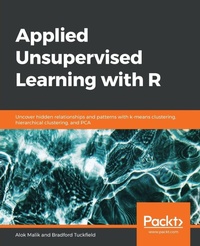
Applied Unsupervised Learning with R
Uncover hidden relationships and patterns with k-means clustering, hierarchical clustering, and PCA
Published on 27. March 2019
Book
Paperback/Softback
320 pages
978-1-78995-639-9 (ISBN)
Description
Design clever algorithms that discover hidden patterns and draw responses from unstructured, unlabeled data.
Key Features
Build state-of-the-art algorithms that can solve your business' problems
Learn how to find hidden patterns in your data
Revise key concepts with hands-on exercises using real-world datasets
Book DescriptionStarting with the basics, Applied Unsupervised Learning with R explains clustering methods, distribution analysis, data encoders, and features of R that enable you to understand your data better and get answers to your most pressing business questions.
This book begins with the most important and commonly used method for unsupervised learning - clustering - and explains the three main clustering algorithms - k-means, divisive, and agglomerative. Following this, you'll study market basket analysis, kernel density estimation, principal component analysis, and anomaly detection. You'll be introduced to these methods using code written in R, with further instructions on how to work with, edit, and improve R code. To help you gain a practical understanding, the book also features useful tips on applying these methods to real business problems, including market segmentation and fraud detection. By working through interesting activities, you'll explore data encoders and latent variable models.
By the end of this book, you will have a better understanding of different anomaly detection methods, such as outlier detection, Mahalanobis distances, and contextual and collective anomaly detection.What you will learn
Implement clustering methods such as k-means, agglomerative, and divisive
Write code in R to analyze market segmentation and consumer behavior
Estimate distribution and probabilities of different outcomes
Implement dimension reduction using principal component analysis
Apply anomaly detection methods to identify fraud
Design algorithms with R and learn how to edit or improve code
Who this book is forApplied Unsupervised Learning with R is designed for business professionals who want to learn about methods to understand their data better, and developers who have an interest in unsupervised learning. Although the book is for beginners, it will be beneficial to have some basic, beginner-level familiarity with R. This includes an understanding of how to open the R console, how to read data, and how to create a loop. To easily understand the concepts of this book, you should also know basic mathematical concepts, including exponents, square roots, means, and medians.
Key Features
Build state-of-the-art algorithms that can solve your business' problems
Learn how to find hidden patterns in your data
Revise key concepts with hands-on exercises using real-world datasets
Book DescriptionStarting with the basics, Applied Unsupervised Learning with R explains clustering methods, distribution analysis, data encoders, and features of R that enable you to understand your data better and get answers to your most pressing business questions.
This book begins with the most important and commonly used method for unsupervised learning - clustering - and explains the three main clustering algorithms - k-means, divisive, and agglomerative. Following this, you'll study market basket analysis, kernel density estimation, principal component analysis, and anomaly detection. You'll be introduced to these methods using code written in R, with further instructions on how to work with, edit, and improve R code. To help you gain a practical understanding, the book also features useful tips on applying these methods to real business problems, including market segmentation and fraud detection. By working through interesting activities, you'll explore data encoders and latent variable models.
By the end of this book, you will have a better understanding of different anomaly detection methods, such as outlier detection, Mahalanobis distances, and contextual and collective anomaly detection.What you will learn
Implement clustering methods such as k-means, agglomerative, and divisive
Write code in R to analyze market segmentation and consumer behavior
Estimate distribution and probabilities of different outcomes
Implement dimension reduction using principal component analysis
Apply anomaly detection methods to identify fraud
Design algorithms with R and learn how to edit or improve code
Who this book is forApplied Unsupervised Learning with R is designed for business professionals who want to learn about methods to understand their data better, and developers who have an interest in unsupervised learning. Although the book is for beginners, it will be beneficial to have some basic, beginner-level familiarity with R. This includes an understanding of how to open the R console, how to read data, and how to create a loop. To easily understand the concepts of this book, you should also know basic mathematical concepts, including exponents, square roots, means, and medians.
More details
Language
English
Place of publication
Birmingham
United Kingdom
Target group
Professional and scholarly
US School Grade: College Graduate Student
Dimensions
Height: 235 mm
Width: 191 mm
Thickness: 17 mm
Weight
600 gr
ISBN-13
978-1-78995-639-9 (9781789956399)
Copyright in bibliographic data and cover images is held by Nielsen Book Services Limited or by the publishers or by their respective licensors: all rights reserved.
Schweitzer Classification
Other editions
Additional editions
Alok Malik | Bradford Tuckfield
Applied Unsupervised Learning with R
Uncover hidden relationships and patterns with k-means clustering, hierarchical clustering, and PCA
E-Book
09/2024
Packt Publishing
from
€39.29
Available for download
Persons
Alok Malik is a data scientist based in India. He has previously worked on creating and deploying unsupervised learning solutions in fields such as finance, cryptocurrency trading, logistics, and natural language processing. He has a bachelor's degree in technology from the Indian Institute of Information Technology, Design and Manufacturing, Jabalpur, where he studied electronics and communication engineering. Bradford Tuckfield has designed and implemented data science solutions for firms in a variety of industries. He studied math for his bachelor's degree and economics for his Ph.D. He has written for scholarly journals and the popular press, on topics including linear algebra, psychology, and public policy.
Content
Table of Contents