

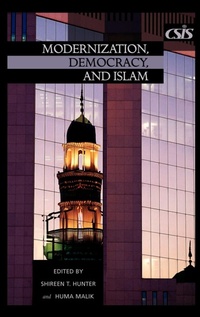
Modernization, Democracy, and Islam
Published on 30. January 2005
Book
Hardback
376 pages
978-0-275-98511-0 (ISBN)
Description
The Islamic world has a poor record in terms of modernization and democracy. However, the source of this situation is not religion, but factors including colonialism, international economic and trading systems, and the role of the military, among others. Recognizing these themes allows the consideration of possible remedies for change in the Muslim world.
The Islamic world has a poor record in terms of modernization and democracy. However, the source of this situation is not religion-Islam-but rather factors including colonialism, international economic and trading systems, and the role of the military, among others. Recognizing these themes allows the consideration of possible remedies for change in the Muslim world.
The distinguished scholars contributing to this volume identify key factors-some intrinsic to the Muslim world, and some external-that contribute to Islam's current predicament. Contrary to much prevailing thought and opinion, Islam is neither monolithic nor impervious to change. It is neither anti-democratic nor inherently anti-modernization. Islam itself, as this book shows, is not the root cause of the malaise of the Islamic world.
The Islamic world has a poor record in terms of modernization and democracy. However, the source of this situation is not religion-Islam-but rather factors including colonialism, international economic and trading systems, and the role of the military, among others. Recognizing these themes allows the consideration of possible remedies for change in the Muslim world.
The distinguished scholars contributing to this volume identify key factors-some intrinsic to the Muslim world, and some external-that contribute to Islam's current predicament. Contrary to much prevailing thought and opinion, Islam is neither monolithic nor impervious to change. It is neither anti-democratic nor inherently anti-modernization. Islam itself, as this book shows, is not the root cause of the malaise of the Islamic world.
Reviews / Votes
"Recommended. General readers, secondary school students, and lower-division undergraduates." - Choice "[A] book with the tripartite title Modernization, Democracy, and Islam may be said to cover all bases, and it does just that. The quality articles treat such diverse subjects as the econometric dimension, the role of the military, comparisons between the Middle East and Latin America, and gender inequality." - Foreign AffairsMore details
Language
English
Place of publication
United States
Publishing group
Bloomsbury Publishing Plc
Dimensions
Height: 240 mm
Width: 161 mm
Thickness: 25 mm
Weight
728 gr
ISBN-13
978-0-275-98511-0 (9780275985110)
Copyright in bibliographic data and cover images is held by Nielsen Book Services Limited or by the publishers or by their respective licensors: all rights reserved.
Schweitzer Classification
Other editions
Additional editions
Shireen T. Hunter | Huma Malick
Modernization, Democracy, and Islam
E-Book
01/2005
1st Edition
Praeger Publishers Inc
€38.99
Available for download
Persons
Shireen T. Hunter is Director of the Islam Program at the Center for Strategic and International Studies. Her areas of expertise include the Middle East-especially the Persian Gulf region-and Islam-particularly in Russia, Europe, and the United States. She is the author of The Future of Islam and the West: Clash of Civilizations or Peaceful Coexistence? (CSIS/Praeger, 1998) and editor of Islam: Europe's Second Religion (Praeger, 2002).
Huma Malik is a fellow in the CSIS Islam Program. Her research focuses on ethnic and sectarian conflicts in South Asia. She is the co-editor of two reports for CSIS, Islam in Europe and the United States: A Comparative Perspective and Integrating Muslim Communities in Europe and the United States (2003).
Huma Malik is a fellow in the CSIS Islam Program. Her research focuses on ethnic and sectarian conflicts in South Asia. She is the co-editor of two reports for CSIS, Islam in Europe and the United States: A Comparative Perspective and Integrating Muslim Communities in Europe and the United States (2003).
Content
Introduction Culture and Development by Heather Deegan Development and Democracy: The Muslim World in Comparative Perspective by Mehran Kamrava Is Gender Inequality a Barrier to Modernization and Democratization? by Valentine Moghadam Islam and Modernity by Tamara Sonn Islam and Democracy: Is Modernization a Barrier? by John Voll Responses to Modernization: Muslim Experience in Comparative Perspective by Tim McDaniel Military Establishment and the Challenge of Reformism by Elizabeth Picard Economic Foundations of States and Democratisation: Shifting Political Geography of the Arab Private Sector by Giacomo Luciani Demographic, Economic, and Social Conditions in Muslim Majority Countries: Prospects for Democratization by Ibrahim Oweiss The Legacy of Colonialism: Impact on the Modernization and Democratization of the Muslim World by Ayesha Jalal The Muslim World's Poor Democratic Record: The Interplay of External and Internal Factors by Mohammad Ayoob Systemic Factors and Economic Development in Islamic Countries by Peter Nunnenkamp The Roots of Sub-Saharan Africa's Modernization and Democratization Dilemmas by Chuka Onwumechili Arab Liberal Legacies Full Circle by Saad Eddin Ibrahim Central Asia and Azerbaijan by Mehrdad Haghyeghi The Case of Pakistan by Mumtaz Ahmad Malaysia's Path to Modernization and Democratization by Osman Bakar Islam, Modernization and Democratization: The Case of Iran by Shireen Hunter & Nasser Hadian A Secular Democracy in the Muslim World: The Turkish Model by Binnaz Toprak Conclusions