

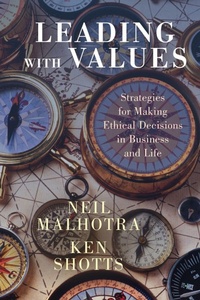
Leading With Values
Strategies for Making Ethical Decisions in Business and Life
Will be published approx. on 8. January 2026
Book
Paperback/Softback
182 pages
978-1-108-78975-2 (ISBN)
Description
As societies become more polarized, there is increasing pressure for business leaders to have a sense of purpose and to make moral decisions. Being a good leader requires both a keen understanding of the realities of human decision making as well as an analysis of what is right and wrong. This book integrates lessons from three intellectual traditions - psychology, philosophy, and political economy - to guide readers on a journey to rigorously explore their values and decision making. The authors begin by examining people's intuitions about right and wrong. They then clarify principles that embody these intuitions and help readers engage with others whose intuitions or principles differ from their own. Ultimately, this book teaches readers how to be strategic as they lead with their values: as individuals, as designers of organizations, and as businesspeople interacting with societal institutions.
Reviews / Votes
'This is a marvelous book. Malhotra and Shotts combine results from the leading edge of at least four disciplines - normative ethics, behavioral ethics, organizational theory and political economy - to give us an integrated account of what it means to take values seriously as a business and as a business leader. In a world in which simply maximizing shareholder value is no longer enough, they give us a roadmap for what it means to act ethically that is both theoretically grounded and deeply practical. In the business world there's a lot of loose talk about 'purpose'. This is the book to read if you're curious as to what it might look like in action.' Rebecca Henderson, John and Natty McArthur University Professor, Harvard University, Author of Reimagining Capitalism in a World on Fire 'Businesses everywhere are being asked to do better. Leading with Values helps show us how, by providing tools and insights for a new era of responsible, engaged business leadership' Jim Coulter, Co-Founder, TPG and Managing Partner, The Rise Funds 'Malhotra and Shotts have achieved the seemingly impossible: they have written a truly useful book on ethical leadership. Unlike other books, Leading with Values recognizes its goal is not to turn the reader into an armchair philosopher. Instead, they brilliantly integrate philosophical insights, psychological tendencies, and organizational realities to offer a clear and replicable path for solving any real-world leadership challenge.' Adam Galinsky, Paul Calello Professor of Leadership and Ethics, Columbia Business School Co-author of Friend & Foe '... a concise, usable, and balanced guide to making ethical decisions in business.' Donald R. Riccomini, Technical CommunicationMore details
Language
English
Place of publication
Cambridge
United Kingdom
Target group
Professional and scholarly
College/higher education
Edition type
New edition
Product notice
Paperback (trade)
Unsewn / adhesive bound
Illustrations
Worked examples or Exercises
Dimensions
Height: 224 mm
Width: 149 mm
Thickness: 11 mm
Weight
256 gr
ISBN-13
978-1-108-78975-2 (9781108789752)
Copyright in bibliographic data and cover images is held by Nielsen Book Services Limited or by the publishers or by their respective licensors: all rights reserved.
Schweitzer Classification
Other editions
Additional editions
Neil Malhotra | Ken Shotts
Leading With Values
Strategies for Making Ethical Decisions in Business and Life
Book
02/2022
Cambridge University Press
€47.50
Shipment within 15-20 days
Neil Malhotra | Ken Shotts
Leading With Values
Strategies for Making Ethical Decisions in Business and Life
E-Book
02/2022
Cambridge University Press
€31.49
Available for download
Persons
Neil Malhotra is the Edith M. Cornell Professor of Political Economy at Stanford Graduate School of Business.
Content
1. Core values: why we lead, why we follow; 2. Follow your gut?; 3. Self-deception and rationalization; 4. The power of the situation; 5. Shareholders, stakeholders, and societal institutions; 6. Weighing consequences; 7. Perspective-taking; 8. Being fair; 9. What are your core values?