

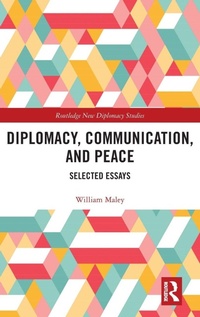
Diplomacy, Communication, and Peace
Selected Essays
1st Edition
Published on 16. November 2020
Book
Hardback
266 pages
978-0-367-43976-7 (ISBN)
Description
This book is composed of interconnected essays which reflect on challenging new issues related to diplomacy, communication, and peace.
This book begins by drawing out some of the challenges for diplomacy that arise from modern theories of semantics and of strategic communication, as well as those posed by the need for secrecy, and by the activities of agents of influence. It then proceeds to examine important issues in contemporary diplomacy, including refugee diplomacy, humanitarian diplomacy, sovereignty, norms, and consular activities. It concludes with an exploration of dilemmas that confront attempts to promote peace through multilateral means, such as the limitations of peacemaking diplomacy, the difficulty of promoting democratic governance, and the problems associated with dealing with morally repugnant actors. The book is grounded in the conception of diplomacy as a social practice with multiple players, and recognises that 'the state' has many different elements, and that 'state actors' live in worlds shaped not just by their relations with other states, but also by their own complex domestic politics.
This book will be of much interest to students of diplomacy, foreign policy, and International Relations.
This book begins by drawing out some of the challenges for diplomacy that arise from modern theories of semantics and of strategic communication, as well as those posed by the need for secrecy, and by the activities of agents of influence. It then proceeds to examine important issues in contemporary diplomacy, including refugee diplomacy, humanitarian diplomacy, sovereignty, norms, and consular activities. It concludes with an exploration of dilemmas that confront attempts to promote peace through multilateral means, such as the limitations of peacemaking diplomacy, the difficulty of promoting democratic governance, and the problems associated with dealing with morally repugnant actors. The book is grounded in the conception of diplomacy as a social practice with multiple players, and recognises that 'the state' has many different elements, and that 'state actors' live in worlds shaped not just by their relations with other states, but also by their own complex domestic politics.
This book will be of much interest to students of diplomacy, foreign policy, and International Relations.
More details
Series
Language
English
Place of publication
London
United Kingdom
Publishing group
Taylor & Francis Ltd
Target group
College/higher education
Professional and scholarly
Dimensions
Height: 240 mm
Width: 161 mm
Thickness: 19 mm
Weight
581 gr
ISBN-13
978-0-367-43976-7 (9780367439767)
Copyright in bibliographic data and cover images is held by Nielsen Book Services Limited or by the publishers or by their respective licensors: all rights reserved.
Schweitzer Classification
Other editions
Additional editions
Book
05/2022
1st Edition
Routledge
€65.50
Shipment within 15-20 days
E-Book
11/2020
1st Edition
Routledge
€59.49
Available for download
E-Book
11/2020
1st Edition
Routledge
€59.49
Available for download
Person
William Maley is Professor of Diplomacy at the Asia-Pacific College of Diplomacy, The Australian National University.
Content
1. Introduction: Diplomacy, Diplomatic Studies, and Diplomatic History Part I: Diplomacy and Communication 2. Minimal English and Diplomacy 3. Terrorism, Diplomacy and Strategic Communication 4. Secret and Quiet Diplomacy 5. Agents of Influence Part II: New Directions in Diplomacy 6. Refugee Diplomacy 7. Australia's Refugee Policy: Domestic Politics and Diplomatic Consequences 8. The United Nations, NGOs and the land-mines initiative: an Australian Perspective 9. Humanitarianism and Humanitarian Diplomacy 10. Trust, Legitimacy, and the Sharing of Sovereignty 11. Norms as Frames for Institutions 12. Risk, Populism and the Evolution of Consular Responsibilities Part III: Diplomacy and Peacemaking 13. Peacekeeping and Peacemaking 14. Democratic Governance and Post-Conflict Transitions 15. The United Nations and Ethnic Conflict Management: Lessons from the Disintegration of Yugoslavia 16. Negotiating with Morally-Repugnant Actors