

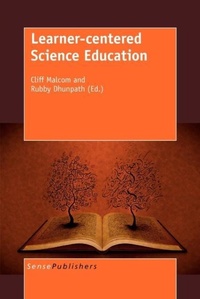
Learner-centered Science Education
Published on 1. January 2008
Book
Paperback/Softback
292 pages
978-90-8790-661-0 (ISBN)
Description
This book arises from the author's experience of the South African science curriculum development and teaching since 1994, exploring definitions of science and approaches to science education appropriate to a newly liberated developing country. Each of the 50 chapters is borne out of Cliff Malcolm's close relationships with communities in SA where he obtained deep insights into their attitudes to science teaching and learning, providing him with an empirical basis to challenge tertiary institutions to transform their curriculum offerings to embrace the culture and world views of African students. The author makes a compelling case for the evolution of relevant science teaching and learning that provide 'capital' for indigenous knowledges. The book has relevance also to first world countries, because the social and educational problems facing South Africa, though starker here, are present in all countries.
The book addresses, among others, the nature of scientific knowledge and knowledge production; how scientific knowledge can be accessed and represented; what counts as legitimate scientific knowledge in the South African context of colonization, liberation, inequity and African belief systems. The book extends the debates on "African" Science, and offers ways of talking and writing about science that reframe it, acknowledging problematics and pluralism, offering ways of bringing Western and African thought together.
Using a richly descriptive novelistic style, the author sketches vivid portraits of his research sites, participants and experiences. His vignettes are embedded in deep theoretical insights, lending gravity to the development discourse in science education, providing a coherent language for the transformational agendas of science educators committed to the project of social justice through a relevant science.
The book addresses, among others, the nature of scientific knowledge and knowledge production; how scientific knowledge can be accessed and represented; what counts as legitimate scientific knowledge in the South African context of colonization, liberation, inequity and African belief systems. The book extends the debates on "African" Science, and offers ways of talking and writing about science that reframe it, acknowledging problematics and pluralism, offering ways of bringing Western and African thought together.
Using a richly descriptive novelistic style, the author sketches vivid portraits of his research sites, participants and experiences. His vignettes are embedded in deep theoretical insights, lending gravity to the development discourse in science education, providing a coherent language for the transformational agendas of science educators committed to the project of social justice through a relevant science.
More details
Series
Language
English
Place of publication
Rotterdam
Netherlands
Target group
Professional and scholarly
Product notice
Paperback (trade)
Unsewn / adhesive bound
Dimensions
Height: 234 mm
Width: 156 mm
Thickness: 15 mm
Weight
413 gr
ISBN-13
978-90-8790-661-0 (9789087906610)
Copyright in bibliographic data and cover images is held by Nielsen Book Services Limited or by the publishers or by their respective licensors: all rights reserved.
Schweitzer Classification
Other editions
Additional editions
Cliff Malcom | Michael Anthony Samuel
Learner-centered Science Education
Book
01/2008
Sense Publishers
€115.67
Article exhausted; check different version