

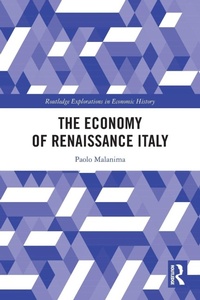
The Economy of Renaissance Italy
1st Edition
Published on 29. January 2024
Book
Paperback/Softback
192 pages
978-0-367-67776-3 (ISBN)
Description
Drawing on a wide range of literature and adopting a macroeconomic approach, this book provides a comprehensive overview of the Italian economy during the Renaissance, focusing on the period between 1348, the year of the Black Death, and 1630.
The Italian Renaissance played a crucial role in the formation of the modern world, with developments in culture, art, politics, philosophy, and science sitting alongside, and overlapping with, significant changes in production, forms of organization, trades, finance, agriculture, and population. Yet, it is usually argued that splendour in culture coexisted with economic depression and that the modernity of Renaissance culture coincided with an epoch of epidemics, famines, economic crisis, poverty, and destitution. This book examines both faces of the Italian economy during the Renaissance, showing that capital per worker was plentiful and productive capacity and incomes were relatively high. The endemic presence of the plague, curbing population growth, played an important role in this. It is also shown that the organization of production in industry and finance, consumerism, human capital, and mercantile rationality were the forerunners of modern-day capitalism.
This book is an invaluable resource for scholars and students of the Renaissance and Italian economic history.
The Italian Renaissance played a crucial role in the formation of the modern world, with developments in culture, art, politics, philosophy, and science sitting alongside, and overlapping with, significant changes in production, forms of organization, trades, finance, agriculture, and population. Yet, it is usually argued that splendour in culture coexisted with economic depression and that the modernity of Renaissance culture coincided with an epoch of epidemics, famines, economic crisis, poverty, and destitution. This book examines both faces of the Italian economy during the Renaissance, showing that capital per worker was plentiful and productive capacity and incomes were relatively high. The endemic presence of the plague, curbing population growth, played an important role in this. It is also shown that the organization of production in industry and finance, consumerism, human capital, and mercantile rationality were the forerunners of modern-day capitalism.
This book is an invaluable resource for scholars and students of the Renaissance and Italian economic history.
More details
Series
Language
English
Place of publication
London
United Kingdom
Publishing group
Taylor & Francis Ltd
Target group
College/higher education
Postgraduate and Undergraduate
Illustrations
40 s/w Tabellen, 43 s/w Abbildungen, 43 s/w Zeichnungen
40 Tables, black and white; 43 Line drawings, black and white; 43 Illustrations, black and white
Dimensions
Height: 234 mm
Width: 156 mm
Thickness: 12 mm
Weight
327 gr
ISBN-13
978-0-367-67776-3 (9780367677763)
Copyright in bibliographic data and cover images is held by Nielsen Book Services Limited or by the publishers or by their respective licensors: all rights reserved.
Schweitzer Classification
Other editions
Additional editions
Paolo Malanima
The Economy of Renaissance Italy
Book
05/2022
1st Edition
Routledge
€205.40
Shipment within 15-20 days
Paolo Malanima
The Economy of Renaissance Italy
E-Book
05/2022
1st Edition
Routledge
€59.49
Available for download
Paolo Malanima
The Economy of Renaissance Italy
E-Book
05/2022
1st Edition
Routledge
€59.49
Available for download
Person
Paolo Malanima is an economic historian. He has been Director of the Institute of Studies on Mediterranean Societies (ISSM-CNR) in Naples, Italy, and Professor of Compared Economies and Development Economics in Magna Graecia University in Catanzaro, Italy. His main research interests span the long-term Italian economy and past and present energy consumption.
Content
Introduction 1 Population and labour 2 Wealth and capital 3 Productivity and efficiency 4 Production and income