

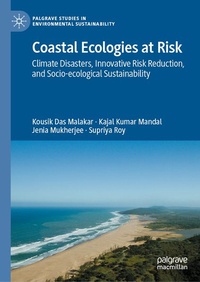
Coastal Ecologies at Risk
Description
This book examines coastal ecologies under the growing pressures of climate change and climate-related disasters. It explores coastal vulnerability, disaster risk reduction, resilience, and socio-ecological sustainability. Bringing together theory, policy discussion, and empirical case studies, the book highlights how coastal communities, ecosystems, and governance systems respond to climate risks and environmental changes.
The book is organized into five parts. The first part introduces key ideas related to climate disasters and socio-ecological vulnerability in coastal regions. The second part discusses coastal resilience and management strategies, including infrastructure resilience, risk perception, communication and early warning systems, ecosystem-based adaptation, and community participation. The third part focuses on policy frameworks, sustainable coastal management, and future challenges in reducing climate-related risks. The fourth part highlights participatory research approaches and field experiences from coastal communities in the Global South. The final part presents case studies demonstrating the use of geographic information systems, community knowledge, nature-based solutions, and participatory planning in coastal disaster risk reduction.
The book enhances disaster policy planning by integrating coastal community perspectives into geographic analysis, benefiting policy planners, scientists, researchers, professionals, students and those working in disaster studies.
More details
Persons
Kousik Das Malakar is Assistant Professor of Geography at GDC Memorial College, Chaudhary Bansi Lal University, Bahal, India.
Kajal Kumar Mandal is Assistant Professor (Guest) of Geography at the Central University of Haryana, India.
Jenia Mukherjee is Associate Professor at Indian Institute of Technology Kharagpur, India.
Supriya Roy is a GIS analyst and socio-environmental geographer with a master's degree from Visva-Bharati University, Santiniketan, India.
Content
Part I: Fundamentals of Climate Disasters and Coastal Ecologies.- Chapter 1. Introduction to Climate Disasters and Coastal Ecologies.- Chapter 2. Climate Disasters, Socio-ecological Vulnerability and Coastal Ecologies: Assessment and Mapping.- Part II: Understanding the Coastal Socio-Ecological Systems: Climate Disasters, Coastal Resilience, and Management.- Chapter 3.Climate Disasters and Coastal Infrastructural Resilience.- Chapter 4. Risk Perceptions, Communication and Early Warning Systems.- Chapter 5. Climate Disasters and Enhancing Coastal Resilience: Applications of Ecosystem-based Adaptation.- Chapter 6. Climate Disasters and Enhancing Coastal Resilience: Applications of Community-based Adaptation and Participatory Approaches.- Chapter 7. Climate-induced Disaster Risk Reduction and Integrated Coastal Zone Management.- Part III: Risk Reduction Practices and Socio-ecological Sustainability: Policy Frameworks and Future Challenges.- Chapter 8. Policy Frameworks and Governance: Enhancing Coastal Resilience.- Chapter 9. Sustainable Coastal Development and Blue Economy.- Chapter 10. Coastal Disaster Risk Reduction Practices: Future Challenges and Opportunities.- Part IV: Participatory Approaches in Coastal Disaster Risk Reduction and Sustainability: Risk Perceptions and Field Narratives.- Chapter 11. Risk Perceptions in Coastal Disaster Risk Reduction: Participatory Insights.- Chapter 12. Voices from the Coast: Field Narratives on Participatory Coastal Disaster Risk Reduction and Sustainability.- Part V: Applications of GIScience and Participatory Approaches in Coastal Disaster Risk Reduction and Sustainability: Case Studies.- Chapter 13. Geospatial Science for Disaster Risk Monitoring, Management and Sustainability: Insights from the Indian Coast.- Chapter 14. Coastal-Climate Nexus and Participatory Interactions in the Indian Delta: Implications for Disaster Risk Reduction and Socio-ecological Sustainability.