

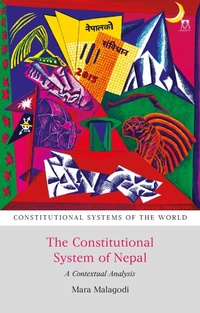
The Constitutional System of Nepal
A Contextual Analysis
Will be published approx. on 23. July 2026
Book
Hardback
224 pages
978-1-5099-4725-6 (ISBN)
Description
The book presents an evolutionary view of Nepal's constitutional system, grounded in the country's historico-political context.
In particular, the analysis focuses on three aspects. First, the book investigates Nepal's processes of state formation and nation-building, centred on the institution of the Shah monarchy, Hinduism, and the Nepali language vis-a-vis Nepal's high degree of socio-cultural diversity. Second, it explores the difficulties in democratising Nepal's constitutional arrangements and entrenching the doctrine of popular sovereignty. This is reflected in the tensions between hereditary political power (the Shah monarchy and the Rana Prime Ministers) and representative political forces (political parties). Constitutionally, these tensions have resulted in the marginalisation of the legislature vis-a-vis the executive throughout the country's history, notwithstanding the fact that Nepal has always featured a parliamentary form of government.
Lastly, the frequent changes in Nepal's fundamental law also reflect the profound influences of various foreign institutional models (in particular that of a 'modified' Westminster model) and their specific re-negotiation in the Nepali context, regardless of the fact that Nepal was never colonised.
In particular, the analysis focuses on three aspects. First, the book investigates Nepal's processes of state formation and nation-building, centred on the institution of the Shah monarchy, Hinduism, and the Nepali language vis-a-vis Nepal's high degree of socio-cultural diversity. Second, it explores the difficulties in democratising Nepal's constitutional arrangements and entrenching the doctrine of popular sovereignty. This is reflected in the tensions between hereditary political power (the Shah monarchy and the Rana Prime Ministers) and representative political forces (political parties). Constitutionally, these tensions have resulted in the marginalisation of the legislature vis-a-vis the executive throughout the country's history, notwithstanding the fact that Nepal has always featured a parliamentary form of government.
Lastly, the frequent changes in Nepal's fundamental law also reflect the profound influences of various foreign institutional models (in particular that of a 'modified' Westminster model) and their specific re-negotiation in the Nepali context, regardless of the fact that Nepal was never colonised.
More details
Series
Language
English
Place of publication
Oxford
United Kingdom
Publishing group
Bloomsbury Publishing PLC
Target group
Professional and scholarly
Product notice
Laminated cover
Dimensions
Height: 216 mm
Width: 138 mm
Thickness: 12 mm
Weight
263 gr
ISBN-13
978-1-5099-4725-6 (9781509947256)
Copyright in bibliographic data and cover images is held by Nielsen Book Services Limited or by the publishers or by their respective licensors: all rights reserved.
Schweitzer Classification
Person
Content
1. Historical Overview: Constitutionalism and the Quest for Democracy in Nepal
2. Identity Politics and Nepal's State Structure
3. The Executive Branch of Government
4. The Legislature
5. Nepal's Embattled Judiciary
6. Fundamental Rights
7. Constitutional Change and Continuity in Nepal
2. Identity Politics and Nepal's State Structure
3. The Executive Branch of Government
4. The Legislature
5. Nepal's Embattled Judiciary
6. Fundamental Rights
7. Constitutional Change and Continuity in Nepal