

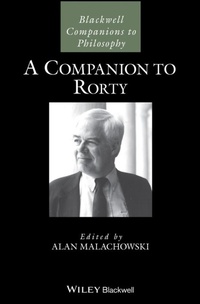
A Companion to Rorty
Description
A provocative and often controversial thinker, Richard Rorty and his ideas have been the subject of renewed interest to philosophers working in epistemology, metaphysics, analytic philosophy, and the history of philosophy. Having called for philosophers to abandon representationalist accounts of knowledge and language, Rorty introduced radical and challenging concepts to modern philosophy, generating divisive debate through the new form of American pragmatism which he advocated and the renunciation of traditional epistemology which he espoused.
However, while Rorty has been one of the most widely-discussed figures in modern philosophy, few volumes have dealt directly with the expansive reach of his thought or its implications for the fields of philosophy in which he worked. The Blackwell Companion to Rorty is a collection of essays by prominent scholars which provide close, and long-overdue, examination of Rorty's groundbreaking work. Divided into five parts, this volumecovers the major intellectual movements of Rorty's career from his early work on consciousness and transcendental arguments, to the lasting impacts of his major writings, to his approach to pragmatism and his controversial appropriations from other philosophers, and finally to his later work in culture, politics, and ethics.
Offers a comprehensive, balanced, and insightful account of Rorty's approach to philosophy
Provides an assessment of Rorty's more controversial thoughts and his standing as an "anti-philosopher's philosopher"
Contains new and original exploration of Rorty's thinking from leading scholars and philosophers
Includes new perspectives on topics such as Rorty's influence in Central Europe
Despite the relevance of Rorty's work for the wider community of philosophers and for those working in fields such as international relations, legal and political theory, sociology, and feminist studies, the secondary literature surrounding Rorty's work and legacy is limited. A Companion to Rorty address this absence, providinga comprehensive resource for philosophers and general readers.
<b>A groundbreaking reference work on the revolutionary philosophy and intellectual legacy of Richard Rorty</b>
A provocative and often controversial thinker, Richard Rorty and his ideas have been the subject of renewed interest to philosophers working in epistemology, metaphysics, analytic philosophy, and the history of philosophy. Having called for philosophers to abandon representationalist accounts of knowledge and language, Rorty introduced radical and challenging concepts to modern philosophy, generating divisive debate through the new form of American pragmatism which he advocated and the renunciation of traditional epistemology which he espoused.
However, while Rorty has been one of the most widely-discussed figures in modern philosophy, few volumes have dealt directly with the expansive reach of his thought or its implications for the fields of philosophy in which he worked. <i>The Blackwell Companion to Rorty</i> is a collection of essays by prominent scholars which provide close, and long-overdue, examination of Rorty's groundbreaking work. Divided into five parts, this volumecovers the major intellectual movements of Rorty's career from his early work on consciousness and transcendental arguments, to the lasting impacts of his major writings, to his approach to pragmatism and his controversial appropriations from other philosophers, and finally to his later work in culture, politics, and ethics.
<ul><li>Offers a comprehensive, balanced, and insightful account of Rorty's approach to philosophy</li><li>Provides an assessment of Rorty's more controversial thoughts and his standing as an "anti-philosopher's philosopher"</li><li>Contains new and original exploration of Rorty's thinking from leading scholars and philosophers</li><li>Includes new perspectives on topics such as Rorty's influence in Central Europe </li></ul>Despite the relevance of Rorty's work for the wider community of philosophers and for those working in fields such as international relations, legal and political theory, sociology, and feminist studies, the secondary literature surrounding Rorty's work and legacy is limited. <i>A Companion to Rorty </i>address this absence, providinga comprehensive resource for philosophers and general readers.
More details
Other editions
Additional editions
Person
<b>Alan Malachowski</b> is Research Fellow at the Centre for Applied Ethics, Stellenbosch University, South Africa. He has published extensively on both Richard Rorty and Pragmatism and has authored and edited many volumes, including <i>Reading Rorty</i> (Blackwell, 1990).
Content
Preface and Acknowledgments viii
Contributors ix
Introduction: Rorty's Approach to Philosophy: Time for Reassessment 1
<i>Alan Malachowski</i>
<b>Prologue 9</b>
1 Reading Rorty: A Sketch of a Plan 11
<i>Danielle Macbeth</i>
<b>Part I Early Developments 25</b>
2 Was Rorty an Eliminative Materialist? 27
<i>William Ramsey</i>
3 Rorty's Philosophy of Consciousness 43
<i>James Tartaglia</i>
4 Rorty and Transcendental Arguments 59
<i>Neil Gascoigne</i>
<b>Part II Texts 79</b>
5 <i>Philosophy and the Mirror of Nature </i>81
<i>James Tartaglia</i>
6 The Uses of Philosophy after the Collapse of Metaphysics: Ironism and Liberalism in Rorty's <i>Contingency, Irony, and Solidarity </i>100
<i>Colin Koopman</i>
7 Rhetoric Between Philosophy and Poetry: Rorty as Essayist 119
<i>William M. Curtis</i>
8 Rorty's Inspirational Liberalism 135
<i>Richard J. Bernstein</i>
<b>Part III Themes 147</b>
9 Are Pragmatists About Truth True Democrats? 149
<i>Pascal Engel</i>
10 Richard Rorty and (the End of) Metaphysics (?) 163
<i>David Macarthur</i>
11 Rorty, Pragmatism, and Ethics: The Value of Hope 178
<i>Marjorie C. Miller</i>
12 The Center and Circumference of Knowledge: Rorty on Pragmatism and Romanticism 194
<i>Isaac Nevo</i>
13 Rorty and Analytic Philosophy 211
<i>Gary Gutting</i>
14 Speculative Pragmatism: Richard Rorty and the Hyperboles of Philosophy 229
<i>Paul Trembath</i>
<b>Part IV Appropriations 251</b>
15 Rorty <i>on Hegel </i>on the Mind in History 253
<i>Paul Redding</i>
16 Rorty and the Mirror of Nietzsche 268
<i>Steven Michels</i>
17 The Truth of Being and the History of Philosophy 281
<i>Mark Okrent</i>
18 Rorty's Romantic Polytheism: The Influence of William James 297
<i>Carol Nicholson</i>
19 Inconvenient Conversational Partners: Rorty and Freud 312
<i>Alan Malachowski</i>
20 Rorty and Dewey 335
<i>David L. Hildebrand</i>
21 Common Understanding Without Uncommon Certainty: Rorty's Wittgenstein Revisited 357
<i>Alan Malachowski</i>
22 Rorty, Davidson, and Representation 370
<i>Steven Levine</i>
23 The Rorty-Habermas Debate: A Critical Appraisal 395
<i>Anton A. van Niekerk</i>
<b>Part V Culture, Politics, and Religion 411</b>
24 Rorty and Literature 413
<i>Serge Grigoriev</i>
25 The Contested Marriage of Rorty and Feminism 427
<i>Elizabeth Sperry</i>
26 Rorty and Religion: Beyond the Culture Wars? 444
<i>Molly B. Farneth</i>
27 Rorty's Philosophy of Religion 456
<i>Emil Visn?ovsky</i>
28 Rorty and the Intellectual Culture of Central Europe 467
<i>Emil Visn?ovsky, Alexander Kremer, and Krzysztof Piotr Skowro</i><i>nski</i>
29 Rorty and Nihilism 482
<i>Tracy Llanera</i>
30 Rorty's Ethics of Responsibility 490
<i>Christopher J. Voparil</i>
<b>Part VI Coda 505</b>
31 Poetry as (a Kind of) Philosophy: For Richard Rorty 507
<i>Christopher Norris</i>
Internet Resources 528
Index 529