

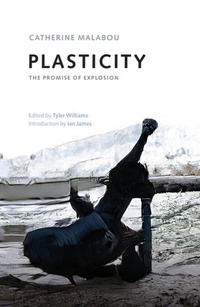
Plasticity
The Promise of Explosion
Published on 26. April 2022
Book
Paperback/Softback
344 pages
978-1-4744-6212-9 (ISBN)
Description
Catherine Malabou is one of the foremost, most innovative intelligences working in contemporary French philosophy today. Her work articulates a coherent conceptualisation of 'plasticity' by merging recent neurobiology and medicinal sciences with the history of philosophy and political theory. Across the essays gathered in 'Plasticity: The Promise of Explosion', Malabou carves a philosophical space between structuralism, deconstruction, cognitive psychology, psychoanalysis and speculative realism. By demonstrating the plastic transformability at the heart of these disciplines, a change that always promises future explosion, Malabou, as a female philosopher, also articulates the need to 'change difference' within patriarchal concepts of tradition itself.
Reviews / Votes
Plasticity is a thoughtfully curated collection of essays by one of the most innovative and inspiring philosophers writing today. For the past several decades, Catherine Malabou has bravely blazed a trail towards something thus-far unprecedented: a novel form of naturalism shaped by the insights of European theoretical currents from German idealism through today. Malabou deftly addresses anew such perennial-yet-pressing philosophical tensions as those between mind and body, freedom and determinism, as well as transcendentalism and historicism. Malabou's oeuvre, both philosophically important and politically timely, opens up crucial possibilities for radically rethinking the interrelationships between philosophy, science, psychoanalysis, feminism, and politics. * Adrian Johnston, University of New Mexico * Apart from confirming Catherine Malabou as a major philosopher with a sustained interest in biology, this collection highlights two underappreciated aspects of her thought: its political implications, ranging from her writing on the crowd, to the prison, sovereignty, decolonization, and anarchism; most of all, it demonstrates her relentless commitment to self-questioning. * Arne De Boever, California Institute of the Arts and author of <i>Plastic Sovereignties</i> *More details
Language
English
Place of publication
Edinburgh
United Kingdom
Target group
Professional and scholarly
Dimensions
Height: 232 mm
Width: 155 mm
Thickness: 21 mm
Weight
522 gr
ISBN-13
978-1-4744-6212-9 (9781474462129)
Copyright in bibliographic data and cover images is held by Nielsen Book Services Limited or by the publishers or by their respective licensors: all rights reserved.
Schweitzer Classification
Persons
Catherine Malabou is Professor of Philosophy at the Centre for Research in Modern European Philosophy (CRMEP) at Kingston University (UK) and in the Departments of Comparative Literature and European Languages and Studies at the University of California, Irvine. She took her PhD under the supervision of Jacques Derrida at Ecoles des Hautes Etudes. She is the author of Morphing Intelligence: From IQ Measurement to Artificial Brains (Columbia University Press, 2019), Before Tomorrow: Epigenesis and Rationality (Polity, 2016), Self and Emotional Life: Philosophy, Psychoanalysis and Neuroscience (Columbia University Press, 2013), Ontology of the Accident: An Essay on Destructive Plasticity (Polity, 2012), The New Wounded, from Neuroscience to Brain Damage (Fordham University Press, 2012), Changing Difference, The Feminine and the Question of Philosophy (Polity, 2011), The Heidegger Change: On the Fantastic in Philosophy (SUNY, 2011), Plasticity at the Dusk of Writing: Dialectic, Destruction, Deconstruction (Columbia University Press, 2010), What Should we do with our Brain? (Fordham University Press, 2008), The Future of Hegel: Plasticity, Temporality and Dialectic (Routledge, 2005) and Counterpath: travelling with Jacques Derrida (Stanford University Press, 2004). Tyler M. Williams is Assistant Professor of English, Humanities, and Philosophy at Midwestern State University. He is co-translator of Marc Crepon's The Trial of Hatred (EUP, 2021) and The Vocation of Writing: Literature, Philosophy, and the Test of Violence (SUNY, 2018). He is editor of Plasticity: The Promise of Explosion by Catherine Malabou. Ian James is Fellow in French at Downing College, University of Cambridge.
Content
Introduction by Ian James
Part I: Philosophical Heritages
1. An Eye on the Edge of Discourse: Speech, Vision, Idea
2. Following Generation: Biological and Poetic Cloning
3. Philosophy in Erection: Derrida's Columns
4. The Possibility of the Worst: On Faith and Knowledge
5. Before and Above: Spinoza and Symbolic Necessity
6. Can We Relinquish the Transcendental?
7. Is Science the Subject of Philosophy? Miller, Badiou and Derrida Respond
Part II: Masks
8. The Crowd: Figuring the Democracy to Come
9. Life and Prison
10. Odysseus' Changed Soul: A Contemporary Reading of the Myth of Er
11. Epigenesis of the Text: New Paths in Biology and Hermeneutics
12. Reading Lazlo Foeldenyi's Dostoyevsky Reads Hegel in Siberia and Bursts into Tears
13. Philosophy and the Outside: Foucault and Decolonial Thinking
Part III: Psyches, Brains, Cells
14. The Brain of History, or, the Mentality of the Anthropocene
15. Whither Materialism? Althusser/Darwin
16. Philosophy and Anarchism: Alternative or Dilemma?
17. One Life Only: Biological Resistance, Political Resistance
18. Philosophers, Biologists: Some More Effort If You Wish to Become Revolutionaries!
19. How Is Subjectivity Undergoing Deconstruction Today? Philosophy, Auto-Hetero-Affection and Neurobiological Emotion
20. Floating Signifiers Revisited: Poststructuralism Meets Neurolinguistics
Part IV: Destructive Forms
21. Is Retreat a Metaphor?
22. Plasticity and Elasticity in Freud's Beyond the Pleasure Principle
23. Are There Still Traces? Memory and the Obsolescence of the Paradigm of Inscription
24. Phantom Limbs and Plasticity: Merleau-Ponty and Current Neurobiology
25. The Example of Plasticity: An Interview with Catherine Malabou
Works cited
Part I: Philosophical Heritages
1. An Eye on the Edge of Discourse: Speech, Vision, Idea
2. Following Generation: Biological and Poetic Cloning
3. Philosophy in Erection: Derrida's Columns
4. The Possibility of the Worst: On Faith and Knowledge
5. Before and Above: Spinoza and Symbolic Necessity
6. Can We Relinquish the Transcendental?
7. Is Science the Subject of Philosophy? Miller, Badiou and Derrida Respond
Part II: Masks
8. The Crowd: Figuring the Democracy to Come
9. Life and Prison
10. Odysseus' Changed Soul: A Contemporary Reading of the Myth of Er
11. Epigenesis of the Text: New Paths in Biology and Hermeneutics
12. Reading Lazlo Foeldenyi's Dostoyevsky Reads Hegel in Siberia and Bursts into Tears
13. Philosophy and the Outside: Foucault and Decolonial Thinking
Part III: Psyches, Brains, Cells
14. The Brain of History, or, the Mentality of the Anthropocene
15. Whither Materialism? Althusser/Darwin
16. Philosophy and Anarchism: Alternative or Dilemma?
17. One Life Only: Biological Resistance, Political Resistance
18. Philosophers, Biologists: Some More Effort If You Wish to Become Revolutionaries!
19. How Is Subjectivity Undergoing Deconstruction Today? Philosophy, Auto-Hetero-Affection and Neurobiological Emotion
20. Floating Signifiers Revisited: Poststructuralism Meets Neurolinguistics
Part IV: Destructive Forms
21. Is Retreat a Metaphor?
22. Plasticity and Elasticity in Freud's Beyond the Pleasure Principle
23. Are There Still Traces? Memory and the Obsolescence of the Paradigm of Inscription
24. Phantom Limbs and Plasticity: Merleau-Ponty and Current Neurobiology
25. The Example of Plasticity: An Interview with Catherine Malabou
Works cited