

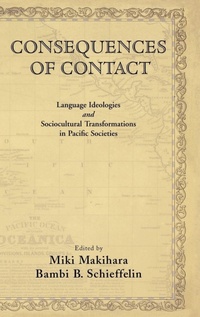
Consequences of Contact
Language Ideologies and Sociocultural Transformations in Pacific Societies
Published on 11. October 2007
Book
Hardback
248 pages
978-0-19-532497-6 (ISBN)
Description
The Pacific is historically an area of enormous linguistic diversity, where talk figures as a central component of social life. Pacific communities also represent diverse contact zones, where between indigenous and introduced institutions and ideas; between local actors and outsiders; and involving different lingua franca, colonial, and local language varieties. Contact between colonial and post-colonial governments, religious institutions, and indigenous communities has spurred profound social change, irrevocably transforming linguistic ideologies and practices.
Drawing on ethnographic and linguistic analyses, this edited volume examines situations of intertwined linguistic and cultural change unfolding in specific Pacific locations in the late twentieth and early twenty-first centuries. Its overarching concern is with the multiple ways that processes of historical change have shaped and been shaped by linguistic ideologies reflexive sensibilities about languages and language useheld by Pacific peoples and other agents of change. The essays demonstrate that language and linguistic practices are linked to changing consciousness of self and community through notions of agency, morality, affect, authority, and authenticity.
In times of cultural contact, communities often experience language change at an accelerated rate. This is particularly so in small-scale communities where innovations and continuity routinely depend on the imagination, creativity, and charisma of fewer individuals. The essays in this volume provide evidence of this potential and a record of their voices, as they document new types of local actors, e.g., pastors, Bible translators, teachers, political activists, spirit mediums, and tour guides, some of whom introduce, innovate, legitimate, or resist new ideas and ways to express them through language. Drawing on and transforming metalinguistic concepts, local actors (re)shape language, reproducing and changing the communicative economy. In the process, they cultivate new cultural conceptions of language, for example, as a medium for communicating religious knowledge and political authority, and for constructing social boundaries and transforming relationships of domination.
Drawing on ethnographic and linguistic analyses, this edited volume examines situations of intertwined linguistic and cultural change unfolding in specific Pacific locations in the late twentieth and early twenty-first centuries. Its overarching concern is with the multiple ways that processes of historical change have shaped and been shaped by linguistic ideologies reflexive sensibilities about languages and language useheld by Pacific peoples and other agents of change. The essays demonstrate that language and linguistic practices are linked to changing consciousness of self and community through notions of agency, morality, affect, authority, and authenticity.
In times of cultural contact, communities often experience language change at an accelerated rate. This is particularly so in small-scale communities where innovations and continuity routinely depend on the imagination, creativity, and charisma of fewer individuals. The essays in this volume provide evidence of this potential and a record of their voices, as they document new types of local actors, e.g., pastors, Bible translators, teachers, political activists, spirit mediums, and tour guides, some of whom introduce, innovate, legitimate, or resist new ideas and ways to express them through language. Drawing on and transforming metalinguistic concepts, local actors (re)shape language, reproducing and changing the communicative economy. In the process, they cultivate new cultural conceptions of language, for example, as a medium for communicating religious knowledge and political authority, and for constructing social boundaries and transforming relationships of domination.
Reviews / Votes
The idea of language ideology has matured to the point where it can be used to frame research agendas well beyond that of defining and defending the concept itself. Consequences of Contact does a splendid job of demonstrating the promise of this approach, offering insights into social and cultural transformation where multiple languages and language ideologies are in play. * Language in Society *More details
Language
English
Place of publication
New York
United States
Target group
College/higher education
Dimensions
Height: 240 mm
Width: 161 mm
Thickness: 18 mm
Weight
540 gr
ISBN-13
978-0-19-532497-6 (9780195324976)
Copyright in bibliographic data and cover images is held by Nielsen Book Services Limited or by the publishers or by their respective licensors: all rights reserved.
Schweitzer Classification
Other editions
Additional editions
Miki Makihara | Bambi B. Schieffelin
Consequences of Contact
Language Ideologies and Sociocultural Transformations in Pacific Societies
E-Book
09/2007
1st Edition
OUP eBook
€19.99
Available for download
Miki Makihara | Bambi B. Schieffelin
Consequences of Contact
Language Ideologies and Sociocultural Transformations in Pacific Societies
E-Book
09/2007
1st Edition
OUP eBook
€19.99
Available for download
Persons
Miki Makihara is Associate Professor of Anthropology, Queens College, CUNY
Bambi B. Schieffelin is Professor of Anthropology, New York University
Bambi B. Schieffelin is Professor of Anthropology, New York University
Content
1: Miki Makihara and Bambi B. Schieffelin: Cultural Processes and Linguistic Mediations: Pacific Explorations
2: Christine Jourdan: Linguistic Paths to Urban Self in Post-Colonial Solomon Islands
3: Miki Makihara: Linguistic Purism in Rapa Nui Political Discourse
4: Kathleen C. Riley: To Tangle or Not to Tangle: Shifting Language Ideologies and the Socialization of Charabia in the Marquesas, French Polynesia
5: Rupert Stasch: Demon Language: The Otherness of Indonesian in a Papuan Community
6: Joel Robbins: You Can't Talk Behind the Holy Spirit's Back: Christianity and Changing Language Ideologies in a Papua New Guinea Society
7: Bambi B. Schieffelin: Found in Translating: Reflexive Language Across Time and Texts in Bosavi, Papua New Guinea
8: Courtney Handman: Speaking to the Soul: On Native Language and Authority in Papua New Guinea Bible Translation
9: Susan U. Phillips: Changing Scholarly Representations of Tongan Honorific Lexicon
10: J. Joseph Errington: Postscript: Making Contact Between Consequences
2: Christine Jourdan: Linguistic Paths to Urban Self in Post-Colonial Solomon Islands
3: Miki Makihara: Linguistic Purism in Rapa Nui Political Discourse
4: Kathleen C. Riley: To Tangle or Not to Tangle: Shifting Language Ideologies and the Socialization of Charabia in the Marquesas, French Polynesia
5: Rupert Stasch: Demon Language: The Otherness of Indonesian in a Papuan Community
6: Joel Robbins: You Can't Talk Behind the Holy Spirit's Back: Christianity and Changing Language Ideologies in a Papua New Guinea Society
7: Bambi B. Schieffelin: Found in Translating: Reflexive Language Across Time and Texts in Bosavi, Papua New Guinea
8: Courtney Handman: Speaking to the Soul: On Native Language and Authority in Papua New Guinea Bible Translation
9: Susan U. Phillips: Changing Scholarly Representations of Tongan Honorific Lexicon
10: J. Joseph Errington: Postscript: Making Contact Between Consequences