

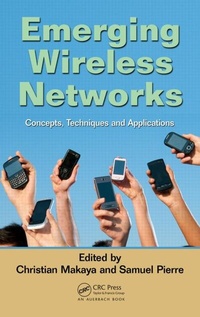
Emerging Wireless Networks
Concepts, Techniques and Applications
1st Edition
Will be published approx. on 12. December 2011
Book
Hardback
444 pages
978-1-4398-2135-0 (ISBN)
Description
An authoritative collection of research papers and surveys, Emerging Wireless Networks: Concepts, Techniques, and Applications explores recent developments in next-generation wireless networks (NGWNs) and mobile broadband networks technologies, including 4G (LTE, WiMAX), 3G (UMTS, HSPA), WiFi, mobile ad hoc networks, mesh networks, and wireless sensor networks. Focusing on improving the performance of wireless networks and provisioning better quality of service and quality of experience for users, it reports on the standards of different emerging wireless networks, applications, and service frameworks.
The book begins by appraising the management challenges in emerging wireless networks. It examines the state-of-the-art in mobility management for IP-based mobile networks, at both the network and link layers. Proposing an integrated network architecture design for NGWNs-including wireless local, metropolitan, and wide area networks-it analyzes WLAN/3G network convergence and advanced mobility features based on the IP Multimedia Subsystem (IMS) architecture. It highlights the challenges and issues related to mobile virtual private networks, and also:
Examines the emerging mobile broadband wireless standards such as IEEE 802.16 and LTE
Introduces a mechanism that provides service continuity to end-users in self-organizing IP Multimedia Subsystem environments
Considers the challenges, solutions, and services of vehicular communication networks
Unveils a new transmission paradigm (network coding) to improve the performance of the transmission control protocol.
The book presents a novel distributed scheme based on the stochastic optimization formulation of the network selection problem for heterogeneous wireless networks by using cognitive radio networks concepts. Describing the issues and schemes for network selection and congestion avoidance in multi-access networks, it supplies you with a clear perspective of where the technology is headed and where future opportunities might be found for mobile broadband technologies.
The book begins by appraising the management challenges in emerging wireless networks. It examines the state-of-the-art in mobility management for IP-based mobile networks, at both the network and link layers. Proposing an integrated network architecture design for NGWNs-including wireless local, metropolitan, and wide area networks-it analyzes WLAN/3G network convergence and advanced mobility features based on the IP Multimedia Subsystem (IMS) architecture. It highlights the challenges and issues related to mobile virtual private networks, and also:
Examines the emerging mobile broadband wireless standards such as IEEE 802.16 and LTE
Introduces a mechanism that provides service continuity to end-users in self-organizing IP Multimedia Subsystem environments
Considers the challenges, solutions, and services of vehicular communication networks
Unveils a new transmission paradigm (network coding) to improve the performance of the transmission control protocol.
The book presents a novel distributed scheme based on the stochastic optimization formulation of the network selection problem for heterogeneous wireless networks by using cognitive radio networks concepts. Describing the issues and schemes for network selection and congestion avoidance in multi-access networks, it supplies you with a clear perspective of where the technology is headed and where future opportunities might be found for mobile broadband technologies.
More details
Language
English
Place of publication
Bosa Roca
United States
Publishing group
Taylor & Francis Inc
Target group
Professional and scholarly
Academic and Professional Practice & Development
Illustrations
172 s/w Abbildungen, 20 s/w Tabellen
20 Tables, black and white; 172 Illustrations, black and white
Dimensions
Height: 234 mm
Width: 156 mm
Weight
734 gr
ISBN-13
978-1-4398-2135-0 (9781439821350)
Copyright in bibliographic data and cover images is held by Nielsen Book Services Limited or by the publishers or by their respective licensors: all rights reserved.
Schweitzer Classification
Other editions
Additional editions
Book
06/2017
1st Edition
CRC Press
€110.30
Shipment within 10-20 days
E-Book
12/2011
1st Edition
CRC Press
€81.99
Available for download
E-Book
12/2011
1st Edition
CRC Press
€81.99
Available for download
Persons
Christian Makaya is a senior research scientist in Advanced Technology Solutions, at Telcordia Technologies. He received a Ph.D. degree in computer engineering from the Ecole Polytechnique de Montreal, University of Montreal, Canada in 2007. Prior to joining Telcordia, he was a research fellow and a lecturer within the Department of Computer Engineering of the Ecole Polytechnique de Montreal. He also held a position as principal architect and senior scientist for a start-up consulting firm in Montreal, where he led research and development (R&D) activities in the area of advanced wireless networking technologies and software development.
Dr. Makaya has served as a reviewer for numerous international journals, and as a program committee member of several workshops and conferences. The focus of his research interests is on wireless networking and mobile computing, which includes, but not limited to: radio resource management, interworking architectures design, mobility management, performance evaluation, network planning, machine-to-machine communications, IP multimedia subsystem, cloud computing, self-organizing networks, and open source mobile platforms implementation. Dr Makaya has authored numerous technical papers (in journals, conferences and workshops) and book chapters.
Samuel Pierre received his B.Eng. degree in civil engineering in 1981 from Ecole Polytechnique de Montreal, Quebec, Canada, B.Sc. and M.Sc. degrees in mathematics and computer science in 1984 and 1985, respectively, from the UQAM, Montreal, a M.Sc. degree in economics in 1987 from the University of Montreal, and a Ph.D. degree in electrical engineering in 1991 from the Ecole Polytechnique de Montreal. He is currently a Professor of Computer Engineering at Ecole Polytechnique de Montreal, University of Montreal, where he is Director of the Mobile Computing and Networking Research Laboratory (LARIM), Chairholder of the NSERC/Ericsson Chair in Next Generations and Mobile Networking Systems. His research interests include wireline and wireless networks, mobile computing, artificial intelligence, and tele-learning.
From 1987 to 1998, he was a Professor at the University of Quebec at Trois-Rivieres prior to joining the TeleUniversite of Quebec, an Adjunct Professor at Universite Laval, Ste-Foy, Quebec, an Invited Professor at the Swiss Federal Institute of Technology, Lausanne, Switzerland, and the University Paris 7, France. Dr. Pierre has received several distinctions such as the Prix Poly 1873 for excellence in teaching (2001 and 2005), Fellow of the Engineering Institute of Canada (EIC) in 2003. He is Fellow of Canadian Academy of Engineering (2008). Dr. Pierre serves on editorial board of several international journals as well as general chair or technical program committee member of various conferences.
Dr. Makaya has served as a reviewer for numerous international journals, and as a program committee member of several workshops and conferences. The focus of his research interests is on wireless networking and mobile computing, which includes, but not limited to: radio resource management, interworking architectures design, mobility management, performance evaluation, network planning, machine-to-machine communications, IP multimedia subsystem, cloud computing, self-organizing networks, and open source mobile platforms implementation. Dr Makaya has authored numerous technical papers (in journals, conferences and workshops) and book chapters.
Samuel Pierre received his B.Eng. degree in civil engineering in 1981 from Ecole Polytechnique de Montreal, Quebec, Canada, B.Sc. and M.Sc. degrees in mathematics and computer science in 1984 and 1985, respectively, from the UQAM, Montreal, a M.Sc. degree in economics in 1987 from the University of Montreal, and a Ph.D. degree in electrical engineering in 1991 from the Ecole Polytechnique de Montreal. He is currently a Professor of Computer Engineering at Ecole Polytechnique de Montreal, University of Montreal, where he is Director of the Mobile Computing and Networking Research Laboratory (LARIM), Chairholder of the NSERC/Ericsson Chair in Next Generations and Mobile Networking Systems. His research interests include wireline and wireless networks, mobile computing, artificial intelligence, and tele-learning.
From 1987 to 1998, he was a Professor at the University of Quebec at Trois-Rivieres prior to joining the TeleUniversite of Quebec, an Adjunct Professor at Universite Laval, Ste-Foy, Quebec, an Invited Professor at the Swiss Federal Institute of Technology, Lausanne, Switzerland, and the University Paris 7, France. Dr. Pierre has received several distinctions such as the Prix Poly 1873 for excellence in teaching (2001 and 2005), Fellow of the Engineering Institute of Canada (EIC) in 2003. He is Fellow of Canadian Academy of Engineering (2008). Dr. Pierre serves on editorial board of several international journals as well as general chair or technical program committee member of various conferences.
Content
MOBILITY MANAGEMENT AND NETWORKS CONVERGENCE. Management Challenges for Emerging Wireless Networks. Mobility Management for All-IP Mobile Networks. Integrated Network Architecture Design for Next-Generation Wireless Systems. WLAN/3G Convergence and Advanced Mobility Features. CROSS-LAYER DESIGN AND SESSION CONTINUITY. Mobile VPNs Architectures: Challenges and Issues. Cross-Layer Handover for Mobile WiMAX Networks. Service Continuity Support in Self-Organizing IMS Networks. Vehicular Communication Networks - Challenges, Solutions and Services. RESOURCE MANAGEMENT AND COGNITIVE NETWORKS. Network Coding Approach to Improve TCP Throughput in Wireless Networks. Network Selection and Spectrum Sharing for Cognitive Radio Systems. Network Selection and Congestion Avoidance Control. Efficient Spectrum Band Packing for Hosting Multiple Wireless Systems.