

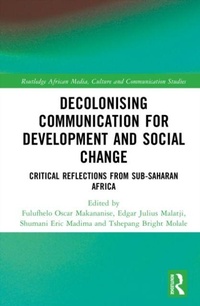
Decolonising Communication for Development and Social Change
Critical Reflections from Sub-Saharan Africa
1st Edition
Will be published approx. on 22. October 2026
Book
Hardback
288 pages
978-1-041-30098-4 (ISBN)
Description
This book brings together research and critical perspectives from scholars across Sub-Saharan Africa and its diaspora to advance African-centred approaches to communication for development and social change. It challenges Western-dominated frameworks by foregrounding indigenous knowledge systems and positioning communication as a space for decolonial transformation, social justice, and inclusive development.
The volume develops theoretical and methodological insights that centre African epistemologies within global debates, interrogating entrenched power structures while promoting cultural diversity and social cohesion. Through interdisciplinary approaches, it draws on decolonial and postcolonial frameworks to examine how African knowledge informs communication practices across education, health, digital media, intercultural engagement, and community contexts. The volume explores pedagogical practices, health communication strategies, and media dynamics through a decolonial lens. The book offers practical and conceptual tools for fostering resistance, collective action, and socially grounded transformation, while encouraging critical reflection on dominant knowledge systems.
This book is intended for scholars, researchers, students, and practitioners in communication, development studies, higher education, and the social sciences who are interested in decoloniality, African knowledge systems, and socially just approaches to communication.
The volume develops theoretical and methodological insights that centre African epistemologies within global debates, interrogating entrenched power structures while promoting cultural diversity and social cohesion. Through interdisciplinary approaches, it draws on decolonial and postcolonial frameworks to examine how African knowledge informs communication practices across education, health, digital media, intercultural engagement, and community contexts. The volume explores pedagogical practices, health communication strategies, and media dynamics through a decolonial lens. The book offers practical and conceptual tools for fostering resistance, collective action, and socially grounded transformation, while encouraging critical reflection on dominant knowledge systems.
This book is intended for scholars, researchers, students, and practitioners in communication, development studies, higher education, and the social sciences who are interested in decoloniality, African knowledge systems, and socially just approaches to communication.
More details
Series
Language
English
Place of publication
London
United Kingdom
Publishing group
Taylor & Francis Ltd
Target group
College/higher education
Professional and scholarly
Academic and Postgraduate
Illustrations
8 s/w Abbildungen, 8 s/w Zeichnungen, 5 s/w Tabellen
5 Tables, black and white; 8 Line drawings, black and white; 8 Illustrations, black and white
Dimensions
Height: 234 mm
Width: 156 mm
ISBN-13
978-1-041-30098-4 (9781041300984)
Copyright in bibliographic data and cover images is held by Nielsen Book Services Limited or by the publishers or by their respective licensors: all rights reserved.
Schweitzer Classification
Persons
Fulufhelo Oscar Makananise is an NRF-rated researcher and Associate Professor in Media Studies at the University of South Africa (UNISA). He holds a doctoral degree in Media Studies from the University of Limpopo. Prof. Makananise obtained a PG (dip)HE from Rhodes University. He also serves as an external examiner in other South African universities and as a reviewer in international and national scholarly journals. Prof. Makananise has authored and published academic articles in peer-reviewed and DHET-accredited journals. In addition, Prof. Makananise has presented papers at both national and international conferences. His research interests include new media technology, digital media, indigenous language media, social media, political communication, digital diplomacy, and news media consumption.
Edgar Julius Malatji is a Senior Lecturer in Media Studies at the University of South Africa and holds a PhD in Media Studies. Also, he was a coordinator of the Programme of Media Studies within the Department of Communication, Media, and Information Studies at the University of Limpopo. Dr. Malatji has recently acquired a Postgraduate Diploma in Higher Education from the Durban University of Technology. He published several scholarly contributions, including book chapters, articles as well and conference papers. Some of his scholarly presentations were delivered in Ireland, France, Russia, and Nigeria. Currently, Dr. Malatji is working on a book titled "Decolonising Communication for Development and Social Change Research: Intercultural Perspectives from the Global South". Lastly, his research interests focus on Indigenous Language Media, Digital Media, Development Communication, and Broadcasting Studies.
Shumani Eric Madima is a Linguistics Senior Lecturer at the University of Venda (UNIVEN) in the Department of English, Media Studies and Linguistics, Faculty of Humanities, Social Sciences and Education. He teaches Linguistics to undergraduate and postgraduate students. He completed his BA degree at the University of South Africa (Unisa), BA (Hons) in Applied Linguistics at the University of Pretoria, MA (Cum Laude) in Linguistics, and PhD in Linguistics at the University of Venda. He has been a teacher and a lecturer at South African Teacher Education (SACTE). His fields of specialisation are Sociolinguistics, Language Planning, Psycholinguistics, Language and gender, Linguistics in Educational Context and Media Studies. He has written several articles on various themes, such as Linguistics and Media Studies, which have been published in different international journals.
Tshepang Bright Molale holds a PhD in Communication Studies and is a senior lecturer in Media Studies at the University of the Witwatersrand. He has published journal articles and book chapters widely in international and locally accredited peer-reviewed outlets, including a co-edited anthology entitled "Strategic Communication Management for Development and Social Change: Perspectives from the African Region". His research interests also include Communication for Development and Social Change, Development Journalism and African Language Media Studies.
Edgar Julius Malatji is a Senior Lecturer in Media Studies at the University of South Africa and holds a PhD in Media Studies. Also, he was a coordinator of the Programme of Media Studies within the Department of Communication, Media, and Information Studies at the University of Limpopo. Dr. Malatji has recently acquired a Postgraduate Diploma in Higher Education from the Durban University of Technology. He published several scholarly contributions, including book chapters, articles as well and conference papers. Some of his scholarly presentations were delivered in Ireland, France, Russia, and Nigeria. Currently, Dr. Malatji is working on a book titled "Decolonising Communication for Development and Social Change Research: Intercultural Perspectives from the Global South". Lastly, his research interests focus on Indigenous Language Media, Digital Media, Development Communication, and Broadcasting Studies.
Shumani Eric Madima is a Linguistics Senior Lecturer at the University of Venda (UNIVEN) in the Department of English, Media Studies and Linguistics, Faculty of Humanities, Social Sciences and Education. He teaches Linguistics to undergraduate and postgraduate students. He completed his BA degree at the University of South Africa (Unisa), BA (Hons) in Applied Linguistics at the University of Pretoria, MA (Cum Laude) in Linguistics, and PhD in Linguistics at the University of Venda. He has been a teacher and a lecturer at South African Teacher Education (SACTE). His fields of specialisation are Sociolinguistics, Language Planning, Psycholinguistics, Language and gender, Linguistics in Educational Context and Media Studies. He has written several articles on various themes, such as Linguistics and Media Studies, which have been published in different international journals.
Tshepang Bright Molale holds a PhD in Communication Studies and is a senior lecturer in Media Studies at the University of the Witwatersrand. He has published journal articles and book chapters widely in international and locally accredited peer-reviewed outlets, including a co-edited anthology entitled "Strategic Communication Management for Development and Social Change: Perspectives from the African Region". His research interests also include Communication for Development and Social Change, Development Journalism and African Language Media Studies.
Content
INTRODUCTION: Whose Knowledge Counts? Decolonisation of Development Communication and Social Change in Postcolonial African Contexts PART 1: DECOLONISING COMMUNICATION SYSTEMS AND PRACTICES IN AFRICAN HIGHER EDUCATION 1: Decolonising Communication for Development and Social Change in Higher Education: The Impact of Digital Technologies in Kenya 2: Decolonising Internal Communication for Employee Engagement: A Systematic Literature Review of Higher Education Institutions in South Africa 3: Reimagining Communication for Development in Higher Education: The Influence of Digital Technologies on Decolonisation 4: Alien Communication Systems and Shifting Educational Approaches: Catalysts for the Erosion of Cultural Values in Malawi PART 2: THE DECOLONIAL PROJECT IN HEALTH COMMUNICATION, AND DIGITAL JOURNALISM 5: Decolonising South African Public Health Communication: A Stylistic Analysis of the Coverage of the COVID-19 Pandemic by Ngoho Community Newspaper 6: Deconstructing Colonial Narratives of HIV/AIDS in South Africa's Post-Apartheid Film Yesterday (2003) 7: Transforming Digital Journalism in South Africa: Striving for a Paradigm Shift towards Decolonisation 8: Citizen Journalism during the War in Tigray: Practices and Challenges PART 3: INDIGENOUS LANGUAGE, NEWS MEDIA, AND DEVELOPMENT JOURNALISM FOR SOCIAL CHANGE 9: Unmasking Fake News: The Influence of Digital Media Literacy in the Fight Against Misinformation among Marginalised Communities in South Africa 10: The Practices and Predicaments of Development Journalism in Tigrai, Ethiopia 11: Empowering Indigenous and Minority Communities: The Role of Community Newspapers in Rural Community Development and Social Change Communication 12: Social Media as a Platform for Indigenous Cultural Expression among South African Youth PART 4: SELECTED CASES ON DECOLONIAL EXPRESSIONS THROUGH INDIGENOUS MUSIC, ACTIVISM AND STORYTELLING FOR SOCIAL CHANGE 13: Decolonising Music in Africa: Analysing Incantations in Ayinla Omowura's Songs of South-West Nigeria 14: Decolonising Indigenous Music Stereotypes for Sociocultural Change among South African Rural University Students 15: Legitimising, Tapping from, and Endorsing Authorities: Confirming the Authenticity of a Protest Movement through the Tweets of Prominent Nigerian Activists 16: Unveiling Hidden Memories: Exploring the Relevance of Autoethnographic Film for Social Change in Liberal Arts Education PART 5: COMMUNICATION STRATEGIES FOR COMMUNITY ENGAGEMENT AND DEVELOPMENT 17: Afro-Communitarianism as a Stakeholder Engagement Approach to Facilitate Sustainable Development, Social Change and Development: A Study of African Communities 18: Developing Strategic Communication Insights For Social Change Through Dialogic Learning: The "Full-On Picture" Method 19: Community Engagement Through Digital Platforms: Analysis of Compliance and Resistance to Municipal Communications via Facebook and WhatsApp in South African Small Towns