

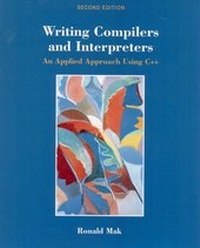
Writing Compilers and Interpreters
An Applied Approach Using C++
2nd Edition
Published on 10. August 1996
Book
Paperback/Softback
XXIV, 840 pages
978-0-471-11353-9 (ISBN)
Description
Quickly master all the skills you need to build your own compilers and interpreters in C++
Whether you are a professional programmer who needs to write a compiler at work or a personal programmer who wants to write an interpreter for a language of your own invention, this book quickly gets you up and running with all the knowledge and skills you need to do it right. It cuts right to the chase with a series of skill-building exercises ranging in complexity from the basics of reading a program to advanced object-oriented techniques for building a compiler in C++.
Here's how it works:
Every chapter contains anywhere from one to three working utility programs that provide a firsthand demonstration of concepts discussed, and each chapter builds upon the preceding ones. You begin by learning how to read a program and produce a listing, deconstruct a program into tokens (scanning), and how to analyze it based on its syntax (parsing). From there, Ron Mak shows you step by step how to build an actual working interpreter and an interactive debugger. Once you've mastered those skills, you're ready to apply them to building a compiler that runs on virtually any desktop computer.
Visit the Wiley Computer Books Web page at: http://www.wiley.com/compbooks/
Whether you are a professional programmer who needs to write a compiler at work or a personal programmer who wants to write an interpreter for a language of your own invention, this book quickly gets you up and running with all the knowledge and skills you need to do it right. It cuts right to the chase with a series of skill-building exercises ranging in complexity from the basics of reading a program to advanced object-oriented techniques for building a compiler in C++.
Here's how it works:
Every chapter contains anywhere from one to three working utility programs that provide a firsthand demonstration of concepts discussed, and each chapter builds upon the preceding ones. You begin by learning how to read a program and produce a listing, deconstruct a program into tokens (scanning), and how to analyze it based on its syntax (parsing). From there, Ron Mak shows you step by step how to build an actual working interpreter and an interactive debugger. Once you've mastered those skills, you're ready to apply them to building a compiler that runs on virtually any desktop computer.
Visit the Wiley Computer Books Web page at: http://www.wiley.com/compbooks/
More details
Edition
2., Auflage
Language
English
Place of publication
New York
United States
Publishing group
John Wiley and Sons Ltd
Target group
Professional and scholarly
Edition type
Revised edition
Illustrations
Ill.
Dimensions
Height: 23.3 cm
Width: 18.9 cm
Weight
1446 gr
ISBN-13
978-0-471-11353-9 (9780471113539)
Schweitzer Classification
Other editions
New editions
Book
09/2009
3rd Edition
Wiley
€78.00
Shipment within 10-20 days
Person
RONALD MAK develops software for BroadVision, Inc., a firm specializing in secure software programs for World Wide Web-based electronic commerce. Prior to moving to BroadVision, Ron was a developer at Apple Computer, where he trained and directed programmers writing Newton Applications.
Content
Reading and Listing the Source Program.
Scanning.
The Symbol Table.
Parsing Expressions.
Parsing Statements.
Parsing Declarations.
Parsing Programs, Procedures and Functions.
Interpreting Declared Procedures and Functions.
Interpreting Control Statements and the Standard Procedures and Functions.
An Interactive Source-Level Debugger.
Machine Architecture and Assembly Code.
Compiling Procedures, Functions, and Assignment Statements.
Compiling Control Statements.
Advanced Concepts: An Overview.
Appendices.
Scanning.
The Symbol Table.
Parsing Expressions.
Parsing Statements.
Parsing Declarations.
Parsing Programs, Procedures and Functions.
Interpreting Declared Procedures and Functions.
Interpreting Control Statements and the Standard Procedures and Functions.
An Interactive Source-Level Debugger.
Machine Architecture and Assembly Code.
Compiling Procedures, Functions, and Assignment Statements.
Compiling Control Statements.
Advanced Concepts: An Overview.
Appendices.