

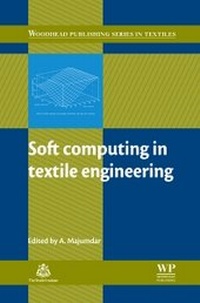
Soft Computing in Textile Engineering
Yarns, fabrics, garments and technical textile applications
Published on 29. November 2010
Book
Hardback
568 pages
978-1-84569-663-4 (ISBN)
Description
Soft computing refers to a collection of computational techniques which study, model and analyse complex phenomena. As many textile engineering problems are inherently complex in nature, soft computing techniques have often provided optimum solutions to these cases. Although soft computing has several facets, it mainly revolves around three techniques; artificial neural networks, fuzzy logic and genetic algorithms. The book is divided into five parts, covering the entire process of textile production, from fibre manufacture to garment engineering. These include soft computing techniques in yarn manufacture and modelling, fabric and garment manufacture, textile properties and applications and textile quality evaluation.
More details
Series
Language
English
Place of publication
Cambridge
United Kingdom
Publishing group
Elsevier Science & Technology
Target group
College/higher education
Professional and scholarly
Dimensions
Height: 234 mm
Width: 156 mm
Weight
960 gr
ISBN-13
978-1-84569-663-4 (9781845696634)
Copyright in bibliographic data and cover images is held by Nielsen Book Services Limited or by the publishers or by their respective licensors: all rights reserved.
Schweitzer Classification
Other editions
Additional editions
Abhijit Majumdar
Soft Computing in Textile Engineering
Book
08/2016
Woodhead Publishing Ltd
€210.46
Shipment within 10-15 days
E-Book
11/2010
Woodhead Publishing Ltd
€205.00
Available for download
Person
Abhijit Majumdar is currently holding the position of R. Jaikumar Chair Professor for Decision
Sciences in the Textile and Fibre Engineering department at the Indian Institute of Technology, Delhi, India
(IIT Delhi). He has published 145 research papers in international refereed journals. His research
areas include protective fibrous materials, operations management, and sustainable supply chains.
management. He has authored two textbooks, edited four books, and two monographs. He is the
associate editor of the Journal of the Institution of Engineers (India) Series E (Chemical and Textile
Engineering) and OPSEARCH.
Sciences in the Textile and Fibre Engineering department at the Indian Institute of Technology, Delhi, India
(IIT Delhi). He has published 145 research papers in international refereed journals. His research
areas include protective fibrous materials, operations management, and sustainable supply chains.
management. He has authored two textbooks, edited four books, and two monographs. He is the
associate editor of the Journal of the Institution of Engineers (India) Series E (Chemical and Textile
Engineering) and OPSEARCH.
Content
Part 1 Introduction to soft computing: Introduction to soft computing techniques: Artificial neural networks, fuzzy logic and genetic algorithm; Artificial neural networks in materials modeling; Fundamentals of soft models in textiles. Part 2 Soft computing in yarn manufacturing: Artificial neural network in yarn property modeling; Performance evaluation and enhancement of artificial neural network in prediction modeling; Yarn engineering using artificial neural network; Adaptive neuro-fuzzy systems in yarn modeling. Part 3 Soft computing in fabric manufacturing: Woven fabric engineering by mathematical modeling and soft computing methods; Soft computing applications in knitting technology; Modelling nonwovens using artificial neural networks. Part 4 Soft computing for textile properties and applications: Garment modelling by fuzzy logic; Soft computing applications for sewing machines; Artificial neural network modeling for prediction of thermal transmission properties of woven fabrics. Part 5 Soft computing in textile quality evaluation: Fuzzy decision making and its applications in cotton fibre grading; Silk cocoon grading by fuzzy expert systems; Artificial neural network applications in textile composites; Modelling the fabric tearing process; Textile quality evaluation by image processing and soft computing techniques.