

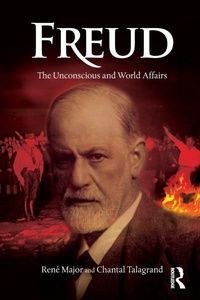
Freud
The Unconscious and World Affairs
Published on 31. October 2017
Book
Paperback/Softback
256 pages
978-1-78220-534-0 (ISBN)
Description
This book sheds a new light on Freud, who from the beginning was aware that the psychoanalytic edifice he was constructing - which revealed in each individual an "ego not master in its own house" - had clear implications for understanding collective human behaviour, including religion, morality, and civilisation.The authors' political focus is unusual, and their choice of quotes from lesser-known sources holds great interest. Freud's interlocutors include Oskar Pfisrer, the Swiss pastor and lay analyst; Einstein; and the American diplomat William Bullitt, with whom Freud wrote a study of President Wilson, entitled Thomas Widrow Wilson: A Psychological Study. In his introduction to this book, written in 1930, Freud describes Wilson as a person for whom mere facts held no significance; he esteemed highly nothing but human motives and opinions. As a result, writes Freud, it was natural for him to ignore the facts of the real outer world, even to deny they existed if they conflicted with his hopes and wishes. In effect, Wilson's vision of America as saviour of the world led to the disastrous consequences of the 1919 Treaty of Versailles, causing William Bullitt to predict that it would make renewed international conflicts inevitable, subjecting nations to a century of future wars.Rene Major and Chantal Talagrand present psychoanalysis itself as political. What is at stake is liberation from all forms of bondage of the self, the other and the world. While focusing on the uniqueness of inner life, Freud never lost sight of humanity as a whole. Toward the end of his life, he concluded: "A great part of my life's work has been spent [trying to] destroy illusions of my own and those of mankind". By highlighting Freud's involvement in the political realities of his era, this book draws attention to the inextricable link between psychoanalytic and sociopolitical perspectives. In other words, it includes psychoanalysis in the urgent affairs of the world.
Reviews / Votes
'Unlike other biographies of Freud, Rene Major and Chantal Talagrand's book is unique in the richness of its contextualisation and the scope and clarity of its historical framework. With the confidence that comes from a deep knowledge of their subject, they present a political Freud, engaged with the issues of his day, and whose thought cannot be ignored given the challenges of our own time. Written with elegance and wisdom, this is an inspiring and important book.'- Darian Leader, psychoanalyst and member of the Centre for Freudian Analysis and Research
'This biography is unique in that, for the first time, it analytically draws on the Freudian method in its retelling of Freud's life and work. Using Nachtraeglichkeit (afterwardsness) as the guiding principle of its investigation, this compelling study revisits, with exceptional rigour and acumen, the Freudian archive as a whole. Above all, Freud underlines the political pertinence of psychoanalysis, and its lucidity regarding the drive to power, relentless cruelty and the endless wars being waged across the world-and within ourselves.'
- Ginette Michaud, professor, Universite de Montreal
'This new biography of Freud deserves a place of honour. The authors are applying the psychoanalytic method to the understanding of historical facts-specifically those of Freud's history-and perhaps this is the source of the book's original flavour. Their panoramic knowledge of Freud's works and his extensive correspondence, and their incorporation of world history data, enables them to bring to life not only these works, but also their context. The portrait of Freud's family is more complete than any I had seen; it encompasses many of the minor characters, including his children, their progeny, and their respective fates. Freud's clinical cases are portrayed as people whose conflicts come alive in the context of their analyst's struggle with his discoveries and the technique he was attempting to perfect.'
- Marion M. Oliner, psychoanalyst and author, in The Psychoanalytic Quarterly
'In this very original "analytic biography" of Freud, with a graceful and narrative style, the authors retrace Freud's life and work, drawing attention, broadly speaking, to its ethical and political significance. Against the cliche of a politically conservative Freud, they restore to psychoanalysis the transgressive charge it carried at its beginnings, showing that, in a certain sense, even today, Freud's work risks being burned as it was by the Nazis in 1933; particularly because a psychoanalysis liberated from both doctors and priests destroys all illusions, even those of the psychoanalysts.'
- Sergio Benvenuto, psychoanalyst and philosopher, editor of the European Journal of Psychoanalysis
More details
Language
English
Place of publication
London
United Kingdom
Publishing group
Taylor & Francis Ltd
Target group
College/higher education
Professional and scholarly
Professional Practice & Development
Dimensions
Height: 229 mm
Width: 152 mm
Thickness: 13 mm
Weight
351 gr
ISBN-13
978-1-78220-534-0 (9781782205340)
Copyright in bibliographic data and cover images is held by Nielsen Book Services Limited or by the publishers or by their respective licensors: all rights reserved.
Schweitzer Classification
Other editions
Persons
Rene Major is a renowned psychoanalyst practicing in Paris. He was previously Director of the Institut de psychanalyse de Paris. In 1979 he created the journal 'Confrontation', a publication linking contemporary art to literature, philosophy, and psychoanalysis. He was later named Program Director at the International College of Philosophy in Paris where he placed particular emphasis on the intersection between philosophy and psychoanalysis. In 2000, he organised an international meeting of psychoanalysts at the Sorbonne, attended by over 1000 participants from thirty-four countries, to discuss the general state of the "science" of psychoanalysis. In 2003 he founded the Institut des hautes etudes en psychanalyse (Institute of Advanced Studies in Psychoanalysis). Rene Major is the author of numerous books, including 'Rever l'autre', 'Le Discernement', 'De l'Election', 'Lacan avec Derrida', 'La Democratie en cruaute', 'Au coeur de l'economie, l'inconscient' ('The Unconscious at the Heart of Economy'). He also edited the collective work 'Derrida pour les temps a venir'. Chantal Talagrand is a psychoanalyst practicing in Paris. At the Institut des hautes etudes en psychanalyse she conducts a seminar on the relation between psychoanalysis, criminology, and law. She was editor-in-chief of the magazines 'Cahiers Confrontation' and 'Contretemps', and has published many articles in France and abroad, including 'Confrontation', 'Etudes freudiennes', 'Psychanalyse a l'Universite, Traverses, Intersignes, Textuel', and 'Filigrane'. In addition, she has contributed to'Jenseits des Identichen' ('Beyond Identity'), 'Depuis Lan' ('Since Lacan'), and 'Etats generaux de la psychanalyse' ('The General State of Psychoanalysis')..
Content
FOREWORD
Why Burn Freud's Books?
Vienna at the End of the 19th Century
Family Portrait
Kindred Spirits in Literature and Philosophy
Revenants
Questioning the Teachers
A Fortunate Contretemps
The Lure of the South
Sexuality Theories
10. Freud the Man
11. The First Circle of Followers
12. Case Histories
13. The War Years
14. Death
15. Life without Illusions
16. The Right to Psychoanalysis
17. Why War
18. The Unpromised Land
Timeline of Life Events
Why Burn Freud's Books?
Vienna at the End of the 19th Century
Family Portrait
Kindred Spirits in Literature and Philosophy
Revenants
Questioning the Teachers
A Fortunate Contretemps
The Lure of the South
Sexuality Theories
10. Freud the Man
11. The First Circle of Followers
12. Case Histories
13. The War Years
14. Death
15. Life without Illusions
16. The Right to Psychoanalysis
17. Why War
18. The Unpromised Land
Timeline of Life Events