

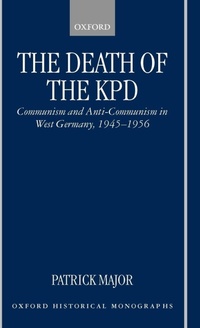
The Death of the KPD
Communism and Anti-Communism in West Germany, 1945-1956
Published on 5. February 1998
Book
Hardback
370 pages
978-0-19-820693-4 (ISBN)
Description
Why was the West German Communist Party banned in 1956, only 11 years after it had emerged from Nazi persecution? Although politically weak, the postwar party was in fact larger than its Weimar predecessor and initially dominated works councils at the Ruhr pits and Hamburg docks, as well as the steel giant, Krupp. Under the control of East Berlin, however, the KPD was sent off on a series of overambitious and flawed campaigns to promote national unification and prevent West German rearmament. At the same time, the party was steadily criminalized by the Anglo-American occupiers, and ostracized by a heavily anti-communist society. Patrick Major has used material available only since the end of the Cold War, from both Communist archives in the former GDR as well as western intelligence, to trace the final decline and fall of the once-powerful KPD.
Reviews / Votes
His concentrated style of presentation, spiced with sarcastic jokes and a dry sense of humour, frequently helps the reader over unavoidable redundancies in what, after all, seems like the story of a hopeless loser. The conceptional strength of Major's work, however, lies in the fact that he consistently avoids attributing responsibility for the death of the KPD to one single factor. * Thomas Lindenberger, German Hist. Inst. Bulletin, Vol.XXII, No.2, Nov. 00. * not only a successful contribution to the history of political parties, but also the first step towards a social history of the Cold War. * Thomas Lindenberger, German Hist. Inst. Bulletin, Vol.XXII, No.2, Nov. 00. * This is labour history without heroes. Patrick Major's excellent study shows understanding of workers and of Communist agitators but does not romanticise the working class or the labour movement ... Major's book is rich in sources and fastidious in detail. * Jonathon Osmond, Labour History Review, vol64, No2 Summer 1999. * a major contribution to our understanding of the recent history of eastern Europe. It is a fine study both of political culture and of Communist party organisation. Impeccably scholarly, the book is also readily acessible to interested non-specialist readers. * History Today - August 1999 * this study fills a significant gap in the history of West Germany and communism. * D. Prowe, Carleton College, CHOICE, Oct 98 * Patrick Major's book is one of very few scholarly studies of the KPD in the Federal Republic, certainly the first that uses to full advantage the archives opened since 1989... Major has produced an intelligent study not just of a small communist party, but of the formation of German politics and society in the aftermath of total war and in the context of the cold war. * Eric D. Weitz, Journal of Modern History *More details
Series
Language
English
Place of publication
Oxford
United Kingdom
Target group
Professional and scholarly
Illustrations
tables
Dimensions
Height: 222 mm
Width: 145 mm
Thickness: 24 mm
Weight
628 gr
ISBN-13
978-0-19-820693-4 (9780198206934)
Copyright in bibliographic data and cover images is held by Nielsen Book Services Limited or by the publishers or by their respective licensors: all rights reserved.
Schweitzer Classification