

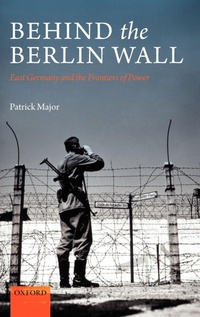
Behind the Berlin Wall
East Germany and the Frontiers of Power
Published on 26. November 2009
Book
Hardback
336 pages
978-0-19-924328-0 (ISBN)
Description
Few historical changes occur literally overnight, but on 13 August 1961 eighteen million East Germans awoke to find themselves walled in by an edifice which was to become synonymous with the Cold War: the Berlin Wall.
This new history rejects traditional, top-down approaches to Cold War politics, exploring instead how the border closure affected ordinary East Germans, from workers and farmers to teenagers and even party members, 'caught out' by Sunday the Thirteenth. Party, police and Stasi reports reveal why one in six East Germans fled the country during the 1950s, undermining communist rule and forcing the eleventh-hour decision by Khrushchev and Ulbricht to build a wall along the Cold War's frontline.
Did East Germans resist or come to terms with immurement? Did the communist regime become more or less dictatorial within the confines of the so-called 'Antifascist Defence Rampart'? Using film and literature, but also the GDR's losing battle against Beatlemania, Patrick Major's cross-disciplinary study suggests that popular culture both reinforced and undermined the closed society. Linking external and internal developments, Major argues that the GDR's official quest for international recognition, culminating in Ostpolitik and United Nations membership in the early 1970s, became its undoing, unleashing a human rights movement which fed into, but then broke with, the protests of 1989. After exploring the reasons for the fall of the Wall and reconstructing the heady days of the autumn revolution, the author reflects on the fate of the Wall after 1989, as it moved from demolition into the realm of memory.
This new history rejects traditional, top-down approaches to Cold War politics, exploring instead how the border closure affected ordinary East Germans, from workers and farmers to teenagers and even party members, 'caught out' by Sunday the Thirteenth. Party, police and Stasi reports reveal why one in six East Germans fled the country during the 1950s, undermining communist rule and forcing the eleventh-hour decision by Khrushchev and Ulbricht to build a wall along the Cold War's frontline.
Did East Germans resist or come to terms with immurement? Did the communist regime become more or less dictatorial within the confines of the so-called 'Antifascist Defence Rampart'? Using film and literature, but also the GDR's losing battle against Beatlemania, Patrick Major's cross-disciplinary study suggests that popular culture both reinforced and undermined the closed society. Linking external and internal developments, Major argues that the GDR's official quest for international recognition, culminating in Ostpolitik and United Nations membership in the early 1970s, became its undoing, unleashing a human rights movement which fed into, but then broke with, the protests of 1989. After exploring the reasons for the fall of the Wall and reconstructing the heady days of the autumn revolution, the author reflects on the fate of the Wall after 1989, as it moved from demolition into the realm of memory.
Reviews / Votes
Major's mastery of the archival sources is most impressive...a model of a truly integrated history...indispensable for anyone seeking to understand the origins and reality of the modern 'State With the Wall'. * Diethelm Prowe, German History * Major succeeds in producing a truly integrated, readable, and thought-provoking history of politics and people that adds significantly to our understanding of the GDR. * Bill Niven, Central European History * This study offers such a wealth of data, information, insights, and judgements * Michael Kubina, German Historical Institute London Bulletin * provide[s] a fascinating and astute insight into the workings of East German communism. * Josie McLellan, English Historical Review *More details
Language
English
Place of publication
Oxford
United Kingdom
Illustrations
12 b/w illustrations, numerous maps
Dimensions
Height: 240 mm
Width: 161 mm
Thickness: 23 mm
Weight
669 gr
ISBN-13
978-0-19-924328-0 (9780199243280)
Copyright in bibliographic data and cover images is held by Nielsen Book Services Limited or by the publishers or by their respective licensors: all rights reserved.
Schweitzer Classification
Other editions
Additional editions
Book
01/2011
Oxford University Press
€56.31
Shipment within 15-20 days
Patrick Major
Behind the Berlin Wall: East Germany and the Frontiers of Power
East Germany and the Frontiers of Power
E-Book
11/2009
1st Edition
OUP Oxford
€14.89
Available for download
Patrick Major
Behind the Berlin Wall: East Germany and the Frontiers of Power
East Germany and the Frontiers of Power
E-Book
11/2009
1st Edition
OUP Oxford
€14.89
Available for download
Person
Patrick Major studied as an undergraduate and postgraduate at the University of Oxford. He came to know East Berlin during a year living in West Berlin in 1985-86, and was one of the first western researchers allowed into the East German communist party's archives after the fall of the wall in February 1990, for a PhD on The Death of the KPD: Communism and Anti-Communism in West Germany, 1945-1956 (OUP, 1997) which won the Royal Historical Society's Gladstone Prize.
Content
1. Introduction ; PART I: BEFORE THE WALL 1945-61 ; 2. East Germany's Dual Crisis: Politics and Economics on the Eve of the Wall ; 3. Crossing the Line: Republikflucht between Defection and Migration ; 4. Holding the Line: Policing the Open Border ; PART II: BEHIND THE WALL 1961-89 ; 5. Walled In: 13 August 1961 ; 6. In the Shadow of the Wall ; 7. Wanderlust: Travel, Emigration and the Movement ; PART III: BEYOND THE WALL ; 8. The Fall of the Wall: 9 November 1989 ; 9. Seeking Closure: Remembering the Wall