

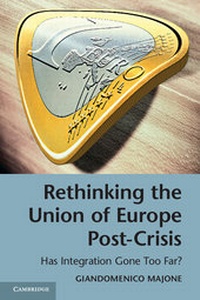
Rethinking the Union of Europe Post-Crisis
Has Integration Gone Too Far?
Published on 24. April 2014
Book
Paperback/Softback
376 pages
978-1-107-69479-8 (ISBN)
Description
In this important new book, Giandomenico Majone examines the crucial but often overlooked distinction between the general aim of European integration and the specific method of integration employed in designing an (ill-considered) monetary union. Written with the author's customary insight and precision, this highly topical and provocative book reviews the Union's leaders' tradition of pushing through ambitious projects without considering the serious hurdles that lie in the way of their success. Regional and European integration topics are discussed, including credibility of commitments, delegation of powers, bargaining and influence activities, adverse selection and moral hazard. The author also offers a deeper examination of the specific crisis of monetary integration, arguing that it might be more effectively achieved with inter-jurisdictional competition and suggesting how integration should be managed in the globalized world.
More details
Language
English
Place of publication
Cambridge
United Kingdom
Target group
Professional and scholarly
Product notice
Paperback (trade)
Dimensions
Height: 228 mm
Width: 152 mm
Thickness: 20 mm
Weight
540 gr
ISBN-13
978-1-107-69479-8 (9781107694798)
Copyright in bibliographic data and cover images is held by Nielsen Book Services Limited or by the publishers or by their respective licensors: all rights reserved.
Schweitzer Classification
Other editions
Additional editions
Book
04/2014
Cambridge University Press
€103.50
Shipment within 15-20 days
E-Book
04/2014
1st Edition
Cambridge University Press
€32.49
Available for download
Person
Giandomenico Majone is Emeritus Professor of Public Policy at the European University Institute in Florence.
Content
Introduction: varieties of regional integration; 1. Monetary union as a metaphor; 2. A political culture of total optimism: its rise and fall; 3. Integration and its modes; 4. Deepening integration: transaction costs and sociopolitical limits; 5. European integration and the decoupling of politics and economics; 6. From the democratic deficit to a democratic default? The normative dimension of the Euro crisis; 7. 'More Europe'; 8. The limits of leaderless Europe; 9. Integration through cooperative competition; 10. The nation state between globalization and regional integration.