

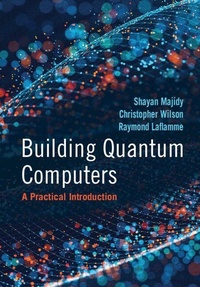
Building Quantum Computers
A Practical Introduction
Published on 11. July 2024
Book
Hardback
272 pages
978-1-009-41701-3 (ISBN)
Description
The global race to build the world's first quantum computer has attracted enormous investment from government and industry, and it attracts a growing pool of talent. As with many cutting-edge technologies, the optimal implementation is not yet settled. This important textbook describes four of the most advanced platforms for quantum computing: nuclear magnetic resonance, quantum optics, trapped ions, and superconducting systems. The fundamental physical concepts underpinning the practical implementation of quantum computing are reviewed, followed by a balanced analysis of the strengths and weaknesses inherent to each type of hardware. The text includes more than 80 carefully designed exercises with worked solutions available to instructors, applied problems from key scenarios, and suggestions for further reading, facilitating a practical and expansive learning experience. Suitable for senior undergraduate and graduate students in physics, engineering, and computer science, Building Quantum Computers is an invaluable resource for this emerging field.
Reviews / Votes
'Building Quantum Computers offers a concise yet comprehensive overview of quantum information processing and various cutting-edge technologies geared toward the development of quantum computers. I find this book particularly valuable due to its compendium-style presentation, making it an ideal resource for graduate students and for professionals actively involved in quantum computing research.' Rainer Blatt, Austrian Academy of Sciences 'Building Quantum Computers presents a pedagogical account of the basic quantum computing concepts and, perhaps for the first time, uniformly and comprehensively discusses the main hardware platforms that are used in building quantum computers. With carefully chosen end-of-chapter exercises, the authors provide an excellent textbook for advanced undergraduate and graduate students in physics and engineering who want to join the thriving quantum computation and simulation communities.' Pedram Roushan, Google 'In an age where it can be difficult to know who and what to trust, I am pleased to say you can 100% rely on these authors. Not only are they renowned experts in their field, but they clearly worked very hard to make the difficult topics in this book not-so-difficult. It offers something that no other textbook does.' Olivia Lanes, IBM Quantum 'With its consistent notation, rigorous attention to detail, and a wealth of exercises, this textbook is an indispensable resource for students and researchers alike. Finally, the quantum information community has its pedagogical guide to modern quantum computing architectures.' Alexandre Blais, Universite de Sherbrooke 'Quantum technology, at the intersection of physics, computer science, engineering, and mathematics, could very well be considered a discipline in its own right, and yet undergraduates rarely arrive at graduate-level quantum technology courses with enough background in each foundational discipline to be successful. A carefully crafted introduction to the topic of quantum technologies can make all the difference to one's success in this exciting and rapidly developing space, and this textbook delivers on this challenge. It serves as a lucid, accessible, and foundational introduction to the field of quantum technology, building upon tried-tested-and-true methods established over years at one of the world's most experienced quantum technology academic institutes.' Stephanie Simmons, Simon Fraser University 'Building Quantum Computers provides a very accessible treatment of the concepts underlying proposed implementations of quantum computers. It is a great resource to learn about the strengths, limitations, physical principles, and mathematical underpinnings of a variety of approaches to building and operating qubits.' Andrew Childs, University of Maryland 'This book treats the reality of building quantum computing hardware for several of the most advanced technologies (nuclear spins, optics, ions, superconductors). For each topic, both the theoretical framework as well as the gory details of the actually needed physical resources are discussed. The book is a very good resource for advanced students interested in quantum information technology and will be a main resource for my next classes on the topic.' Wolfgang Harneit, University of OsnabruckMore details
Language
English
Place of publication
Cambridge
United Kingdom
Illustrations
Worked examples or Exercises
Dimensions
Height: 260 mm
Width: 183 mm
Thickness: 19 mm
Weight
701 gr
ISBN-13
978-1-009-41701-3 (9781009417013)
Copyright in bibliographic data and cover images is held by Nielsen Book Services Limited or by the publishers or by their respective licensors: all rights reserved.
Schweitzer Classification
Persons
Shayan Majidy is a Banting Fellow at Harvard, USA. He completed his PhD at the Institute for Quantum Computing (IQC) at the University of Waterloo, Canada, where he earned prestigious awards including the Vanier Scholarship and IQC Achievement Award. He is recognized for his contributions in science education and outreach, founding a not-for-profit company to bring advanced science research to a wider audience. He has also taught quantum computing in various capacities, including as a sessional instructor, guest lecturer, and teaching assistant, and at multiple summer schools.
Content
List of symbols; Foreword; Preface; 1. Introduction to quantum computing; 2. Review of quantum mechanics for quantum computing; 3. Nuclear magnetic resonance; 4. Optics; 5. Trapped ions; 6. Superconducting circuits; 7. Benchmarking; References; Index.