

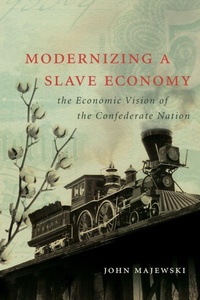
Modernizing a Slave Economy
The Economic Vision of the Confederate Nation
Published on 1. March 2014
Book
Paperback/Softback
256 pages
978-1-4696-1491-5 (ISBN)
Description
What would separate Union and Confederate countries look like if the South had won the Civil War? In fact, this was something that southern secessionists actively debated. Imagining themselves as nation builders, they understood the importance of a plan for the economic structure of the Confederacy.
The traditional view assumes that Confederate slave-based agrarianism went hand in hand with a natural hostility toward industry and commerce. Turning conventional wisdom on its head, John Majewski's analysis finds that secessionists strongly believed in industrial development and state-led modernization. They blamed the South's lack of development on Union policies of discriminatory taxes on southern commerce and unfair subsidies for northern industry.
Majewski argues that Confederates' opposition to a strong central government was politically tied to their struggle against northern legislative dominance. Once the Confederacy was formed, those who had advocated states' rights in the national legislature in order to defend against northern political dominance quickly came to support centralized power and a strong executive for war making and nation building.
The traditional view assumes that Confederate slave-based agrarianism went hand in hand with a natural hostility toward industry and commerce. Turning conventional wisdom on its head, John Majewski's analysis finds that secessionists strongly believed in industrial development and state-led modernization. They blamed the South's lack of development on Union policies of discriminatory taxes on southern commerce and unfair subsidies for northern industry.
Majewski argues that Confederates' opposition to a strong central government was politically tied to their struggle against northern legislative dominance. Once the Confederacy was formed, those who had advocated states' rights in the national legislature in order to defend against northern political dominance quickly came to support centralized power and a strong executive for war making and nation building.
Reviews / Votes
Will generate a lot of new discussions around the economics of the antebellum South and the Confederacy. For that his work has to be welcomed and read by all of those interested in the region and the origins of its 'nation.'"--American Nineteenth Century History|"Majewski's book asks important questions about the rise and fall of Confederate economic nationalism and sounds a clarion call for future state studies."--Louisiana History
|"[A] compelling and surprising perspective on the motives of the secessionists."--Journal of Regional Science
|"[Majewski's] analysis [is] well articulated and sophisticated at every turn....[He] opens important directions in historical investigation and sets a new standard in the scholarly debate."--EH.Net
|"[Majewski] is particularly skilled at bringing statistical analysis to bear on the subject, and the book includes a statistical appendix, happily written in plain English for the uninitiated. . . . Should be of interest to all students of the nineteenth-century American economy."--Georgia Historical Quarterly
|"[Majewski] uses an impressive blend of quantitative and qualitative analysis to shed light on Americans' efforts during the antebellum era to achieve regional economic growth. . . . [Makes] many valuable contributions."
|"Majewski presents a bold, revisionist argument that should inspire continued study and debate."--The Alabama Review
|"A refreshingly well-written, concise treatment of a complex subject that helps us better define southern nationalism."--The Alabama Review
|"Has much to offer scholars of the Old South. . . . An important marker in the recent shift in southern scholarship. . . . Will prompt historians to rethink many of the commonly held assumptions about states' rights and secession."--Civil War History
|"[An] impressively argued book. . . . Builds a bridge between the Old South and the New South and adds to the findings of scholars interested in the construction of mythic Souths both Old and New."--Alpata
|"Compelling. . . . Majewski makes a stimulating argument that calls into question many comfortable assumptions about the development of secessionist thought. . . . Makes exciting contributions to the history of political economy of the United States before the Civil War."--H-Net Reviews
|"[A] finely written and astutely argued book. . . . The book's strong interdisciplinary focus will appeal to all historians of the Civil War and the south. . . . This book should have an impact not only on debates about slavery and economic development but also on the coming of secession and southern political ideology."--Journal of Interdisciplinary History
|"Modernizing a Slave Economy offers a lively and insightful summation of southern economic thought in the antebellum decades, as well as of the difficulties encountered when reformers' visions confronted economic realities."--Register of the Kentucky Historical Society
|"The key to this book's value is its portrayal of secessionists not as a group of free-trade, states' rights libertarians, but rather as leaders who often had conditional views about free trade and states' rights."--The Independent Review
|"Majewski makes a compelling case that secession and the creation of the Confederacy gave Southerners an opportunity to initiate statist policies that had been germinating well before the war. . . . Brings a fresh approach, particularly in his statistical analysis of agricultural data, to several nagging historical questions."--The Journal of American History
|"[A] bracing, sophisticated, and persuasive revisionist account. . . . Will be read with enormous profit by scholars of the Civil War and the Old South."--American Historical Review
|"A tightly knit, well-written and cogently argued narrative. . . . Offers an outstanding example of how modern political economy can be interdisciplinary, empirically rigorous, and accessible."--H-Net Reviews
|"A stimulating and original analysis."--Enterprise & Society
|"Interesting, well written, and well organized. . . . Recommended."--Choice
More details
Series
Edition
New edition
Language
English
Place of publication
Chapel Hill
United States
Target group
College/higher education
Professional and scholarly
Edition type
New edition
Dimensions
Height: 234 mm
Width: 156 mm
Thickness: 15 mm
Weight
445 gr
ISBN-13
978-1-4696-1491-5 (9781469614915)
Copyright in bibliographic data and cover images is held by Nielsen Book Services Limited or by the publishers or by their respective licensors: all rights reserved.
Schweitzer Classification
Other editions
Additional editions
E-Book
04/2011
The University of North Carolina Press
€19.49
Available for download
Person
John Majewski is professor of history at the University of California, Santa Barbara. He is author of A House Dividing: Economic Development in Pennsylvania and Virginia before the Civil War.