

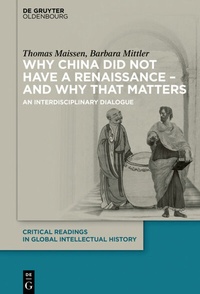
Why China did not have a Renaissance - and why that matters
An interdisciplinary Dialogue
1st Edition
Published on 6. July 2020
Book
Paperback/Softback
XVII, 238 pages
978-3-11-071006-9 (ISBN)
Description
Concepts of historical progress or decline and the idea of a cycle of historical movement have existed in many civilizations. In spite of claims that they be transnational or even universal, periodization schemes invariably reveal specific social and cultural predispositions.
Our dialogue, which brings together a Sinologist and a scholar of early modern History in Europe, considers periodization as a historical phenomenon, studying the case of the "Renaissance." Understood in the tradition of J. Burckhardt, who referred back to ideas voiced by the humanists of the 14th and 15th centuries, and focusing on the particularities of humanist dialogue which informed the making of the "Renaissance" in Italy, our discussion highlights elements that distinguish it from other movements that have proclaimed themselves as "r/Renaissances," studying, in particular, the Chinese Renaissance in the early 20th century.
While disagreeing on several fundamental issues, we suggest that interdisciplinary and interregional dialogue is a format useful to addressing some of the more far-reaching questions in global history, e.g. whether and when a periodization scheme such as "Renaissance" can fruitfully be applied to describe non-European experiences.
Our dialogue, which brings together a Sinologist and a scholar of early modern History in Europe, considers periodization as a historical phenomenon, studying the case of the "Renaissance." Understood in the tradition of J. Burckhardt, who referred back to ideas voiced by the humanists of the 14th and 15th centuries, and focusing on the particularities of humanist dialogue which informed the making of the "Renaissance" in Italy, our discussion highlights elements that distinguish it from other movements that have proclaimed themselves as "r/Renaissances," studying, in particular, the Chinese Renaissance in the early 20th century.
While disagreeing on several fundamental issues, we suggest that interdisciplinary and interregional dialogue is a format useful to addressing some of the more far-reaching questions in global history, e.g. whether and when a periodization scheme such as "Renaissance" can fruitfully be applied to describe non-European experiences.
More details
Series
Language
English
Place of publication
Berlin/München/Boston
Germany
Target group
Professional and scholarly
US School Grade: College Graduate Student
Product notice
Klappenbroschur
Illustrations
10 Abbildungen
10 b/w ill.
Dimensions
Height: 230 mm
Width: 155 mm
Thickness: 15 mm
Weight
391 gr
ISBN-13
978-3-11-071006-9 (9783110710069)
Schweitzer Classification
Other editions
Additional editions
Thomas Maissen | Barbara Mittler
Why China did not have a Renaissance - and why that matters
An interdisciplinary Dialogue
E-Book
06/2018
1st Edition
De Gruyter Oldenbourg
€99.95
Available for download
Thomas Maissen | Barbara Mittler
Why China did not have a Renaissance - and why that matters
An interdisciplinary Dialogue
Book
06/2018
1st Edition
De Gruyter Oldenbourg
€99.95
Shipment within 7-9 days
Thomas Maissen | Barbara Mittler
Why China did not have a Renaissance - and why that matters
An interdisciplinary Dialogue
E-Book
06/2018
1st Edition
De Gruyter Oldenbourg
€99.95
Available for download
Persons
Thomas Maissen
, Deutsches Historisches Institut, Paris, Universität Heidelbert;
Barbara Mittler
, Universität Heidelberg.