

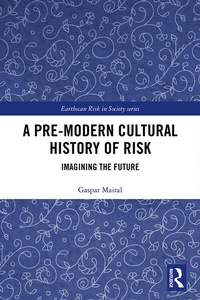
A Pre-Modern Cultural History of Risk
Imagining the Future
1st Edition
Published on 6. March 2020
Book
Hardback
256 pages
978-0-367-36185-3 (ISBN)
Description
This book answers the need for a contextual, long-term and interpretative analysis of risk from original sources.
Risk has historically been a way of imagining what could happen in the future based on expert theories and predictions. This book explores this notion of "managing the future" by tracing the conceptual development of risk from its origin in Islamic Koranic theology. It follows its long voyage from mercantile law and navigation in Medieval Mediterranean and the Atlantic Ocean, to Columbus' arrival to the Indies and the Spanish exploration and colonization in the Americas. It considers the mathematical invention of probability in games of chance, the birth of journalism in Britain with Defoe's Journal of the Plague Year, the earthquake of Lisbon in 1755 and the subsequent controversy between apocalyptic believers and enlightened philosophers. Tracking the growth and evolution of risk as a concept across various historical periods and events, Mairal highlights four key features of risk - time, knowledge, relationship and probability - and argues that risk is not based on perception as it is generally presented, but rather on knowledge accrued and developed over a vast historical time frame.
A Pre-Modern Cultural History of Risk will be of great interest to students and scholars of risk management.
Risk has historically been a way of imagining what could happen in the future based on expert theories and predictions. This book explores this notion of "managing the future" by tracing the conceptual development of risk from its origin in Islamic Koranic theology. It follows its long voyage from mercantile law and navigation in Medieval Mediterranean and the Atlantic Ocean, to Columbus' arrival to the Indies and the Spanish exploration and colonization in the Americas. It considers the mathematical invention of probability in games of chance, the birth of journalism in Britain with Defoe's Journal of the Plague Year, the earthquake of Lisbon in 1755 and the subsequent controversy between apocalyptic believers and enlightened philosophers. Tracking the growth and evolution of risk as a concept across various historical periods and events, Mairal highlights four key features of risk - time, knowledge, relationship and probability - and argues that risk is not based on perception as it is generally presented, but rather on knowledge accrued and developed over a vast historical time frame.
A Pre-Modern Cultural History of Risk will be of great interest to students and scholars of risk management.
More details
Series
Language
English
Place of publication
London
United Kingdom
Publishing group
Taylor & Francis Ltd
Target group
College/higher education
Illustrations
1 s/w Tabelle
1 Tables, black and white
Dimensions
Height: 234 mm
Width: 156 mm
Weight
650 gr
ISBN-13
978-0-367-36185-3 (9780367361853)
Copyright in bibliographic data and cover images is held by Nielsen Book Services Limited or by the publishers or by their respective licensors: all rights reserved.
Schweitzer Classification
Other editions
Additional editions
Book
09/2021
1st Edition
Routledge
€65.50
Shipment within 10-20 days
E-Book
03/2020
1st Edition
Routledge
€59.49
Available for download
E-Book
03/2020
1st Edition
Routledge
€59.49
Available for download
Person
Gaspar Mairal is Professor of Social Anthropology at the University of Zaragoza, Spain.
Content
1. The Mediterranean Origin of Risk 2. The Conquest of the Ocean 3. When Risk Navigated to the Americas: The Great Adventure of Christopher Columbus 4. When Risk Set Foot in the Americas 5. From Narrative to the Probability Calculus 6. Daniel Defoe and A Journal of the Plague Year 7. The Lisbon Earthquake of 1755, or the First Modern Catastrophe 8. Conclusion: risk in its historical context Index