

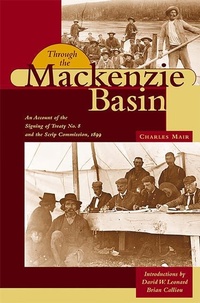
Through the Mackenzie Basin
An Account of the Signing of Treaty No. 8 and the Scrip Commission, 1899
Published on 1. June 1999
Book
Paperback/Softback
246 pages
978-0-88864-326-1 (ISBN)
Description
When Through the Mackenzie Basin was published in 1908, it became an immediate success as an adventure book on the unsettled regions of Northwest Canada. Many of the issues the book addresses are still topical and contentious, a century after the signing of Treaty 8. In this new edition, David Leonard's introduction puts Mair's work into its historical context, while Brian Calliou's introduction adds a First Nations perspective. Charles Mair's first-hand account of the siging of Treaty No. 8 at Lesser Slave Lake in 1899 and the distribution of scrip in the District of Athabaska "has come to constitute the most detailed published source for the interpretation of these events," albeit from Mair's imperial perspective, notes Leonard, as "a government supporter, ardent Canadian nationalist and firm believer in the British institutions." This edition also includes the complete text of Treaty No. 8 including signatories, the "Order In Council Ratifying Treaty No. 8," and "The Report of Commissioners for Treaty No. 8."
Reviews / Votes
"The new edition of Through the Mackenzie Basin is a welcome addition to early Prairie literature." - Albert Braz, University of Toronto Quarterly, Winter 2001/2002, Letters in Canada, vol 71:1More details
Series
Language
English
Place of publication
Edmonton
Canada
Target group
Professional and scholarly
Product notice
Paperback (trade)
Dimensions
Height: 229 mm
Width: 152 mm
Thickness: 16 mm
Weight
417 gr
ISBN-13
978-0-88864-326-1 (9780888643261)
Copyright in bibliographic data and cover images is held by Nielsen Book Services Limited or by the publishers or by their respective licensors: all rights reserved.
Schweitzer Classification
Persons
Mair was born at Lanark, Upper Canada, to Margaret Holmes and James Mair. He attended Queen's University but did not graduate. On leaving college, he became a journalist.[1] In Ottawa in 1868, Mair was introduced by civil servant and writer Henry Morgan to young lawyers George Denison, William Foster, and Robert Haliburton. "Together they organized the overtly nationalistic Canada First movement, which began as a small social group."[1] Mair "represented the Montreal Gazette during the first Riel Rebellion, and was imprisoned and narrowly escaped being shot by the rebels."[2] Mair was a Freemason[3] Mair "was an Officer of the Governor-General's Body Guard during the second Riel rebellion in 1885, and was later employed in the Canadian civil service in the West."[2] He died in Victoria, British Columbia. David Leonard is an insightful historian and dedicated archivist who has played a key role in the preservation and understanding of Alberta's history. He has been particularly effective in preserving the history of Alberta's northwest Peace River Country. David was born in Fairview, Alberta on February 17, 1945 and raised in Sexsmith. Brian Calliou became the program director for The Banff Centre's Indigenous Leadership and Management in August 2003, bringing a wealth of experience to this role. Aside from being the former associate director of the Indigenous Leadership and Management programs from 2000 to 2002, Calliou has served on a number of boards. For example, he served as the chair of the Alberta Historical Resources Foundation board, vice-president of the board of the Indigenous Bar Association, and chair of the Boyle Street Coop.
Content
Introduction; From Edmonton to Lesser Slave Lake; Lesser Slave River & Lesser Slave Lake; Treaty at Lesser Slave Lake; The Half-Breed Scrip Commission; Resources of Lesser Slave Lake Region; On the Trail to Peace River; Down the Peace River; From Fort Chipewyan to Fort M'murray; The Athabasca River Region; The Trip to Wahpooskow; Conclusion.