

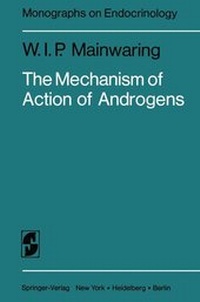
The Mechanism of Action of Androgens
1st Edition
Published on 1. March 1977
Book
Hardback
192 pages
978-3-540-07941-5 (ISBN)
Description
My introduction to androgens was neither auspicious nor impressive. I was sitting my viva voce examination for a degree in physiology and had haltingly intimated to my examiner (name decorously withheld) that I intended to pursue a career in re- search. "On what topic?" was the reply. I had been deeply impressed by the work of C. Huggins and C. V. Hodges (Cancer Res. 1, 293, 1941) on the dramatic arrest of canine prostatic hyperplasia by the administration of stilboestrol. With some en- thusiasm, I responded, "On steroid hormones, because I am struck by the profound effects that may be achieved by relatively small numbers of molecules. " The examiner sank into deep contemplation before replying, "Young man, have you considered go- ing into teaching?" Suitably chastened, I finally began my research career investigating the effects of steroids on the nucleic acid metabolism of experimental tumours and on the process cells. Reaching an impasse in this work, I mentioned one of senescence in animal day to Dr. G. F. Marrian that, somewhat surprisingly, we had no understanding of the fundamental mechanism of action of steroid hormones, especially the androgens. me to tackle this problem, particularly since exciting new insights He encouraged were then being made into the interaction of radioactively labelled oestradiol-l?
,8 with such tissues as rat uterus.
,8 with such tissues as rat uterus.
More details
Series
Language
English
Place of publication
Berlin
Germany
Publishing group
Springer-Verlag Berlin and Heidelberg GmbH & Co. KG
Target group
Professional and scholarly
Research
Illustrations
biography
Weight
550 gr
ISBN-13
978-3-540-07941-5 (9783540079415)
Copyright in bibliographic data and cover images is held by Nielsen Book Services Limited or by the publishers or by their respective licensors: all rights reserved.
Schweitzer Classification
Other editions
Additional editions
W.I.P. Mainwaring
The Mechanism of Action of Androgens
E-Book
12/2012
Springer
€96.29
Available for download
W.I.P. Mainwaring
The Mechanism of Action of Androgens
Book
04/2012
Springer
€106.99
Shipment within 7-9 days
Content
I. A Contemporary Model for the Mechanism of Action of Androgens.- 1. Definitions.- 2. The Model for the Mechanism of Action of Androgens.- 3. Experimental Support for the Model.- a) Antiandrogens.- b) Experimental Testicular Feminisation Syndromes.- c) Specificity of Induction and Dose-Response Phenomena.- d) Temporal Integration of Steroid-Mediated Responses.- e) Tumours with Different Sensitivities to Androgens.- 4. Limitations of the Model of Androgen Action.- a) Fundamental Mechanisms of Hormone Action.- b) Redundant (Aberrant) Binding.- c) General Applicability of the Model.- d) Acute Tissue-Specificity of Androgenic Responses.- e) Androgen Responses Independent of the Receptor System.- f) Hormonal Synergism.- g) Responses Independent of Transcription.- 5. Conclusions.- II. The Metabolism of Androgens in Relation to Their Mechanism of Action.- 1. Relative Biological Activities of Testosterone and Its Metabolites.- 2. General Comments on the Metabolism of Androgens.- 3. Developmental Aspects of the Metabolism of Testosterone.- a) Foetal Development.- b) Neonatal Development.- c) Adult Development.- d) Fluctuations in the Circulating Concentrations of Androgens.- 4. Androgenic Responses Not Mediated by 5?-dihydrotestosterone.- 5. Interconversion of Steroid Hormones.- 6. Conclusions.- III. Initial Events in the Mechanism of Action of Androgens.- 1. The Uptake, Retention, and Release of Androgens: Studies on Rat Ventral Prostate Gland.- a) Transport of Testosterone and Related Steroids in Plasma.- b) Entry of Testosterone into Cells.- c) Cytoplasmic Receptors for Androgens.- d) Antiandrogens.- e) The Nuclear Binding of 5?-dihydrotestosterone.- f) Reconstituted, Cell-Free Systems for the Nuclear Transfer of 5?-dihydrotestosterone: the Acceptor Hypothesis.- g) The Structure of Chromatin and the Nature of Nuclear Acceptor Sites.- h) The Exit of 5?-dihydrotestosterone from the Prostate Gland: Receptor Cycling.- i) Binding of Steroids Other than 5?-dihydrotestosterone.- j) Purification of Receptor Proteins.- 2. The Binding of Androgens in Other Target Cells.- a) Distribution and Specificity of Receptors for Androgens and Related Steroids.- b) Physical Properties of Cytoplasmic and Nuclear Receptors.- c) Binding of Hormones Other than Androgens.- d) Specificity of Androgenic Responses.- 3. Initial Biochemical Events Stimulated by Androgens.- a) Protein Synthesis.- b) Activation of Protein Phosphokinases.- c) Stimulation of the Initiation Step of Protein Synthesis.- d) The Androgenic Regulation of RNA Synthesis: Receptor Effects in vitro.- 4. Conclusions.- IV.Early Events Stimulated by Androgens.- 1. Early Biochemical Changes Stimulated by Androgens.- 2. A More Detailed Enquiry into Enzyme Induction by Androgens: Aldolase in Rat Prostate.- 3. Experimental Models for Studying Tissue-Specific Responses.- a) Rat Seminal Vesicle.- b) Mouse Kidney.- 4. Morphologic Aspects of Androgenic Stimulation.- 5. Conclusions.- V.Late Events in the Mechanism of Action of Androgens.- 1. Cell Renewal and Morphologic Studies on the Mitogenic Activity of Testosterone and Its Metabolites.- 2. Biochemical Approaches to the Regulation of Mitosis in Rat Ventral Prostate Gland.- a) Enzymes Engaged in DNA Replication.- b) Proteins Regulating the Onset of Mitosis.- c) DNA-Unwinding Proteins.- d) Synthesis of Histones.- 3. Conclusions.- Overall Conclusions.- References.