

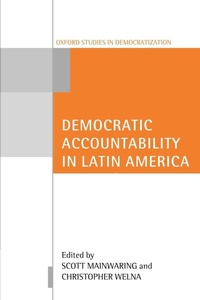
Democratic Accountability in Latin America
Edited by Mainwaring, Scott / Welna, Christopher
Published on 31. July 2003
Book
Paperback/Softback
360 pages
978-0-19-925638-9 (ISBN)
Description
This volume on democratic accountability addresses one of the burning issues on the agenda of policy makers and citizens in contemporary Latin America. In much of Latin America, disenchantment and cynicism have set in regarding the quality of elected governments raising the prospect of a new round of democratic erosion and breakdowns. One of the important emerging challenges for improving the quality of democracy resolves around how to build more effective mechanisms of accountability. A widespread perception prevails in much of the region that government officials are not sufficiently subject to routinized controls by oversight agencies. Corruption, lack of oversight, impunity of state actors, and improper use of public resources are major problems in most countries of the region. Dealing with these issues is paramount to restoring and deepening democratic legitimacy.
The fundamental question in this volume is how democratic leaders in Latin America can improve accountability while simultaneously promoting governmental effectiveness. These issues have acquired urgency in contemporary Latin America because of heightened public concern about corruption and improper governmental actions on the one hand, yet on the other, uncertainty about the potential tradeoff between tightened accountability of officials and effective policy results.
The volume enhances understanding of three key issues. First, it enriches understanding of the state of non-electoral forms of democratic accountability in contemporary Latin America. What are some of the major shortcoming in democratic accountability? How can they be addressed? What are some major innovations in the efforts to enhance democratic accountability?
A second contribution of the volume is conceptual. Accountability is a key concept in the social sciences, yt its meaning varies widely form one author to the next. The authors in this volume, especially in the first four chapters, explicitly debate how bet to define and delimit the concept.
Finally the volume also furthers understanding of the interactions between various mechanism and institutions of accountability. Many of the authors address how electoral accountability (the accountability of elected officials to the voters) interact with the forms of accountability in which state agencies oversee and sanction public officials. The volume provides extensive treatment of this important but hitherto under-explored interaction.
The fundamental question in this volume is how democratic leaders in Latin America can improve accountability while simultaneously promoting governmental effectiveness. These issues have acquired urgency in contemporary Latin America because of heightened public concern about corruption and improper governmental actions on the one hand, yet on the other, uncertainty about the potential tradeoff between tightened accountability of officials and effective policy results.
The volume enhances understanding of three key issues. First, it enriches understanding of the state of non-electoral forms of democratic accountability in contemporary Latin America. What are some of the major shortcoming in democratic accountability? How can they be addressed? What are some major innovations in the efforts to enhance democratic accountability?
A second contribution of the volume is conceptual. Accountability is a key concept in the social sciences, yt its meaning varies widely form one author to the next. The authors in this volume, especially in the first four chapters, explicitly debate how bet to define and delimit the concept.
Finally the volume also furthers understanding of the interactions between various mechanism and institutions of accountability. Many of the authors address how electoral accountability (the accountability of elected officials to the voters) interact with the forms of accountability in which state agencies oversee and sanction public officials. The volume provides extensive treatment of this important but hitherto under-explored interaction.
Reviews / Votes
Mainwaring and Welna's volume broadens the conceptual focus, addressing courts as only one of a group of political and societal actors which jointly provide accountability. The debates raised here, and the insight that the ongoing interaction between various institutions is essential to constructing accountability, will surely become a mainstay of the growing literature on accountability in Latin America. Matthew M. Taylor, University of Sao PauloMore details
Series
Language
English
Place of publication
Oxford
United Kingdom
Target group
Professional and scholarly
Illustrations
numerous tables and 1 figure
Dimensions
Height: 234 mm
Width: 156 mm
Thickness: 19 mm
Weight
547 gr
ISBN-13
978-0-19-925638-9 (9780199256389)
Copyright in bibliographic data and cover images is held by Nielsen Book Services Limited or by the publishers or by their respective licensors: all rights reserved.
Schweitzer Classification
Other editions
Additional editions
Scott Mainwaring | Christopher Welna
Democratic Accountability in Latin America
E-Book
07/2003
1st Edition
OUP eBook
€85.99
Available for download
Persons
Scott Mainwaring is Conley Professor of Political Science, University of Notre Dame
Christopher Welna is Associate Director, Kellog Institute for International Studies, University of Notre Dame
Christopher Welna is Associate Director, Kellog Institute for International Studies, University of Notre Dame
Content
CONCEPTUAL AND THEORETICAL ISSUES ; LEGISLATURES, EXECUTIVES, AND OVERSIGHT AGENCIES ; THE JUDICIARY, THE PUBLIC PROSECUTION OFFICE, AND RULE OF LAW ; SOCIETAL ACCOUNTABILITY