

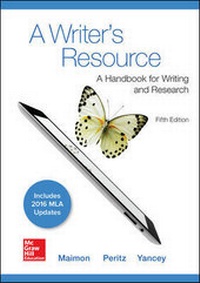
A Writer's Resource 5e MLA 2016 UPDATE
5th Edition
Published on 15. January 2017
Book
Paperback/Softback
672 pages
978-1-259-98857-8 (ISBN)
Description
A Writer's Resource helps writers identify the fundamental elements of any writing situation-from academic papers to blog posts to 140-character tweets. Its innovative, transferable techniques and practices build confidence for composing across genres, media, and the academic curriculum. And with its numerous examples from a rich cross-section of disciplines, the fifth edition clearly demonstrates that every major, every field of study, and every potential career path depends on written communication.
Connect Composition supports instruction across multiple semesters and courses with interactive exercises, online learning videos, enriched ebook materials,annotation and writing tools, and much more!
* LearnSmartAchieve - a continuously adaptive learning system that pinpoints students' individual strengths and weaknesses and provides personalized support to help them master key topics and material. LearnSmart Achieve provides foundational support on key course areas such as the writing process, critical reading, the research process, reasoning and argument, grammar and common sentence problems,punctuation and mechanics, style and word choice, and multilingual writer support.
* Power of Process - a critical reading and writing tool that guides students through instructor-chosen strategies and helps them engage directly with a text through highlighting, annotation, and short answer questions.
*Analytics - Progress dashboards that quickly show how you are performing on your assignments and tips for improvement.
Connect Composition supports instruction across multiple semesters and courses with interactive exercises, online learning videos, enriched ebook materials,annotation and writing tools, and much more!
* LearnSmartAchieve - a continuously adaptive learning system that pinpoints students' individual strengths and weaknesses and provides personalized support to help them master key topics and material. LearnSmart Achieve provides foundational support on key course areas such as the writing process, critical reading, the research process, reasoning and argument, grammar and common sentence problems,punctuation and mechanics, style and word choice, and multilingual writer support.
* Power of Process - a critical reading and writing tool that guides students through instructor-chosen strategies and helps them engage directly with a text through highlighting, annotation, and short answer questions.
*Analytics - Progress dashboards that quickly show how you are performing on your assignments and tips for improvement.
More details
Edition
5th edition
Language
English
Place of publication
OH
United States
Target group
College/higher education
Dimensions
Height: 213 mm
Width: 185 mm
Thickness: 29 mm
Weight
690 gr
ISBN-13
978-1-259-98857-8 (9781259988578)
Copyright in bibliographic data and cover images is held by Nielsen Book Services Limited or by the publishers or by their respective licensors: all rights reserved.
Schweitzer Classification
Persons
Elaine P. Maimon is President of Governors State University in the south suburbs of Chicago, where she is also Professor of English. Previously she was Chancellor of the University of Alaska Anchorage, Provost (Chief Campus Officer) at Arizona State University West, and Vice President of Arizona State University as a whole. In the 1970s, she initiated and then directed the Beaver College writing-across-the-curriculum program, one of the first WAC programs in the nation. A founding Executive Board member of the National Council of Writing Program Administrators (WPA), she has directed national institutes to improve the teaching of writing and to disseminate the principles of writing across the curriculum. With a PhD in English from the University of Pennsylvania, where she later helped to create the Writing Across the University (WATU) program, she has also taught and served as an academic administrator at Haverford College, Brown University, and Queens College.
Janice Haney Peritz is an Associate Professor of English who has taught college writing for more than thirty years, first at Stanford University, where she received her PhD in 1978, and then at the University of Texas at Austin; Beaver College; and Queens College, City University of New York. From 1989 to 2002, she directed the Composition Program at Queens College, where in 1996, she also initiated the colleges writing-across-the-curriculum program and the English Departments involvement with the Epiphany Project and cyber-composition. She also worked with a group of CUNY colleagues to develop The Write Site, an online learning center, and more recently directed the CUNY Honors College at Queens College for three years. Currently, she is back in the English Department doing what she loves most: research, writing, and full-time classroom teaching of writing, literature, and culture.
Kathleen Blake Yancey is the Kellogg W. Hunt Professor of English and Distinguished Research Professor at Florida State University. She has held several national leadership positions, including as President of the Council of Writing Program Administrators (CWPA), Chair of the Conference on College Composition and Communication (CCCC), President of the National Council of Teachers of English (NCTE), and President of the South Atlantic Modern Language Association (SAMLA). She also co-edited the journal Assessing Writing for seven years, and she is the immediate past editor of College Composition and Communication. Her scholarship ranges from reflection and ePortfolios to writing transfer and digital literacies. Previously, she taught at UNC Charlotte and at Clemson University, where she directed the Pearce Center for Professional Communication and created the Class of 1941 Studio for Student Communication, both of which are dedicated to supporting communication across the curriculum.
Janice Haney Peritz is an Associate Professor of English who has taught college writing for more than thirty years, first at Stanford University, where she received her PhD in 1978, and then at the University of Texas at Austin; Beaver College; and Queens College, City University of New York. From 1989 to 2002, she directed the Composition Program at Queens College, where in 1996, she also initiated the colleges writing-across-the-curriculum program and the English Departments involvement with the Epiphany Project and cyber-composition. She also worked with a group of CUNY colleagues to develop The Write Site, an online learning center, and more recently directed the CUNY Honors College at Queens College for three years. Currently, she is back in the English Department doing what she loves most: research, writing, and full-time classroom teaching of writing, literature, and culture.
Kathleen Blake Yancey is the Kellogg W. Hunt Professor of English and Distinguished Research Professor at Florida State University. She has held several national leadership positions, including as President of the Council of Writing Program Administrators (CWPA), Chair of the Conference on College Composition and Communication (CCCC), President of the National Council of Teachers of English (NCTE), and President of the South Atlantic Modern Language Association (SAMLA). She also co-edited the journal Assessing Writing for seven years, and she is the immediate past editor of College Composition and Communication. Her scholarship ranges from reflection and ePortfolios to writing transfer and digital literacies. Previously, she taught at UNC Charlotte and at Clemson University, where she directed the Pearce Center for Professional Communication and created the Class of 1941 Studio for Student Communication, both of which are dedicated to supporting communication across the curriculum.
Content
A Writer's Resource, Fifth Edition by Elaine Maimon - Table of ContentsTAB 1 - Writing TodaySTART SMART: ADDRESSING THE WRITING SITUATION1. Writing across the Curriculum and beyond College2. Writing Situations
a. Approaching writing via the situation
b. Using multimodal elements and genre
c. Choosing the best medium
d. The persuasive power of images
e. Online tools for learning
3. Audience and Academic English
a. Becoming aware of audience
b. Using reading, writing, and speaking to learn about English
c. Tools for multilingual students
TAB 2 - Writing and Designing Texts4. Reading and Writing: The Critical Connection
a. Reading critically
b. Writing critically
5. Planning and Shaping
a. Approaching assignments
b. Exploring ideas
c. Developing a working thesis
d. Planning a structure
e. Considering visuals and multimodal elements
6. Drafting Text and Visuals
a. Using electronic tools for drafting
b. Patterns of organization and visuals
c. Writing paragraphs
d Integrating visuals and multimodal elements
7. Revising and Editing
a. Getting comments
b. Using electronic tools for revising
c. Focusing on the situation
d. Testing your thesis
e. Reviewing structure
f. Revising paragraphs
g. Revising visuals and multimodal elements
h. Editing sentences
i. Proofreading carefully
j. Using campus, Internet, community resources
k. One student's revisions
STUDENT REFLECTIVE TEXT8. Designing Academic Texts and Portfolios
a. Considering audience and purpose
b. Using computer tools
c. Thinking intentionally about design
d. Compiling a print or electronic portfolio
TAB 3 - Common Assignments9. Informative ReportsSTUDENT SAMPLE
10. Interpretive Analyses and Writing about LiteratureSTUDENT SAMPLE
11. ArgumentsSTUDENT SAMPLE
12. Other Kinds of Assignments
a. Personal essays
b. Lab reports
c. Case studies
d. Essay exams
e. Coauthored projects
13. Oral Presentations14. Multimodal Writing
a. Tools for creating multimodal texts
b. Analyzing images
c. Web sites
d. Blogs and wikis
TAB 4 - Writing Beyond College15. Service Learning and Community-Service Writing16. Letters to Raise Awareness and Share Concern
a. Writing about a public issue
b. Writing as a consumer
17. Writing to Get and Keep a Job
a. Internships
b. Resumes
c. Job application letters
d. Job interviews
e. Writing on the job
TAB 5 - Researching18. Understanding Research
a. Primary and secondary research
b. Research and college writing
c. Understanding theresearch assignment
d. Choosing a research question
e. Creating a research plan
19. Finding and Managing Print and Online Sources
a. Using the library
b. Kinds of sources
c. Printed and online reference works
d. Keyword searches
e. Print indexes and online databases
f. Search engines and subject directories
g. Using the library's catalog to find books
h. Government documents
i. Online communication
20. Finding and Creating Effective Visuals, Audio Clips, and Videos
a. Finding and displaying quantitative data
b. Searching for images
c. Searching for or creating audio clips or videos
21. Evaluating Sources
a. Print sources
b. Internet sources
c. Evaluating a source's arguments
22. Doing Research in the Archive, Field, and Lab
a. Ethics
b. Archival research
c. Field research
d. Lab research
23. Plagiarism, Copyright, and Intellectual Property
a. Some definitions
b. Avoiding plagiarism
c. Fair use
24. Working with Sources and Avoiding Plagiarism
a. Working bibliographies
b. Annotated bibliographies
c. Taking notes
d. Paraphrasing, summarizing, quoting, synthesizing
e. Integrating quotations, paraphrases, summaries
TAB 6 - MLA Documentation StyleFINDING SOURCE INFORMATIONAND DOCUMENTING SOURCES IN MLA STYLE
MLA Style: In-Text Citations
MLA Style: List of Works Cited
MLA Style: Explanatory Notes and Acknowledgments
MLA Style: Format
SAMPLE RESEARCH PROJECT IN MLA STYLE
TAB 7 - APA Documentation StyleFINDING SOURCE INFORMATION AND IDENTIFYING AND DOCUMENTING SOURCES IN APA STYLE
APA Style: In-Text Citations
APA Style: References
APA Style: Format
SAMPLE RESEARCH PROJECT IN APA STYLE
TAB 8 - Chicago and CSE Documentation Styles
Chicago Documentation Style: Elements
SAMPLE FROM A STUDENT RESEARCH PROJECT IN CHICAGO STYLE
CSE Documentation Style
TAB 9 - Editing for ClarityIDENTIFYING AND EDITING COMMON PROBLEMS AND QUICK REFERENCE FOR MULTILINGUAL WRITERS
Wordy Sentences
Missing Words
Mixed Constructions
Confusing Shifts
Faulty Parallelism
Misplaced/Dangling Modifiers
Coordination and Subordination
Sentence Variety
Active Verbs
Appropriate Language
Exact Language
The Dictionary and the Thesaurus
Glossary of Usage
TAB 10 - Editing for Grammar Conventions
51 Sentence Fragments
Comma Splices and Run-on Sentences
Subject-Verb Agreement
Problems with Verbs
Problems with Pronouns
Problems with Adjectives and Adverbs
TAB 11 - Editing for Correctness: Punctuation, Mechanics, and Spelling
Commas
Semicolons
Colons
Apostrophes
Quotation Marks
Other Punctuation Marks
Capitalization
Abbreviations and Symbols
Numbers
Italics (Underlining)
Hyphens
Spelling
TAB 12 - Basic Grammar Review with Tips for Multilingual Writers
Parts of Speech
Parts of Sentences
Phrases and Dependent Clauses
Types of Sentences
TAB 13 - Further Resources for Learning
Selected Terms from across the Curriculum
Discipline-Specific Resources
Index
Index for Multilingual Writers
Quick Guide to Key Resources
Abbreviations and Symbols for Editing and Proofreading
a. Approaching writing via the situation
b. Using multimodal elements and genre
c. Choosing the best medium
d. The persuasive power of images
e. Online tools for learning
3. Audience and Academic English
a. Becoming aware of audience
b. Using reading, writing, and speaking to learn about English
c. Tools for multilingual students
TAB 2 - Writing and Designing Texts4. Reading and Writing: The Critical Connection
a. Reading critically
b. Writing critically
5. Planning and Shaping
a. Approaching assignments
b. Exploring ideas
c. Developing a working thesis
d. Planning a structure
e. Considering visuals and multimodal elements
6. Drafting Text and Visuals
a. Using electronic tools for drafting
b. Patterns of organization and visuals
c. Writing paragraphs
d Integrating visuals and multimodal elements
7. Revising and Editing
a. Getting comments
b. Using electronic tools for revising
c. Focusing on the situation
d. Testing your thesis
e. Reviewing structure
f. Revising paragraphs
g. Revising visuals and multimodal elements
h. Editing sentences
i. Proofreading carefully
j. Using campus, Internet, community resources
k. One student's revisions
STUDENT REFLECTIVE TEXT8. Designing Academic Texts and Portfolios
a. Considering audience and purpose
b. Using computer tools
c. Thinking intentionally about design
d. Compiling a print or electronic portfolio
TAB 3 - Common Assignments9. Informative ReportsSTUDENT SAMPLE
10. Interpretive Analyses and Writing about LiteratureSTUDENT SAMPLE
11. ArgumentsSTUDENT SAMPLE
12. Other Kinds of Assignments
a. Personal essays
b. Lab reports
c. Case studies
d. Essay exams
e. Coauthored projects
13. Oral Presentations14. Multimodal Writing
a. Tools for creating multimodal texts
b. Analyzing images
c. Web sites
d. Blogs and wikis
TAB 4 - Writing Beyond College15. Service Learning and Community-Service Writing16. Letters to Raise Awareness and Share Concern
a. Writing about a public issue
b. Writing as a consumer
17. Writing to Get and Keep a Job
a. Internships
b. Resumes
c. Job application letters
d. Job interviews
e. Writing on the job
TAB 5 - Researching18. Understanding Research
a. Primary and secondary research
b. Research and college writing
c. Understanding theresearch assignment
d. Choosing a research question
e. Creating a research plan
19. Finding and Managing Print and Online Sources
a. Using the library
b. Kinds of sources
c. Printed and online reference works
d. Keyword searches
e. Print indexes and online databases
f. Search engines and subject directories
g. Using the library's catalog to find books
h. Government documents
i. Online communication
20. Finding and Creating Effective Visuals, Audio Clips, and Videos
a. Finding and displaying quantitative data
b. Searching for images
c. Searching for or creating audio clips or videos
21. Evaluating Sources
a. Print sources
b. Internet sources
c. Evaluating a source's arguments
22. Doing Research in the Archive, Field, and Lab
a. Ethics
b. Archival research
c. Field research
d. Lab research
23. Plagiarism, Copyright, and Intellectual Property
a. Some definitions
b. Avoiding plagiarism
c. Fair use
24. Working with Sources and Avoiding Plagiarism
a. Working bibliographies
b. Annotated bibliographies
c. Taking notes
d. Paraphrasing, summarizing, quoting, synthesizing
e. Integrating quotations, paraphrases, summaries
TAB 6 - MLA Documentation StyleFINDING SOURCE INFORMATIONAND DOCUMENTING SOURCES IN MLA STYLE
MLA Style: In-Text Citations
MLA Style: List of Works Cited
MLA Style: Explanatory Notes and Acknowledgments
MLA Style: Format
SAMPLE RESEARCH PROJECT IN MLA STYLE
TAB 7 - APA Documentation StyleFINDING SOURCE INFORMATION AND IDENTIFYING AND DOCUMENTING SOURCES IN APA STYLE
APA Style: In-Text Citations
APA Style: References
APA Style: Format
SAMPLE RESEARCH PROJECT IN APA STYLE
TAB 8 - Chicago and CSE Documentation Styles
Chicago Documentation Style: Elements
SAMPLE FROM A STUDENT RESEARCH PROJECT IN CHICAGO STYLE
CSE Documentation Style
TAB 9 - Editing for ClarityIDENTIFYING AND EDITING COMMON PROBLEMS AND QUICK REFERENCE FOR MULTILINGUAL WRITERS
Wordy Sentences
Missing Words
Mixed Constructions
Confusing Shifts
Faulty Parallelism
Misplaced/Dangling Modifiers
Coordination and Subordination
Sentence Variety
Active Verbs
Appropriate Language
Exact Language
The Dictionary and the Thesaurus
Glossary of Usage
TAB 10 - Editing for Grammar Conventions
51 Sentence Fragments
Comma Splices and Run-on Sentences
Subject-Verb Agreement
Problems with Verbs
Problems with Pronouns
Problems with Adjectives and Adverbs
TAB 11 - Editing for Correctness: Punctuation, Mechanics, and Spelling
Commas
Semicolons
Colons
Apostrophes
Quotation Marks
Other Punctuation Marks
Capitalization
Abbreviations and Symbols
Numbers
Italics (Underlining)
Hyphens
Spelling
TAB 12 - Basic Grammar Review with Tips for Multilingual Writers
Parts of Speech
Parts of Sentences
Phrases and Dependent Clauses
Types of Sentences
TAB 13 - Further Resources for Learning
Selected Terms from across the Curriculum
Discipline-Specific Resources
Index
Index for Multilingual Writers
Quick Guide to Key Resources
Abbreviations and Symbols for Editing and Proofreading