

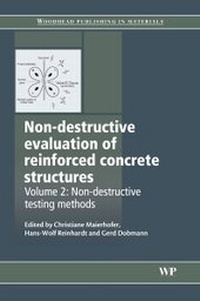
Non-Destructive Evaluation of Reinforced Concrete Structures
Non-Destructive Testing Methods
Published on 27. July 2010
Book
Hardback
624 pages
978-1-84569-950-5 (ISBN)
Description
Engineers have a range of sophisticated techniques at their disposal to evaluate the condition of reinforced concrete structures and non-destructive evaluation plays a key part in assessing and prioritising where money should be spent on repair or replacement of structurally deficient reinforced concrete structures. Non-destructive evaluation of reinforced concrete structures, Volume 2: Non-destructive testing methods reviews the latest non-destructive testing techniques for reinforced concrete structures and how they are used.
Part one discusses planning and implementing non-destructive testing of reinforced concrete structures with chapters on non-destructive testing methods for building diagnosis, development of automated NDE systems, structural health monitoring systems and data fusion. Part two reviews individual non-destructive testing techniques including wireless monitoring, electromagnetic and acoustic-elastic waves, laser-induced breakdown spectroscopy, acoustic emission evaluation, magnetic flux leakage, electrical resistivity, capacimetry, measuring the corrosion rate (polarization resistance) and the corrosion potential of reinforced concrete structures, ground penetrating radar, radar tomography, active thermography, nuclear magnetic resonance imaging, stress wave propagation, impact-echo, surface and guided wave techniques and ultrasonics. Part three covers case studies including inspection of concrete retaining walls using ground penetrating radar, acoustic emission and impact echo techniques and using ground penetrating radar to assess an eight-span post-tensioned viaduct.
With its distinguished editor and international team of contributors, Non-destructive evaluation of reinforced concrete structures, Volume 2: Non-destructive testing methods is a standard reference for civil and structural engineers as well as those concerned with making decisions regarding the safety of reinforced concrete structures.
Part one discusses planning and implementing non-destructive testing of reinforced concrete structures with chapters on non-destructive testing methods for building diagnosis, development of automated NDE systems, structural health monitoring systems and data fusion. Part two reviews individual non-destructive testing techniques including wireless monitoring, electromagnetic and acoustic-elastic waves, laser-induced breakdown spectroscopy, acoustic emission evaluation, magnetic flux leakage, electrical resistivity, capacimetry, measuring the corrosion rate (polarization resistance) and the corrosion potential of reinforced concrete structures, ground penetrating radar, radar tomography, active thermography, nuclear magnetic resonance imaging, stress wave propagation, impact-echo, surface and guided wave techniques and ultrasonics. Part three covers case studies including inspection of concrete retaining walls using ground penetrating radar, acoustic emission and impact echo techniques and using ground penetrating radar to assess an eight-span post-tensioned viaduct.
With its distinguished editor and international team of contributors, Non-destructive evaluation of reinforced concrete structures, Volume 2: Non-destructive testing methods is a standard reference for civil and structural engineers as well as those concerned with making decisions regarding the safety of reinforced concrete structures.
More details
Series
Language
English
Place of publication
Cambridge
United Kingdom
Publishing group
Elsevier Science & Technology
Target group
College/higher education
Professional and scholarly
Dimensions
Height: 234 mm
Width: 156 mm
Weight
1070 gr
ISBN-13
978-1-84569-950-5 (9781845699505)
Copyright in bibliographic data and cover images is held by Nielsen Book Services Limited or by the publishers or by their respective licensors: all rights reserved.
Schweitzer Classification
Other editions
Additional editions
Christiane Maierhofer | Hans-Wolf Reinhardt | Gerd Dobmann
Non-Destructive Evaluation of Reinforced Concrete Structures
Non-Destructive Testing Methods
E-Book
07/2010
Woodhead Publishing
€230.00
Available for download
Persons
Dr Christiane Maierhofer is an expert in NDT at the BAM Federal Institute for Materials Research and Testing, German.
Content
Part 1 Planning and implementing non-destructive testing of reinforced concrete structures: Planning a non-destructive test programme for reinforced concrete structures; Non-destructive testing methods for building diagnosis-state of the art and future trends; Development of automated non-destructive evaluation (NDE) systems for reinforced concrete structures and other applications; Structural health monitoring systems for reinforced concrete structures; Combining the results of different non-destructive evaluation techniques for reinforced concrete: Data fusion. Part 2 Individual non-destructive testing techniques: Wireless monitoring of reinforced concrete structures; Non-destructive testing of concrete with electromagnetic and acoustic-elastic waves: Data analysis; Non-destructive testing of concrete with electromagnetic acoustic-and elastic waves: Modelling and imaging; Laser-induced breakdown spectroscopy (LIBS) for the evaluation of reinforced concrete structures; Acoustic emission (AE) for the evaluation of reinforced concrete structures; Magnetic flux leakage (MFL) for the non-destructive evaluation of prestressed concrete structures; Electrical resistivity for the evaluation of reinforced concrete structures; Capacimetry for the evaluation of reinforced concrete structures; Techniques for measuring the corrosion rate (polarization resistance) and the corrosion potential of reinforced concrete structures; Ground penetrating radar for the evaluation of reinforced concrete structures; Radar tomography for the evaluation of reinforced concrete structures; Active thermography for the evaluation of reinforced concrete structures; Nuclear magnetic resonance imaging (NMR) for the evaluation of reinforced concrete structures; Stress wave propagation for evaluation of reinforced concrete structures; Surface wave techniques for the evaluation of concrete structures; Impact-echo techniques for the evaluation of concrete structures; Ultrasonic techniques for the evaluation of reinforced concrete structures. Part 3 Case studies: Inspection of concrete retaining walls using ground penetrating radar (GPR): A case study; Acoustic emission and impact-echo techniques for the evaluation of reinforced concrete structures: A case study; Using ground penetrating radar to assess an eight-span post-tensioned viaduct: A case study.