

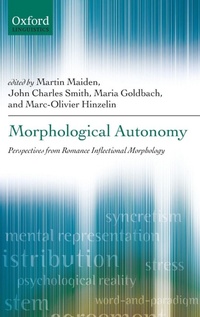
Morphological Autonomy
Perspectives From Romance Inflectional Morphology
Published on 25. August 2011
Book
Hardback
502 pages
978-0-19-958998-2 (ISBN)
Description
This book is about the nature of morphology and its place in the structure of grammar. Drawing on a wide range of aspects of Romance inflectional morphology, leading scholars present detailed arguments for the autonomy of morphology, ie morphology has phenomena and mechanisms of its own that are not reducible to syntax or phonology. But which principles and rules govern this independent component and which phenomena can be described or explicated by the mechanisms of the morphemic level? In shedding light on these questions, this volume constitutes a major contribution to Romance historical morphology in particular, and to our understanding of the nature and importance of morphomic structure in language change in general.
More details
Language
English
Place of publication
Oxford
United Kingdom
Target group
College/higher education
Illustrations
Tables
Dimensions
Height: 240 mm
Width: 161 mm
Thickness: 31 mm
Weight
913 gr
ISBN-13
978-0-19-958998-2 (9780199589982)
Copyright in bibliographic data and cover images is held by Nielsen Book Services Limited or by the publishers or by their respective licensors: all rights reserved.
Schweitzer Classification
Persons
Maria Goldbach studied linguistics of the Romance languages at the Universities of Aix-en-Provence and Hamburg. She was assistant professor for the linguistics of Romance languages at the University of Hamburg. Currently, she is a research assistant at the University of Oxford in the research project 'Autonomous Morphology in Diachrony: Comparative evidence from the Romance languages'
Marc-Olivier Hinzelin studied Romance and General Linguistics in Hamburg and Lyon 2. He worked as a Research Assistant in Hamburg and Konstanz as well as in the research project 'Autonomous Morphology in Diachrony: Comparative evidence from Romance Languages' in Oxford. He is now Maitre de Conferences at the Institut de Linguistique Romane Pierre Gardette at the Universite Catholique de Lyon.
Martin Maiden is Professor of the Romance Languages at the University of Oxford, the Director of the Research Centre for Romance Linguistics, University of Oxford, and Fellow of Trinity College at Oxford. His main research interests are historical and comparative linguistics of the Romance Languages, especially Romanian and Italo-Romance linguistics, and morphological theory.
John Charles Smith has been Fellow and Tutor in French Linguistics at St Catherine's College since 1997. Before returning to Oxford, where he was a student, he held appointments at the Universities of Surrey, Bath, and Manchester. He has also held visiting appointments in Paris, Limoges, Berlin, Melbourne, and Philadelphia. His main field of interest is historical morphosyntax, and he has published widely on agreement, refunctionalization, deixis, and the evolution of case and pronoun systems, with particular reference to Romance. He is Secretary of the International Society for Historical Linguistics, Deputy Director of the University of Oxford Research Centre for Romance Linguistics, and co-editor of the Cambridge History of the Romance Languages. In 2007, he was created chevalier dans l'ordre des Palmes academiques by the French Government, for services to the French language and French culture.
Marc-Olivier Hinzelin studied Romance and General Linguistics in Hamburg and Lyon 2. He worked as a Research Assistant in Hamburg and Konstanz as well as in the research project 'Autonomous Morphology in Diachrony: Comparative evidence from Romance Languages' in Oxford. He is now Maitre de Conferences at the Institut de Linguistique Romane Pierre Gardette at the Universite Catholique de Lyon.
Martin Maiden is Professor of the Romance Languages at the University of Oxford, the Director of the Research Centre for Romance Linguistics, University of Oxford, and Fellow of Trinity College at Oxford. His main research interests are historical and comparative linguistics of the Romance Languages, especially Romanian and Italo-Romance linguistics, and morphological theory.
John Charles Smith has been Fellow and Tutor in French Linguistics at St Catherine's College since 1997. Before returning to Oxford, where he was a student, he held appointments at the Universities of Surrey, Bath, and Manchester. He has also held visiting appointments in Paris, Limoges, Berlin, Melbourne, and Philadelphia. His main field of interest is historical morphosyntax, and he has published widely on agreement, refunctionalization, deixis, and the evolution of case and pronoun systems, with particular reference to Romance. He is Secretary of the International Society for Historical Linguistics, Deputy Director of the University of Oxford Research Centre for Romance Linguistics, and co-editor of the Cambridge History of the Romance Languages. In 2007, he was created chevalier dans l'ordre des Palmes academiques by the French Government, for services to the French language and French culture.
Content
PART 1: AUTONOMOUS MORPHOLOGY - CORROBORATIONS AND CHALLENGES; PART 2: EVOLUTION OF STEM ALLOMORPHY; PART 3: INTERFACES WITH SYNTAX OR SEMANTICS?