

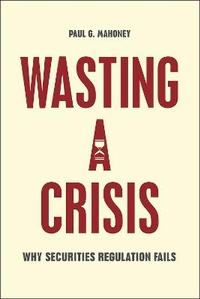
Wasting a Crisis
Why Securities Regulation Fails
Published on 23. March 2015
Book
Hardback
208 pages
978-0-226-23651-3 (ISBN)
Description
The recent financial crisis led to sweeping reforms that inspired countless references to the financial reforms of the New Deal. Comparable to the reforms of the New Deal in both scope and scale, the 2,300 - page Dodd-Frank Act of 2010 - the main regulatory reform package introduced in the United States - also shared with New Deal reforms the assumption that the underlying cause of the crisis was misbehavior by securities market participants, exacerbated by lax regulatory oversight. With Wasting a Crisis, Paul G. Mahoney offers persuasive research to show that this now almost universally accepted narrative of market failure - broadly similar across financial crises - is formulated by political actors hoping to deflect blame from prior policy errors. Drawing on a cache of data, from congressional investigations, litigation, regulatory reports, and filings to stock quotes from the 1920s and '30s, Mahoney moves beyond the received wisdom about the financial reforms of the New Deal, showing that lax regulation was not a substantial cause of the financial problems of the Great Depression.
As new regulations were formed around this narrative of market failure, not only were the majority largely ineffective, they were also often counter-productive, consolidating market share in the hands of leading financial firms. An overview of twenty-first-century securities reforms from the same analytic perspective, including Dodd-Frank and the Sarbanes-Oxley Act of 2002, shows a similar pattern and suggests that they too may offer little benefit to investors and some measurable harm.
As new regulations were formed around this narrative of market failure, not only were the majority largely ineffective, they were also often counter-productive, consolidating market share in the hands of leading financial firms. An overview of twenty-first-century securities reforms from the same analytic perspective, including Dodd-Frank and the Sarbanes-Oxley Act of 2002, shows a similar pattern and suggests that they too may offer little benefit to investors and some measurable harm.
Reviews / Votes
"Mahoney casts the foundational securities laws of the New Deal in a completely different light, going behind the assertions of contemporary commentators and providing compelling evidence that we ought to question their accuracy. This is a truly important book and a timely addition of a powerful contrarian view to today's policy discussions that tend to have a one-sided focus on the need for expanded regulation without regard to whether there is any supporting evidence for proposed policies." (Roberta Romano, Yale Law School)More details
Language
English
Place of publication
Chicago
United States
Publishing group
The University of Chicago Press
Target group
Professional and scholarly
Dimensions
Height: 24 mm
Width: 17 mm
Thickness: 2 mm
Weight
454 gr
ISBN-13
978-0-226-23651-3 (9780226236513)
Copyright in bibliographic data and cover images is held by Nielsen Book Services Limited or by the publishers or by their respective licensors: all rights reserved.
Schweitzer Classification
Other editions
Additional editions
E-Book
05/2024
1st Edition
University of Chicago Press
from
€28.80
Available for download
Person
Paul G. Mahoney is dean of the University of Virginia School of Law, where he is also the David and Mary Harrison Distinguished Professor of Law and the Arnold H. Leon Professor of Law.