

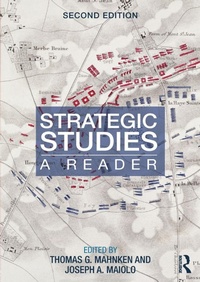
Strategic Studies
A Reader
2nd Edition
Published on 20. January 2014
Book
Paperback/Softback
472 pages
978-0-415-66112-6 (ISBN)
Description
The second edition of Strategic Studies: A Reader brings together key essays on strategic theory by some of the leading contributors to the field. This revised volume contains several new essays and updated introductions to each section.
The volume comprises hard-to-find classics in the field as well as the latest scholarship. The aim is to provide students with a wide-ranging survey of the key issues in strategic studies, and to provide an introduction to the main ideas and themes in the field. The book contains six extensive sections, each of which is prefaced by a short introductory essay:
The Uses of Strategic Theory
Interpretation of the Classics
Instruments of War, Intelligence and Deception
Nuclear Strategy
Irregular Warfare and Small Wars
Future Warfare, Future Strategy
Overall, this volume strikes a balance between theoretical works, which seek to discover generalisations about the nature of modern strategy, and case studies, which attempt to ground the study of strategy in the realities of modern war.
This new edition will be essential reading for all students of strategic studies, security studies, military history and war studies, as well as for professional military college students.
The volume comprises hard-to-find classics in the field as well as the latest scholarship. The aim is to provide students with a wide-ranging survey of the key issues in strategic studies, and to provide an introduction to the main ideas and themes in the field. The book contains six extensive sections, each of which is prefaced by a short introductory essay:
The Uses of Strategic Theory
Interpretation of the Classics
Instruments of War, Intelligence and Deception
Nuclear Strategy
Irregular Warfare and Small Wars
Future Warfare, Future Strategy
Overall, this volume strikes a balance between theoretical works, which seek to discover generalisations about the nature of modern strategy, and case studies, which attempt to ground the study of strategy in the realities of modern war.
This new edition will be essential reading for all students of strategic studies, security studies, military history and war studies, as well as for professional military college students.
Reviews / Votes
'a fine collection of strategic thought' -- Journal of Military History'An essential text for anyone interested in the development of strategic ideas.' -- Stephan Fruehling, Australian National University, Canberra
'The new volume makes an excellent contribution to the study of strategy, and to the ongoing debate on the complexity of strategy and the connection between security and strategy. It is also a great and highly recommended teaching tool for advanced course on strategic studies.' -- Mohiaddin Mesbahi, Florida International University
'By a wide margin this is the premier Reader in the field of Strategic Studies. For research as well as teaching it is an invaluable resource.' -- Colin S. Gray, University of Reading
'A brilliant, and unlike most edited collections, coherent, collection of essays by masters past and present on the theory and practice of strategy. A superb primer for any and all students of the subject.'-- Eliot A. Cohen, School of Advanced International Studies, Johns Hopkins University, Washington, DC 'A brilliant, and unlike most edited collections, coherent, collection of essays by masters past and present on the theory and practice of strategy. A superb primer for any and all students of the subject.'-- Eliot A. Cohen, School of Advanced International Studies, Johns Hopkins University, Washington, DC
'This superb volume provides an essential primer for any student of strategic studies.' -- Theo Farrell, Kings College London, UK
'By a wide margin this is the premier Reader in the field of Strategic Studies. For research as well as teaching it is an invaluable resource.' -- Colin S. Gray, University of Reading, UK
'a fine collection of strategic thought' -- Journal of Military History
'An essential text for anyone interested in the development of strategic ideas.' -- Stephan Fruehling, Australian National University, Canberra
'The new volume makes an excellent contribution to the study of strategy, and to the ongoing debate on the complexity of strategy and the connection between security and strategy. It is also a great and highly recommended teaching tool for advanced course on strategic studies.' -- Mohiaddin Mesbahi, Florida International University
More details
Edition
2nd edition
Language
English
Place of publication
London
United Kingdom
Publishing group
Taylor & Francis Ltd
Target group
College/higher education
Illustrations
10 s/w Zeichnungen, 2 s/w Tabellen
2 Tables, black and white; 10 Line drawings, black and white
Dimensions
Height: 246 mm
Width: 174 mm
Thickness: 25 mm
Weight
833 gr
ISBN-13
978-0-415-66112-6 (9780415661126)
Copyright in bibliographic data and cover images is held by Nielsen Book Services Limited or by the publishers or by their respective licensors: all rights reserved.
Schweitzer Classification
Other editions
Additional editions
Book
01/2014
2nd Edition
Routledge
€272.80
Shipment within 15-20 days
E-Book
01/2014
2nd Edition
Routledge
€100.99
Available for download
E-Book
01/2014
2nd Edition
Routledge
€100.99
Available for download
Previous edition
Book
03/2008
Routledge
€64.56
Article exhausted; check for reprint
Persons
Thomas G. Mahnken is currently Jerome E. Levy Chair of Economic Geography and National Security at the US Naval War College. He is also a Visiting Scholar at the Philip Merrill Center for Strategic Studies at The Johns Hopkins University's Paul H. Nitze School of Advanced International Studies (SAIS). He is the author of Uncovering Ways of War: U.S. Intelligence and Foreign Military Innovation, 1918-1941 (2002), (with James R. FitzSimonds) The Limits of Transformation: Officer Attitudes toward the Revolution in Military Affairs (2003), Technology and the American Way of War Since 1945 (2008), and Uncovering Ways of War: U.S. Intelligence and Foreign Military Innovation, 1918-1941 (2012). He is editor (with Emily O. Goldman) of The Information Revolution in Military Affairs in Asia (2004) and (with Richard K. Betts) Paradoxes of Strategic Intelligence: Essays in Honor of Michael I. Handel (Frank Cass, 2003). He is co-editor of the Journal of Strategic Studies.
Joseph A. Maiolo is Professor of International History in the Department of War Studies, King's College London, UK. He is author of The Royal Navy and Nazi Germany: A study in appeasement and the origins of the Second World War (1998) and Cry Havoc: How the Arms Race Drove the World to War 1931-1941 (2010); co-author of An International History of the Twentieth Century (Routledge, 2004, 2008); and co-editor (with Robert Boyce) The Origins of World War Two: The Debate Continues (2005). He is co-editor of the Journal of Strategic Studies.
Joseph A. Maiolo is Professor of International History in the Department of War Studies, King's College London, UK. He is author of The Royal Navy and Nazi Germany: A study in appeasement and the origins of the Second World War (1998) and Cry Havoc: How the Arms Race Drove the World to War 1931-1941 (2010); co-author of An International History of the Twentieth Century (Routledge, 2004, 2008); and co-editor (with Robert Boyce) The Origins of World War Two: The Debate Continues (2005). He is co-editor of the Journal of Strategic Studies.
Content
General introduction PART I: The uses of strategic theory Introduction 1. Strategic studies and the problem of power, LAWRENCE FREEDMAN 2. What is a military lesson?, WILLIAM C. FULLER, JR. 3. Why Strategy is Difficult, COLIN S. GRAY PART II: Interpretation of the classics Introduction 4. Who's Afraid of Carl von Clausewitz?: A Guide to the Perplexed, MICHAEL I. HANDEL 5. "The Art of War", SUN TZU 6. Strategy: the indirect approach, BASIL LIDDELL HART 7. Arms and In?uence, THOMAS C. SCHELLING PART III: Instruments of war: land, sea, and air power Introduction 8. Some principles of maritime strategy, JULIAN CORBETT 9. Kosovo and the great air power debate, DANIEL L. BYMAN AND MATTHEW C. WAXMAN 10. What's Wrong with the Intelligence Process?, ROBERT JERVIS 11. Deception and Intelligence Failure: Anglo-German Preparations for U-Boat Warfare in the 1930s, JOSEPH A. MAIOLO PART IV: Nuclear strategy Introduction 12. The absolute weapon, BERNARD BRODIE 13, The delicate balance of terror, ALBERT WOHLSTETTER 14. Attacking the Atom: Does Bombing Nuclear Facilities Affect Proliferation?, SARAH KREPS AND MATTHEW FUHRMANN PART V: Irregular warfare and small wars Introduction 15. Science of guerrilla warfare, T.E. LAWRENCE 16. Problems of strategy in China's civil war, MAO TSE TUNG 17. Strategic Terrorism: The Framework and its Fallacies, MICHAEL SMITH AND PETER NEUMANN 18. Hybrid Warfare and Challenges, FRANK G. HOFFMAN PART VI: Future warfare, future strategy Introduction 19. Weapons: The Growth and Spread of the Precision-Strike Regime, THOMAS G. MAHNKEN 20. The Revolution in Military Affairs with Chinese Characteristics, JACQUELINE NEWMYER 21. Iron Cannot Fight: The Role of Technology in Current Russian Military Theory, TOR BUKKVOLL 22. From Kadesh to Kandahar: military theory and the future of war, MICHAEL EVANS 23. Cyber War Will Not Take Place, THOMAS RID 24. The lost meaning of strategy HEW STRACHAN