

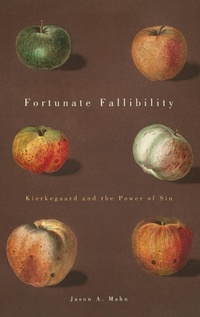
Fortunate Fallibility
Kierkegaard and the Power of Sin
1st Edition
Published on 28. July 2011
Book
Hardback
288 pages
978-0-19-979066-1 (ISBN)
Description
For more than 1,500 years, the claim that Adam's Fall might be considered 'fortunate' has been Christianity's most controversial and difficult idea. While keepers of the Easter vigil in the fifth century (and later John Milton) praised sin only as a backhanded witness to the ineffability of redemption, modern speculative theodicy came to understand all evil as comprehensible, historically productive, and therefore fortunate, while the romantic poets credited transgression with bolstering individual creativity and spirit.
Jason Mahn's compelling study examines Kierkegaard's ''para/orthodixical'' language of human fallibility and Christian sin. Mahn breaks down and reconstructs the concept of the fortunate Fall in Western thought, in context of Kierkegaard's later writings, examining Kierkegaard's blunt critique of Idealism's justification of evil, as well as his playful deconstruction of romantic celebrations of sin. Mahn also argues, though, that Kierkegaard resists the moralization of evil, preferring to consider temptation and sin as determinative dimensions of religious existence. In relation to the assumed ''innocence'' of Christendom's cultured Christians, the self-conscious sinner might be the better religious witness.
Although Mahn shows how Kierkegaard finally replaces actual sin with human fragility, temptation, and the possibility of spiritual offense as that which ''happily'' shapes religious faith, he cogently argues that Kierkegaard's understanding of ''fortunate fallibility'' is at least as rhetorically compelling and theologically operative as talk of a fortunate Fall. Mahn's insights into Kierkegaard's playful maneuvers encourages Christian theologians can speak of sin more particularly and peculiarly than in the typical discourses of church and culture.
Jason Mahn's compelling study examines Kierkegaard's ''para/orthodixical'' language of human fallibility and Christian sin. Mahn breaks down and reconstructs the concept of the fortunate Fall in Western thought, in context of Kierkegaard's later writings, examining Kierkegaard's blunt critique of Idealism's justification of evil, as well as his playful deconstruction of romantic celebrations of sin. Mahn also argues, though, that Kierkegaard resists the moralization of evil, preferring to consider temptation and sin as determinative dimensions of religious existence. In relation to the assumed ''innocence'' of Christendom's cultured Christians, the self-conscious sinner might be the better religious witness.
Although Mahn shows how Kierkegaard finally replaces actual sin with human fragility, temptation, and the possibility of spiritual offense as that which ''happily'' shapes religious faith, he cogently argues that Kierkegaard's understanding of ''fortunate fallibility'' is at least as rhetorically compelling and theologically operative as talk of a fortunate Fall. Mahn's insights into Kierkegaard's playful maneuvers encourages Christian theologians can speak of sin more particularly and peculiarly than in the typical discourses of church and culture.
Reviews / Votes
Mahns reading of Kierkegaard is both fresh and challenging, and there is a lot more material packed into 212 pages than one might expect. * Brian Gregor, Philosophy in Review *More details
Series
Language
English
Place of publication
New York
United States
Target group
College/higher education
Students and scholars of Kierkegaard, theodicy, religion and philosophy, theology
Dimensions
Height: 240 mm
Width: 161 mm
Thickness: 21 mm
Weight
642 gr
ISBN-13
978-0-19-979066-1 (9780199790661)
Copyright in bibliographic data and cover images is held by Nielsen Book Services Limited or by the publishers or by their respective licensors: all rights reserved.
Schweitzer Classification
Other editions
Additional editions
E-Book
09/2011
1st Edition
OUP eBook
€27.49
Available for download
Person
Assistant Professor of Religion, Augustana College
Content
Abbreviations ; Introduction: Fault and Fallibility ; Chapter 1: Figuring a Fortunate Fall ; Chapter 2: Felix Fragilitas in The Concept of Anxiety ; Chapter 3: Felix Fallibilitas in The Sickness unto Death ; Chapter 4: Felix Offensatio in Practice in Christianity ; Chapter 5: Felicitas: Between Cross and Resurrection ; Postscript: Christian Para/Orthodoxy: Toward a Postmodern Hamartiology