

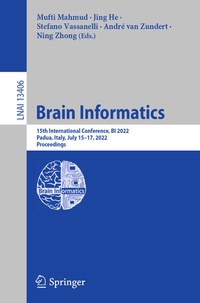
Brain Informatics
15th International Conference, BI 2022, Padua, Italy, July 15-17, 2022, Proceedings
Published on 20. August 2022
Book
Paperback/Softback
XII, 386 pages
978-3-031-15036-4 (ISBN)
Description
This book constitutes the refereed proceedings of the 15th International Conference on Brain Informatics, BI 2022, held as hybrid event in Padua, Italy (in person) and Queensland, Australia (online) in July 2022.
The 29 papers were selected from 65 submissions and the main theme of BI 2022 is Brain Science meets Artificial Intelligence with respect to the five tracks: Cognitive and computational foundations of brain science; human information processing systems; brain big data analytics, curation and management; informatics paradigms for brain and mental health research; and brain-machine intelligence and brain inspired computing.
More details
Series
Edition
1st ed. 2022
Language
English
Place of publication
Cham
Switzerland
Publishing group
Springer International Publishing
Target group
Professional and scholarly
Illustrations
26 s/w Abbildungen, 117 farbige Abbildungen
XII, 386 p. 143 illus., 117 illus. in color.
Dimensions
Height: 235 mm
Width: 155 mm
Thickness: 22 mm
Weight
604 gr
ISBN-13
978-3-031-15036-4 (9783031150364)
DOI
10.1007/978-3-031-15037-1
Schweitzer Classification
Other editions
Additional editions
Mufti Mahmud | Jing He | Stefano Vassanelli
Brain Informatics
15th International Conference, BI 2022, Padua, Italy, July 15-17, 2022, Proceedings
E-Book
08/2022
Springer
€80.24
Available for download
Content
Cognitive and Computational Foundations of Brain Science.- Estimating the Temporal Evolution of Synaptic Weights from Dynamic Functional Connectivity.- From concrete to abstract rules: A computational sketch.- Detection of Healthy and Unhealthy Brain States from Local Field Potentials using Machine Learning.- COSLETS: Recognition of Emotion Based on EEG signals.- Influences of Social Learning in Individual Perception and Decision Making in People with Autism: A Computational Approach.- Investigations of Human Information Processing Systems.- Analysis of Semantic Processes as an Indication for Focal Point Selection by Decomposing Alpha Frequency Band.- Toward the study of the neural-underpinnings of dyslexia during Final-phoneme Elision: A machine learning approach.- Root-Cause Analysis of Activation Cascade Differences in Brain Networks.- Unstructured Categorization with Probabilistic Feedback: Learning Accuracy versus Response Time.- Brain Big Data Analytics, Curation and Management.-Optimizing measures of information encoding in astrocytic calcium signals.- Introducing the Rank-Biased Overlap as Similarity measure for Feature Importance in Explainable Machine Learning: a case study on Parkinson's disease.- Prediction of neuropsychological scores from functional connectivity matrices using deep autoencoders.- Feature Fusion-Based Capsule Network for Cross-Subject Mental Workload Classification.- Brain Source Reconstruction Solution Quality Assessment with Spatial Graph Frequency Features.- Enhancing the MR Neuroimaging by Using the Deep Super-Resolution Reconstruction.- Towards Machine Learning Driven Self-guided Virtual Reality Exposure Therapy based on Arousal State Detection from Multimodal Data.- Convex Hull in Brain Tumor Segmentation.- Informatics Paradigms for Brain and Mental Health Research.- Computer Added Diagnosis Framework for ADHD Detection using Quantitative EEG.- A Machine Learning Approach for Early Detection of Postpartum Depression in Bangladesh.- Epilepsy Detection from EEG Data using a Hybrid CNN-LSTM Model.- Classifying Brain Tumor from MRI Images Using Parallel CNN Model.- Triplet-loss based Siamese Convolutional Neural Network for 4-Way Classification of Alzheimer's Disease.- Understanding syntax structure of language after a head injury.- A Belief Rule Based Expert System To Diagnose Alzheimer's disease Using Whole Blood Gene Expression Data.- Feature-selected Graph Spatial Attention Network for Addictive Brain-Networks Identification.- Brain-Machine Intelligence and Brain-Inspired Computing.- Biologically Inspired Neural Path Finding.- A Second-Order Adaptive Social-Behavioural Model for Individual and Duo Motor Learning.- EEG signal classification using Shallow FBCSP ConvNet with a new cropping strategy.- Becoming Attuned To Each Other Over Time: A Computational Neural Agent Model for the Role of Time Lags in Subjective Synchrony Detection and Related Behavioural Adaptivity.