

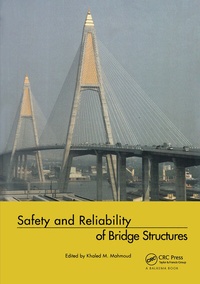
Safety and Reliability of Bridge Structures
1st Edition
Published on 21. September 2009
Book
Hardback
516 pages
978-0-415-56484-7 (ISBN)
Description
Recent surveys of the U.S. infrastructure's condition have rated a staggering number of bridges structurally deficient or functionally obsolete. While not necessarily unsafe, a structurally deficient bridge must be posted for weight and have limits for speed, due to its deteriorated structural components. Bridges with old design features that cannot safely accommodate current traffic volumes, and vehicle sizes and weights are classified as functionally obsolete. Such deficiencies may adversely affect the performance of transportation systems in emergency situations or for disaster response. This narrative has become part of the public debate sparked by the collapse of the I-35W Bridge over the Mississippi River in Minneapolis, Minnesota, USA, on August 1, 2007. Ever since, numerous technical and news articles have been written to answer the persistent question, why did the bridge collapse?
Exhaustive examination of the details of a specific bridge failure, typically, reveals the reasons for the collapse and lessons are drawn from the experience. Each bridge failure, since the Tacoma Narrows Bride disaster in 1940, has served as a wakeup call for the bridge engineering community, initiating radical changes in the design and construction standards. However, a paradigm shift is necessary in the inspection and monitoring practices of the bridge engineering community to provide preventive maintenance and restore the public's confidence in the safety of bridges.
Concerns about bridge safety and reliability go beyond geographical boundaries and are shared by bridge engineers from different countries. This book contains a number of selected papers that were presented at the Fifth New York City Bridge Conference, held on August 17-18, 2009. These papers cover a wide range of topics in the design, construction, maintenance, monitoring and rehabilitation of bridge structures.
Exhaustive examination of the details of a specific bridge failure, typically, reveals the reasons for the collapse and lessons are drawn from the experience. Each bridge failure, since the Tacoma Narrows Bride disaster in 1940, has served as a wakeup call for the bridge engineering community, initiating radical changes in the design and construction standards. However, a paradigm shift is necessary in the inspection and monitoring practices of the bridge engineering community to provide preventive maintenance and restore the public's confidence in the safety of bridges.
Concerns about bridge safety and reliability go beyond geographical boundaries and are shared by bridge engineers from different countries. This book contains a number of selected papers that were presented at the Fifth New York City Bridge Conference, held on August 17-18, 2009. These papers cover a wide range of topics in the design, construction, maintenance, monitoring and rehabilitation of bridge structures.
More details
Language
English
Place of publication
London
United Kingdom
Publishing group
Taylor & Francis Ltd
Target group
Professional and scholarly
Professional
Product notice
Paper over boards
Dimensions
Height: 246 mm
Width: 174 mm
Weight
1020 gr
ISBN-13
978-0-415-56484-7 (9780415564847)
Copyright in bibliographic data and cover images is held by Nielsen Book Services Limited or by the publishers or by their respective licensors: all rights reserved.
Schweitzer Classification
Other editions
Additional editions
Khaled Mahmoud
Safety and Reliability of Bridge Structures
E-Book
09/2009
1st Edition
CRC Press
€311.99
Available for download
Khaled Mahmoud
Safety and Reliability of Bridge Structures
E-Book
09/2009
CRC Press
€311.99
Available for download
Person
Bridge Technology Consulting, NYC, USA & Bridge Engineering Association, NYC, USA
Content
Preface
1 Bridge safety, analysis and design
2 Cable-supported bridges
3 Movable bridges
4 Advanced materials
5 Bridge instrumentation and monitoring
6 Bridge security and testing
7 Bridge inspection, management and assessment
8 Bridge construction, maintenance and retrofit
9 Bridge deck evaluation
10 Bridge history and aesthetics
Author index
1 Bridge safety, analysis and design
2 Cable-supported bridges
3 Movable bridges
4 Advanced materials
5 Bridge instrumentation and monitoring
6 Bridge security and testing
7 Bridge inspection, management and assessment
8 Bridge construction, maintenance and retrofit
9 Bridge deck evaluation
10 Bridge history and aesthetics
Author index