

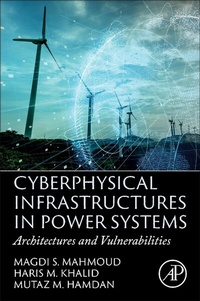
Cyberphysical Infrastructures in Power Systems
Architectures and Vulnerabilities
Published on 28. October 2021
Book
Paperback/Softback
424 pages
978-0-323-85261-6 (ISBN)
Description
In an uncertain and complex environment, to ensure secure and stable operations of large-scale power systems is one of the biggest challenges that power engineers have to address today. Traditionally, power system operations and decision-making in controls are based on power system computations of physical models describing the behavior of power systems. Largely, physical models are constructed according to some assumptions and simplifications, and such is the case with power system models. However, the complexity of power system stability problems, along with the system's inherent uncertainties and nonlinearities, can result in models that are impractical or inaccurate. This calls for adaptive or deep-learning algorithms to significantly improve current control schemes that solve decision and control problems.
Cyberphysical Infrastructures in Power Systems: Architectures and Vulnerabilities provides an extensive overview of CPS concepts and infrastructures in power systems with a focus on the current state-of-the-art research in this field. Detailed classifications are pursued highlighting existing solutions, problems, and developments in this area.
Cyberphysical Infrastructures in Power Systems: Architectures and Vulnerabilities provides an extensive overview of CPS concepts and infrastructures in power systems with a focus on the current state-of-the-art research in this field. Detailed classifications are pursued highlighting existing solutions, problems, and developments in this area.
More details
Language
English
Place of publication
Oxford
United Kingdom
Publishing group
Elsevier Science & Technology
Target group
Professional and scholarly
Primary market/audience: Senior undergraduates and graduates in power, energy, and systems engineering or computer science departments, and college researchers. Secondary market/audience: Process engineers, designers, power system operators, R&D engineers.
Product notice
Paperback (trade)
Dimensions
Height: 229 mm
Width: 152 mm
Thickness: 22 mm
Weight
568 gr
ISBN-13
978-0-323-85261-6 (9780323852616)
Copyright in bibliographic data and cover images is held by Nielsen Book Services Limited or by the publishers or by their respective licensors: all rights reserved.
Schweitzer Classification
Other editions
Additional editions
Magdi S. Mahmoud | Haris M. Khalid | Mutaz M. Hamdan
Cyberphysical Infrastructures in Power Systems
Architectures and Vulnerabilities
E-Book
10/2021
Academic Press
€131.00
Available for download
Persons
Magdi S. Mahmoud is a distinguished professor at King Fahd University of Petroleum and Minerals (KFUPM), Saudi Arabia. He has been faculty member at different universities worldwide including Egypt (CU, AUC), Kuwait (KU), UAE (UAEU), UK (UMIST), USA (Pitt, Case Western), Singapore (Nanyang), and Australia (Adelaide). He lectured in Venezuela (Caracas), Germany (Hanover), UK (Kent), USA (UoSA), Canada (Montreal) and China (BIT, Yanshan). He is the principal author of 51 books, inclusive book-chapters, and author/co-author of more than 610 peer-reviewed papers. He is a fellow of the IEE and a senior member of the IEEE, the CEI (UK). He is currently actively engaged in teaching and research in the development of modern methodologies to distributed control and filtering, networked control systems, fault-tolerant systems, cyberphysical systems, and information technology. Haris M. Khalid is currently an Assistant Professor in Electrical and Electronics Engineering with the Higher Colleges of Technology, Sharjah, UAE. He is an HEA Fellow and IEEE Senior Member. He has served as an Energy Specialist in UAE Space Agency "Tests in Orbit? Competitions, which are partnered with Dream-Up and Nano-Racks. His research interests include power systems, cyberphysical systems, and electric vehicles; signal processing, V2G technology, fault diagnostics, filtering, estimation, and condition monitoring. He is the Associate Editor of "Frontiers in Energy Research | Smart Grid". He is also a Reviewer for the "IEEE Transactions on Power Systems", "Transactions on Neural Networks and Learning Systems", "Transactions on Control of Network Systems", "Transactions on Transportation Electrification", and the "IEEE Systems Journal". Mutaz M. Hamdan obtained a Bachelor of Engineering degree (Honors) in Mechanical Engineering, Mechatronics Engineering Branch from the Palestine Polytechnic University, Hebron, Palestine, in 2006. He received a M.Sc. and a PhD in Systems and Control Engineering from the King Fahd University of Petroleum and Minerals (KFUPM), Dhahran, Saudi Arabia, in 2012 and 2019. He has authored several journal papers. He is currently a post-doctoral fellow at KFUPM, Saudi Arabia. His research interests include linear and nonlinear control systems, networked control systems, distributed control systems, and secure control systems.
Author
Distinguished Professor, Systems Engineering Department, King Fahd University of Petroleum and Minerals, Dhahran, Saudi Arabia
Assistant Professor, Department of Electrical and Electronics Engineering, Higher Colleges of Technology, UAE
Post-doctoral Fellow, Systems Engineering Department, King Fahd University of Petroleum and Minerals, Dhahran, Saudi Arabia
Content
Part I. Background
1. Overview
2. Smart grids: control and cybersecurity
Part II. Control, estimation, and fault detection
3. Safe control methods
4. Event-triggering control of cyberphysical power systems
5. Wide-area monitoring and estimation systems
Part III. Power systems' architectures
6. Future grid architectures
7. Mature industrial functions
8. Secure filtering in power systems
9. Basic mathematical tools
1. Overview
2. Smart grids: control and cybersecurity
Part II. Control, estimation, and fault detection
3. Safe control methods
4. Event-triggering control of cyberphysical power systems
5. Wide-area monitoring and estimation systems
Part III. Power systems' architectures
6. Future grid architectures
7. Mature industrial functions
8. Secure filtering in power systems
9. Basic mathematical tools