

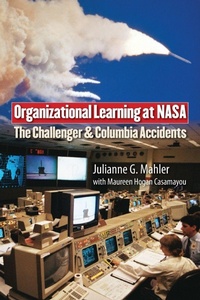
Organizational Learning at NASA
The Challenger and Columbia Accidents
Published on 27. March 2009
Book
Paperback/Softback
256 pages
978-1-58901-266-0 (ISBN)
Description
Just after 9:00 a.m. on February 1, 2003, the space shuttle Columbia broke apart and was lost over Texas. This tragic event led, as the Challenger accident had 17 years earlier, to an intensive government investigation of the technological and organizational causes of the accident. The investigation found chilling similarities between the two accidents, leading the Columbia Accident Investigation Board to conclude that NASA failed to learn from its earlier tragedy. Despite the frequency with which organizations are encouraged to adopt learning practices, organizational learning-especially in public organizations-is not well understood and deserves to be studied in more detail. This book fills that gap with a thorough examination of NASA's loss of the two shuttles. After offering an account of the processes that constitute organizational learning, Julianne G. Mahler focuses on what NASA did to address problems revealed by Challenger and its uneven efforts to institutionalize its own findings. She also suggests factors overlooked by both accident commissions and proposes broadly applicable hypotheses about learning in public organizations.
Reviews / Votes
Mahler and Casamayou make new and creative use of the well-studied NASA case; surface novel insights about NASA as a public organization that enhances our understanding of the subtle and complex organizational and managerial circumstances surrounding these accidents; and extend our conceptual understanding of organizational performance, reform, and change... This is a rich re-analysis of the organizational and managerial context of the Challenger and Columbia accidents... Offers a very worthwhile set of theoretical improvements and practical lessons. Journal of Public Administration Research and Theory [Offers] a well-organized, lucid and informative discussion both of organizational learning theory, and of relevant case details. It provides a well-balanced and evidence-based assessment of factors facilitating or inhibiting organizational learning processes. Moreover, this book is relatively unique in its case-based effort to refine and offer hypotheses relative to existing theory, while simultaneously providing practical insights for managers. The focus on underlying processes related to organizational learning is especially helpful because it renders the framework transferable across various public sector settings or events. Given the range of ongoing public sector concerns in complex and high risk areas such as health pandemics, nuclear proliferation and testing and international relations, this book will have broad relevance and appeal. Management Learning This book deepens our understanding of the complexities of learning processes in the public service context, but it should also be useful to all scholars of organizations and organizational learning for its detailed analysis of the non-learning and unlearning that occurred between the two disasters. Administrative Science QuarterlyMore details
Series
Language
English
Place of publication
Washington, DC
United States
Target group
Professional and scholarly
US School Grade: College Graduate Student and over
Product notice
Paperback (trade)
Illustrations
Not illustrated
Dimensions
Height: 226 mm
Width: 150 mm
Thickness: 18 mm
Weight
386 gr
ISBN-13
978-1-58901-266-0 (9781589012660)
Copyright in bibliographic data and cover images is held by Nielsen Book Services Limited or by the publishers or by their respective licensors: all rights reserved.
Schweitzer Classification
Other editions
Additional editions
E-Book
03/2009
Georgetown University Press
€31.99
Available for download
Persons
Julianne G. Mahler is an associate professor of government and politics at George Mason University. Maureen Hogan Casamayou is a former research fellow and guest scholar at the Brookings Institution, and she has taught at Georgetown University, Mount Vernon College, and George Mason University.
Content
Preface Part 1: Recognizing the Value of Organizational Learning1. Uncanny Similarities: The Challenger and Columbia Accidents2. Identifying Organizational LearningPart 2. Analyzing the Causes of the Shuttle Accidents 3. Structures for Processing Information4. Contractor Relations5. Political and Budgetary Pressures6. Organizational Culture Part 3: Institutionalizing Lessons about Public Organizational Learning7. The Challenges of Learning in Public Organizations8. Lessons from NASA about Organizational Learning References Index