

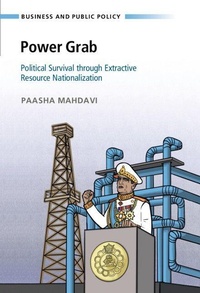
Power Grab
Political Survival through Extractive Resource Nationalization
Published on 2. April 2020
Book
Hardback
278 pages
978-1-108-47889-2 (ISBN)
Description
For rulers whose territories are blessed with extractive resources - such as petroleum, metals, and minerals that will power the clean energy transition - converting natural wealth into fiscal wealth is key. Squandering the opportunity to secure these revenues will guarantee short tenures, while capitalizing on windfalls and managing the resulting wealth will fortify the foundations of enduring rule. This book argues that leaders nationalize extractive resources to extend the duration of their power. By taking control of the means of production and establishing state-owned enterprises, leaders capture revenues that might otherwise flow to private firms, and use this increased capital to secure political support. Using a combination of case studies and cross-national statistical analysis with novel techniques, Mahdavi sketches the contours of a crucial political gamble: nationalize and reap immediate gains while risking future prosperity, or maintain private operations, thereby passing on revenue windfalls but securing long-term fiscal streams.
Reviews / Votes
'Political survival is essential to rulers. In this thoughtful and far-ranging new book, Paasha Mahdavi shows exactly how rulers use control over energy and mining companies to advance their own political survival - often at the peril of their own people and the planet.' David Victor, University of California, San Diego 'This is a very interesting and provocative book on a timely and important topic. It should be read with great interest by academics, policymakers, and students. It speaks to issues that concern comparative political science, international relations, industrial organization, and macroeconomics. The best part about it is that it transcends stale debates about whether there is or is not a resource curse; rather, Mahdavi looks at the causes and consequences of state run oil companies with fresh eyes and exploits original data to make a truly nuanced argument. In doing so, he has really pushed the ball forward and, hopefully, opened up a new research agenda. Bravo!' Victor Menaldo, University of Washington 'Mahdavi's Power Grab offers perhaps the most comprehensive and sophisticated analysis of oil nationalisation and re-nationalisation to date. By focusing on political leaders' perceptions of their probability of survival in oil rich states, it identifies an important paradox in the decision to nationalize: weaker leaders nationalize to bolster their power and become stronger as a result due to greater access to oil revenues, and yet, strong leaders opt not to nationalize, which serves to weaken their power by limiting their access to oil revenue. Power Grab thus offers important insight into the relationship between state ownership of the oil sector and regime survival.' Pauline Jones, Director, International Institute, University of Michigan 'Challenging conventional understandings of resource nationalization as the domain of strong rulers whose tenures are secure, Paasha Mahdavi carefully maps out and then demonstrates how much nationalization is in fact a strategy borne of political insecurity. Power Grab deftly weaves cross-national econometrics and carefully crafted comparative historical analysis to show how. Mahdavi's analysis of the domestic and global-economic milieu in which leaders like Qaddafi gambled on, and won through, resource seizures, represents an ambitious and formidable new scholarly voice in the study of resource politics.' Benjamin Smith, University of FloridaMore details
Series
Language
English
Place of publication
Cambridge
United Kingdom
Target group
Professional and scholarly
Product notice
sewn/stitched
Cloth over boards
Illustrations
Worked examples or Exercises; 16 Tables, black and white; 29 Line drawings, black and white
Dimensions
Height: 229 mm
Width: 152 mm
Thickness: 18 mm
Weight
540 gr
ISBN-13
978-1-108-47889-2 (9781108478892)
Copyright in bibliographic data and cover images is held by Nielsen Book Services Limited or by the publishers or by their respective licensors: all rights reserved.
Schweitzer Classification
Other editions
Additional editions
Book
03/2022
Cambridge University Press
€42.50
Shipment within 15-20 days
E-Book
04/2020
Cambridge University Press
€73.99
Available for download
E-Book
03/2020
Cambridge University Press
€25.99
Available for download
Person
Paasha Mahdavi is Assistant Professor of Political Science at the University of California, Santa Barbara. His research on energy governance and political economy has appeared in Comparative Political Studies, Nature Energy, and World Politics, among other journals, and has received media attention from The Financial Times, The Wall Street Journal, and The Washington Post. Mahdavi earned his M.S. in Statistics and his Ph.D. in Political Science from the University of California, Los Angeles. He has held fellowships at the Initiative for Sustainable Energy Policy, the Payne Institute, and the World Economic Forum, and currently serves as Term Member at the Council on Foreign Relations.
Content
1. The puzzle of extractive resource nationalization; 2. The theory of political survival through nationalization; 3. Defining and measuring operational nationalization; 4. Why nationalize? Evidence from national oil companies around the world; 5. NOCs, oil revenues, and leadership survival; 6. The dynamics of nationalization in Pahlavi Iran; 7. Conclusion: the implications of nationalization.