

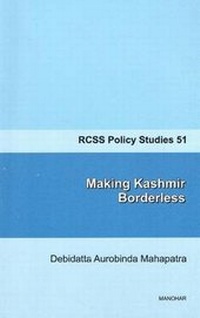
Making Kashmir Borderless
Published on 25. February 2013
Book
Paperback/Softback
84 pages
978-81-7304-989-7 (ISBN)
Description
The study builds on the proposition that in the globalised world, borders have escaped the realist State-centric encumbrance and attained new meanings as lines of contact, commerce and cooperation. It argues that Kashmir considered one of the most protracted conflicts in the world cannot escape from such an eclectic approach which not only refuses to accept violence as a method of conflict resolution but also widens the conflict discourse by locating not the States but the people at the centre-stage of conflict transformation. The study is motivated by two objectives. First, it aims to rescue the space inhabited by the borderlanders people who live on borders and become direct victims of violence as it views that space not as a piece of territory to be fought over but as a space in which borderlanders' identity, socio-cultural life, and economic livelihood thrived for centuries, even surpassing the lifespan of the current nation-state mechanism. Secondly, it scrutinizes the on-going bottom-up peace process in Kashmir, which amply indicates that the methods of violence have become obsolete; rather the motto peace through peaceful means' has gained increasing currency. Kashmir has emerged a prototype of this emerging reality despite myriad obstacles. Published in association with Regional Centre for Strategic Studies, Colombo.
More details
Language
English
Place of publication
New Delhi
India
Dimensions
Height: 215 mm
Width: 140 mm
Weight
124 gr
ISBN-13
978-81-7304-989-7 (9788173049897)
Copyright in bibliographic data and cover images is held by Nielsen Book Services Limited or by the publishers or by their respective licensors: all rights reserved.
Schweitzer Classification
Content
Introduction; Borders & Security; Cost of Artificial Divisions; Soft Border; Humanitarian Implications; Soft Border: Economic Implications; Opening Traditional Routes; Conclusion; Bibliography.