

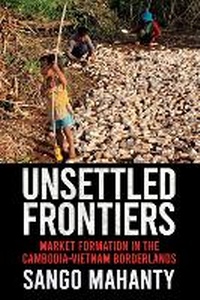
Unsettled Frontiers
Market Formation in the Cambodia-Vietnam Borderlands
Published on 15. February 2022
Book
Paperback/Softback
198 pages
978-1-5017-6148-5 (ISBN)
Description
Unsettled Frontiers provides a fresh view of how resource frontiers evolve over time. Since the French colonial era, the Cambodia-Vietnam borderlands have witnessed successive waves of market integration, migration, and disruption. The region has been reinvented and depleted as new commodities are exploited and transplanted: from vast French rubber plantations to the enforced collectivization of the Khmer Rouge; from intensive timber extraction to contemporary crop booms. The volatility that follows these changes has often proved challenging to govern.
Sango Mahanty explores the role of migration, land claiming, and expansive social and material networks in these transitions, which result in an unsettled frontier, always in flux, where communities continually strive for security within ruptured landscapes.
Sango Mahanty explores the role of migration, land claiming, and expansive social and material networks in these transitions, which result in an unsettled frontier, always in flux, where communities continually strive for security within ruptured landscapes.
Reviews / Votes
[W]hat readers expect is not only a well-rounded ethnography of a market rhizome, but also whether, and to what extent, the state of being in the borderland renders market formation rhizomic.(Journal of Contemporary Asia) Mahanty deftly weaves the story of a particular place within a broader tapestry of shifting market relations and integration, showing how markets are produced through the actions of individuals and families, the policies implemented by governments and other institutions, and the agency of nonhuman nature and the physical environment. Mahanty's accessible prose is complemented by excellent visuals, including clear and detailed maps of her study sites and her own photographs. The result is a text that is clear and compelling in its theoretical arguments but also an excellent resource for those interested in the Vietnam-Cambodia borderlands or the broader question of how markets take hold, how they change over time, and why efforts to govern them often fall short.
(Annals of the AAG) The landscapes of Cambodia are unsettled indeed, and Sango Mahanty capyures the frenetic and precarious effects of market formation n the state-created borderlines delineating (or connecting) Cambodia and Vietnam.
(Sojourn) Sango Mahanty's Unsettled Frontiers is an excellent addition to literature on Southeast Asian agrarian studies.
(Sojourn)
More details
Language
English
Place of publication
Ithaca
United States
Publishing group
Cornell University Press
Product notice
Paperback (trade)
Illustrations
9 b&w halftones, 4 maps, 4 charts - 4 Maps - 9 Halftones, black and white - 4 Charts
Dimensions
Height: 229 mm
Width: 152 mm
Thickness: 16 mm
Weight
454 gr
ISBN-13
978-1-5017-6148-5 (9781501761485)
Copyright in bibliographic data and cover images is held by Nielsen Book Services Limited or by the publishers or by their respective licensors: all rights reserved.
Schweitzer Classification
Other editions
Additional editions
E-Book
02/2022
Cornell University East Asia Program
€21.49
Available for download
Person
Sango Mahanty is Professor in the Resources, Environment, and Development Program at the Australian National University's Crawford School of Public Policy. She is the coauthor and coeditor of several books including Conservation and Development in Cambodia. Follow her on X @sangomahanty.
Content
Introduction: Frontiers in Flux
1. Rubber in French Indochina
2. Market Formation in Tbong Khmum Province
3. Mobilizing Cassava Networks in Mondulkiri
4. Frontier Rupture
5. Intervening in Market Formation
Conclusion: Reexamining Frontier Markets
1. Rubber in French Indochina
2. Market Formation in Tbong Khmum Province
3. Mobilizing Cassava Networks in Mondulkiri
4. Frontier Rupture
5. Intervening in Market Formation
Conclusion: Reexamining Frontier Markets