

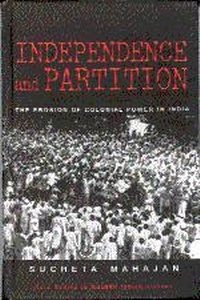
Independence and Partition
The Erosion of Colonial Power in India
1st Edition
Book
Paperback/Softback
428 pages
978-0-7619-9368-1 (ISBN)
Description
This book examines the interplay of imperial, national and communal conflicts during the most crucial phase of India's national movement. By looking at the independence and partition that took place between 1945 and 1947, it covers a wide range of political events and the positions taken by the British, the Congress, the Muslim league and Hindu communal forces.
More details
Series
Language
English
Place of publication
Thousand Oaks
United States
Target group
Professional and scholarly
ISBN-13
978-0-7619-9368-1 (9780761993681)
Copyright in bibliographic data and cover images is held by Nielsen Book Services Limited or by the publishers or by their respective licensors: all rights reserved.
Schweitzer Classification
Person
Sucheta Mahajan is Professor at the Centre for Historical Studies, Jawaharlal Nehru University, New Delhi. She has been Gillespie Visiting Professor at the College of Wooster, Ohio, US, a Fellow of the Indian Institute of Advanced Study, Fellow of the Rockefeller Foundation's Bellagio Center and a Visiting Professor at the Maison des Sciences de l' homme, Paris. Her significant books include Independence and Partition: The Erosion of Colonial Power in India (2000); India's Struggle for Independence (1988; with Bipan Chandra et al); RSS, School Texts and the Murder of Mahatma Gandhi- The Hindu Communal Project (2008; with Aditya and Mridula Mukherjee) and Education and Social Change: MVF and Child Labour (2008). She has also edited many books such as Rites of Passage, A Civil Servant Remembers: H.M. Patel ( 2005); Composite Culture in a Multi-Cultural Society (co-edited with Bipan Chandra), and most recently, Towards Freedom 1947: Documents on India's Freedom Struggle (2013). Her fields of interest span the short and long history of the twentieth century, its politics, political economy and social change.
Content
PART ONE: BACKGROUND
Nationalist Activity and Government Response at the End of the War
Planning of the Political Offer, the Simla Conference and its Breakdown
PART TWO: IMPERIALISM AND NATIONALISM
Congress Strategy and Popular Nationalist Activity
'Popular Movements'
Myth and Reality
Imperial Hegemony and Colonial Policy
PART THREE: IMPERIALISM, NATIONALISM AND COMMUNALISM
'Unite and Quit'
'Decide on a Date and Quit'
'Divide and Quit'
PART FOUR: NATIONALISM AND COMMUNALISM
Congress and the Muslim League's Demand for Pakistan
Two Faces of Hindu Communalism
Majority Reaction, Minority Fears
Hindu Communal Pressure on the Congress
PART FIVE: DENOUEMENT
Congress Accepts Partition
Why Gandhi Accepted the Decision to Partition India
Nationalist Activity and Government Response at the End of the War
Planning of the Political Offer, the Simla Conference and its Breakdown
PART TWO: IMPERIALISM AND NATIONALISM
Congress Strategy and Popular Nationalist Activity
'Popular Movements'
Myth and Reality
Imperial Hegemony and Colonial Policy
PART THREE: IMPERIALISM, NATIONALISM AND COMMUNALISM
'Unite and Quit'
'Decide on a Date and Quit'
'Divide and Quit'
PART FOUR: NATIONALISM AND COMMUNALISM
Congress and the Muslim League's Demand for Pakistan
Two Faces of Hindu Communalism
Majority Reaction, Minority Fears
Hindu Communal Pressure on the Congress
PART FIVE: DENOUEMENT
Congress Accepts Partition
Why Gandhi Accepted the Decision to Partition India