

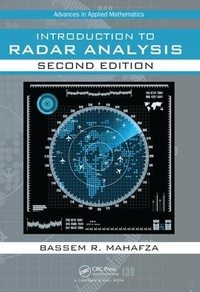
Introduction to Radar Analysis
2nd Edition
Published on 20. November 2017
Book
Hardback
460 pages
978-1-4987-6107-9 (ISBN)
Description
Introduction to Radar Analysis, Second Edition is a major revision of the popular textbook. It is written within the context of communication theory as well as the theory of signals and noise. By emphasizing principles and fundamentals, the textbook serves as a vital source for students and engineers.
Part I bridges the gap between communication, signal analysis, and radar. Topics include modulation techniques and associated Continuous Wave (CW) and pulsed radar systems.
Part II is devoted to radar signal processing and pulse compression techniques.
Part III presents special topics in radar systems including radar detection, radar clutter, target tracking, phased arrays, and Synthetic Aperture Radar (SAR).
Many new exercise are included and the author provides comprehensive easy-to-follow mathematical derivations of all key equations and formulas.
The author has worked extensively for the U.S. Army, the U.S. Space and Missile Command, and other military agencies. This is not just a textbook for senior level and graduates students, but a valuable tool for practicing radar engineers.
Features
Authored by a leading industry radar professional.
Comprehensive up-to-date coverage of radar systems analysis issues.
Easy to follow mathematical derivations of all equations and formulas
Numerous graphical plots and table format outputs. One part of the book is dedicated to radar waveforms and radar signal processing.
Part I bridges the gap between communication, signal analysis, and radar. Topics include modulation techniques and associated Continuous Wave (CW) and pulsed radar systems.
Part II is devoted to radar signal processing and pulse compression techniques.
Part III presents special topics in radar systems including radar detection, radar clutter, target tracking, phased arrays, and Synthetic Aperture Radar (SAR).
Many new exercise are included and the author provides comprehensive easy-to-follow mathematical derivations of all key equations and formulas.
The author has worked extensively for the U.S. Army, the U.S. Space and Missile Command, and other military agencies. This is not just a textbook for senior level and graduates students, but a valuable tool for practicing radar engineers.
Features
Authored by a leading industry radar professional.
Comprehensive up-to-date coverage of radar systems analysis issues.
Easy to follow mathematical derivations of all equations and formulas
Numerous graphical plots and table format outputs. One part of the book is dedicated to radar waveforms and radar signal processing.
More details
Series
Edition
2nd edition
Language
English
Place of publication
Oxford
United States
Publishing group
Taylor & Francis Inc
Target group
College/higher education
Illustrations
456 s/w Abbildungen, 33 s/w Tabellen
33 Tables, black and white; 456 Illustrations, black and white
Dimensions
Height: 254 mm
Width: 178 mm
Weight
964 gr
ISBN-13
978-1-4987-6107-9 (9781498761079)
Copyright in bibliographic data and cover images is held by Nielsen Book Services Limited or by the publishers or by their respective licensors: all rights reserved.
Schweitzer Classification
Other editions
Additional editions
Bassem R. Mahafza
Introduction to Radar Analysis
Book
01/2023
2nd Edition
Chapman & Hall/CRC
€68.00
Shipment within 10-20 days
Bassem R. Mahafza
Introduction to Radar Analysis
E-Book
11/2017
2nd Edition
Chapman & Hall/CRC
€65.99
Available for download
Bassem R. Mahafza
Introduction to Radar Analysis
E-Book
11/2017
2nd Edition
Chapman & Hall/CRC
€65.99
Available for download
Previous edition
Bassem R. Mahafza
Introduction to Rardar Analysis
Book
05/1998
1st Edition
CRC Press
€146.08
Article exhausted; check for reprint
Person
The author is Founder, Principal, and Chief Engineer of deciBel Research, Inc,.specializing in radar systems and associated sensors technologies. At the University of Alabama in Huntsville (UAH) he served as a graduate committee chair, co-chair, and surrogate chair. He published numerous technical referred / journal papers as well as referred conference papers. He continues to teach on different topics of radar systems using several venues. He has taught courses directly to the US Army, US Air Force, and industry engineers as well as through the Continued Education program at the UAH, and the Advanced Technology Institute which is affiliated with the John Hopkins University in Maryland. The author has worked for the US Army, US Space and Missile Command, the Missile Defense Agency, and the US Army Aviation and Missile Command. I started my industry career as a senior scientist at KBM Enterprises and shortly after that at COLSA Corporation. The author founded decibal Research, Inc. in 2002.
Content
Part I - Continuous Wave (CW) and Pulsed Radar Systems Chapter 1 - Continuous and Discrete Time Domain Signal Analysis; Chapter 2 - Radar Types and the Radar Equation; Part II - Radar Subsystems; Chapter 3 - Radar Array Antennas; Chapter 4 - Radar Signal Processing; Chapter 5 - The Ambiguity Function; Chapter 6 - Pulse Compression; Chapter 7 - Probability of Detection Calculations; Chapter 8 - Radar Clutter; Part III - Special Topics in Radars; Chapter 9 - Moving Target Indicator (MTI); Chapter 10 - Environmental Effects; Chapter 11: Target Tracking; Chapter 12 - Synthetic Aperture Radar; Appendix A: Fourier Transform Table; Appendix B: Some Common Probability Densities; Appendix C: Z Transform Table; Bibliography; Index