

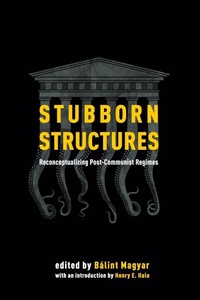
Stubborn Structures
Reconceptualizing Post-Communist Regimes
Published on 10. April 2019
Book
Paperback/Softback
712 pages
978-963-386-214-8 (ISBN)
Description
The editor of this book has brought together contributions designed to capture the essence of post-communist politics in East-Central Europe and Eurasia. Rather than on the surface structures of nominal democracies, the nineteen essays focus on the informal, often intentionally hidden, disguised and illicit understandings and arrangements that penetrate formal institutions. These phenomena often escape even the best-trained outside observers, familiar with the concepts of established democracies. Contributors to this book share the view that understanding post-communist politics is best served by a framework that builds from the ground up, proceeding from a fundamental social context.
The book aims at facilitating a lexical convergence; in the absence of a robust vocabulary for describing and discussing these often highly complex informal phenomena, the authors wish to advance a new terminology of post-communist regimes. Instead of a finite dictionary, a kind of conceptual cornucopia is offered. The resulting variety reflects a larger harmony of purpose that can significantly expand the understanding the "real politics" of post-communist regimes. Countries analyzed from a variety of aspects, comparatively or as single case studies, include Azerbaijan, Belarus, Georgia, Hungary, Kyrgyzstan, Moldova, Poland, Romania, Russia, and Ukraine.
The book aims at facilitating a lexical convergence; in the absence of a robust vocabulary for describing and discussing these often highly complex informal phenomena, the authors wish to advance a new terminology of post-communist regimes. Instead of a finite dictionary, a kind of conceptual cornucopia is offered. The resulting variety reflects a larger harmony of purpose that can significantly expand the understanding the "real politics" of post-communist regimes. Countries analyzed from a variety of aspects, comparatively or as single case studies, include Azerbaijan, Belarus, Georgia, Hungary, Kyrgyzstan, Moldova, Poland, Romania, Russia, and Ukraine.
Reviews / Votes
"The Hungarian sociologist Balint Magyar, who created the concept of the 'post-Communist mafia state,' has just finished editing a new collection of articles called 'Stubborn Structures: Reconceptualizing Post-Communist Regimes' (to be published by C.E.U. Press early this year). In one of his own pieces in the collection, using Russia as an example, Magyar describes the Mafia state as one run by a 'patron' and his 'court'-put another way, the boss and his clan-who appropriate public resources and the institutions of the state for their private use and profit." * New Yorker * "All in all, this is a wonderful collection of essays, a fertile marriage between Hale and Magyar with many splendid applications of their theories to many interesting countries and far-reaching implications for countries beyond the former USSR and East European post-communist world, and not only for China, but also for the Middle East, Africa, Latin America, and the emergent trend to limit the separation of branches of power even in countries we normally label as liberal democracies (like Trump's vision of the United States)." * Theory and Society * "Auf der politischen Ebene diskutiert der Band die Genese und die Funktionsweisen au-toritaerer Herrschaft im Postkommunismus. Die Wege fuehrten nach 1989/91 nicht in die Demokratie, aber es ging doch weiter in Richtung Divergenz. Die Uniformitaet der kommunistischen AEra ist in unserer autoritaeren Epoche passe. Dennoch sind die politischen Systeme der Region auf unterschiedliche Weise durch patrimoniale Strukturen, regionale "Clans" und fehlende Rechtsstaatlichkeit gepraegt. Die enge Steue-rung politischer Parteien, die Kontrolle von Wahlen und die Zensur treten als weitere Merkmale hervor. Ein weiterer Schwerpunkt des Bandes liegt in der Analyse postkommunistischer Wirt-schaftsstrukturen. Wiederum zeigt sich das Erbe der Vergangenheit: einerseits in der Kon-tinuitaet der Eliten und andererseits in der engmaschigen Verknuepfung zwischen Macht und (prekaerem) Eigentum. Als Gemeinsamkeit laesst sich die Entstehung von Rentenoekonomien beobachten, deren Ertraege insbesondere der politischen Klasse und ihren Verbuendeten zu-fliessen." * Journal of East Central European Studies * "All contributors, apart from Hale, come from post-communist countries, making this edited volume a forum for scholars with a deep personal knowledge of the region and an eye for details that may well escape an outside observer... A significant attempt to advance the understanding of post-communist regimes and an ambitious step towards a new conceptual framework to better describe countries increasingly thought to be no longer in transition to democracy." -- Levan Kakhisvili * Europe-Asia Studies * "???? ??????? ?????? ??????????? ????? ????????????? ????? ??? ???????? ???????????????????? ??????? ?????, ??????????, ?????????. ???????????? ??????????? ??????? ??????, ? ?????? ???????? ????? ???????? ???????????? ???????? ? ??????? ????? ??? ??????? ?????????? ????????????. ????????????? ???? ?? ?????? ???????? ???????????? ????????? ???????? ???????? ??? ??????? ????????????? ????????. ?????? ????? ??????????? ? ?. ?????? ? ???, ??? ????????????? ??????? <<????????? ???? ????????? ???????????????????? ???????>>, ? ??????, ?? ????? ???? ????? ???????????? ??? ????????? ????, ?????????????? ?????????? ??????????????." -- ???????? ?. ?. * ???????/Polylogos *More details
Language
English
Place of publication
Budapest
Hungary
Target group
Professional and scholarly
Academic
Product notice
Paperback (trade)
Unsewn / adhesive bound
Dimensions
Height: 229 mm
Width: 152 mm
Thickness: 38 mm
Weight
1013 gr
ISBN-13
978-963-386-214-8 (9789633862148)
Copyright in bibliographic data and cover images is held by Nielsen Book Services Limited or by the publishers or by their respective licensors: all rights reserved.
Schweitzer Classification
Other editions
Additional editions
E-Book
04/2019
1st Edition
Central European University Press
€47.49
Available for download
Person
Balint Magyar is Research Fellow at CEU Democracy Institute, working on the subject of patronalism in post-communist countries.
He was a member of the Hungarian Parliament (1990-2010). As a Minister of Education (1996-1998; 2002-2006) he initiated and carried out reforms in public and higher education.
Henry E. Hale is Professor of Political Science and International Affairs at the Elliott School of International Affairs, George Washington University.
He was a member of the Hungarian Parliament (1990-2010). As a Minister of Education (1996-1998; 2002-2006) he initiated and carried out reforms in public and higher education.
Henry E. Hale is Professor of Political Science and International Affairs at the Elliott School of International Affairs, George Washington University.
Content
List of Figures, List of Tables, Editor's Preface, I. CONCEPTUAL FRAMEWORKS Henry E. Hale: Freeing Post-Soviet Regimes from the Procrustean Bed of Democracy Theory, Janos Kornai: The System Paradigm Revisited: Clarification and Additions in the Light Of Experiences in the Post-Communist Region, Oleksandr Fisun: Neopatrimonialism in Post-Soviet Eurasia, Balint Magyar: Towards a Terminology for Post-communist Regimes, II. ACTORS OF POWER Nikolay Petrov: Putin's Neo-Nomenklatura System and its Evolution, Mikhail Minakov: Republic of Clans: The Evolution of the Ukrainian Political System, Uladzimir Rouda: Is Belarus a Classic Post-Communist Mafia State?, Laszlo Nandor Magyari: The Romanian Patronal System of Public Corruption, III. TECHNIQUES AND TOOLS Zoltan Sz. Biro: The Russian Party System, Andrei Kazakevich: The Belarusian Non-Party Political System: Government, Trust and Institutions, 1990-2015, Miklos Haraszti: Illiberal State Censorship: A Must-have Accessory for Any Mafia State, Dumitru Minzarari: Disarming Public Protests in Russia: Transforming Public Goods into Private Goods, IV. WEALTH AND OWNERSHIP Andrey Ryabov: The Institution of Power & Ownership in the Former USSR: Origin, Diversity of Forms, and Influence on Transformation Processes, Ilja Viktorov: Russia's Network State and Reiderstvo Practices: The Roots to Weak Property Rights Protection after the post-Communist Transition, Balint Magyar: From Free Market Corruption Risk to the Certainty of a State-Run Criminal Organization (using Hungary as an example) V. CONTRASTS AND CONNECTIONS, Alexei Pikulik: Belarus, Russia, and Ukraine as Post-Soviet Rent[1]Seeking Regimes, Sarah Chayes: The Structure of Corruption: A Systemic Analysis, Kalman Mizsei: The New East European Patronal States and the Rule-of-Law, Balint Magyar: Parallel System Narratives-Polish and Hungarian Regime Formations Compared, List of Contributors , Index.