

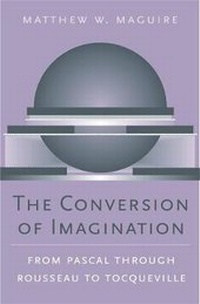
The Conversion of Imagination
From Pascal through Rousseau to Tocqueville
Published on 1. March 2006
Book
Hardback
298 pages
978-0-674-02188-4 (ISBN)
Description
From romanticism through postmodernism, the imagination has become an indispensable reference point for thinking about the self, culture, philosophy, and politics. How has imagination so thoroughly influenced our understanding of experience and its possibilities? In a bold reinterpretation of a crucial development in modern European intellectual history, Matthew W. Maguire uncovers a history of French thought that casts the imagination as a dominant faculty in our experience of the world.
Pascal, turning Augustinianism inside out, radically expanded the powers of imagination implicit in the work of Montaigne and Descartes, and made imagination the determinative faculty of everything from meaning and beauty to political legitimacy and happiness. Maguire traces the ways that others, including Montesquieu and Voltaire, developed and assigned limits to this exalted imagination. But it is above all Rousseau's diverse writings that engage with an expansive imagination. And in the writings of Rousseau's careful readers, particularly Alexis de Tocqueville, imagination is increasingly understood as the medium for an ineffable human freedom against the constrictive power of a new order in politics and culture.
Original and thought-provoking, The Conversion of Imagination will interest a range of readers across intellectual history, political theory, literary and cultural studies, and the history of religious thought.
Pascal, turning Augustinianism inside out, radically expanded the powers of imagination implicit in the work of Montaigne and Descartes, and made imagination the determinative faculty of everything from meaning and beauty to political legitimacy and happiness. Maguire traces the ways that others, including Montesquieu and Voltaire, developed and assigned limits to this exalted imagination. But it is above all Rousseau's diverse writings that engage with an expansive imagination. And in the writings of Rousseau's careful readers, particularly Alexis de Tocqueville, imagination is increasingly understood as the medium for an ineffable human freedom against the constrictive power of a new order in politics and culture.
Original and thought-provoking, The Conversion of Imagination will interest a range of readers across intellectual history, political theory, literary and cultural studies, and the history of religious thought.
Reviews / Votes
A fascinating, dense, mind-stretching, admirably thoughtful book that makes an original argument and is full of arresting and illuminating insights. One comes away from the book with a new sense of the coherence of Rousseau's thought and with new insight into many of the other writers considered--Pascal and Tocqueville to be sure, but also Montesquieu, Constant, Stendhal, and others. It is a book that is at once illuminating and highly personal, a book that allows us to see familiar works in new ways and casts a bright light on the complex role that the idea of imagination has played in the work of some of the most important French thinkers and writers since the seventeenth century. -- Jonathan Beecher, University of California, Santa Cruz In this bold book on the expansion of the imagination, Maguire shows how a single faculty of the soul takes over virtually the whole of the soul's functions, transforming them all. He traces how Rousseau and some of his heirs struggle with the consequences of an exalted imagination, which both constitutes and threatens to destroy the self. This impressive work opens up fresh and provocative perspectives on every thinker it treats. -- Christopher J. Kelly, Boston College Maguire's book is a superb exercise in the study of an idea. Historically the imagination was deemed not much more than one of the senses and always subordinate to the dominion of reason...Like many studies in this genre Maguire's ranges widely, is thickly referenced, and abounds in rich insights. In a final chapter on Tocqueville he has some provocative (although not entirely flattering) things to say about the relationship between imagination and democracy that are very germane at a time when many Americans are worried about the integrity of their political institutions. -- B. G. Murchland * Choice *More details
Series
Language
English
Place of publication
Cambridge, Mass
United States
Target group
College/higher education
Illustrations
none
Dimensions
Height: 235 mm
Width: 156 mm
Thickness: 25 mm
Weight
590 gr
ISBN-13
978-0-674-02188-4 (9780674021884)
Copyright in bibliographic data and cover images is held by Nielsen Book Services Limited or by the publishers or by their respective licensors: all rights reserved.
Schweitzer Classification
Other editions
Additional editions
E-Book
03/2006
Harvard University Press
€182.99
Available for download
Person
Matthew W. Maguire is Assistant Professor of History and Humanities at Kenyon College.
Content
Introduction 1. Pascal: Imagining Memory 2. The Imagination of Reason 3. Rousseau and the Revolution of Enlightenment 4. Illusion's Reflection: Rousseau's Julie 5. The Consuming Infinite 6. Rousseau, and Restoration: Imagination and Memory 7. The Gravity of Illusion: Alexis de Tocqueville Conclusion Notes Index