

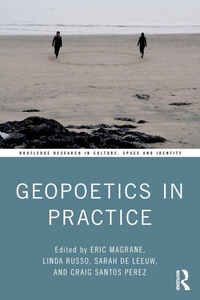
Geopoetics in Practice
1st Edition
Published on 18. December 2019
Book
Paperback/Softback
380 pages
978-0-367-14538-5 (ISBN)
Description
This breakthrough book examines dynamic intersections of poetics and geography. Gathering the essays of an international cohort whose work converges at the crossroads of poetics and the material world, Geopoetics in Practice offers insights into poetry, place, ecology, and writing the world through a critical-creative geographic lens.
This collection approaches geopoetics as a practice by bringing together contemporary geographers, poets, and artists who contribute their research, methodologies, and creative writing. The 24 chapters, divided into the sections "Documenting," "Reading," and "Intervening," poetically engage discourses about space, power, difference, and landscape, as well as about human, non-human, and more-than-human relationships with Earth. Key explorations of this edited volume include how poets engage with geographical phenomena through poetry and how geographers use creativity to explore space, place, and environment.
This book makes a major contribution to the geohumanities and creative geographies by presenting geopoetics as a practice that compels its agents to take action. It will appeal to academics and students in the fields of creative writing, literature, geography, and the environmental and spatial humanities, as well as to readers from outside of the academy interested in where poetry and place overlap.
This collection approaches geopoetics as a practice by bringing together contemporary geographers, poets, and artists who contribute their research, methodologies, and creative writing. The 24 chapters, divided into the sections "Documenting," "Reading," and "Intervening," poetically engage discourses about space, power, difference, and landscape, as well as about human, non-human, and more-than-human relationships with Earth. Key explorations of this edited volume include how poets engage with geographical phenomena through poetry and how geographers use creativity to explore space, place, and environment.
This book makes a major contribution to the geohumanities and creative geographies by presenting geopoetics as a practice that compels its agents to take action. It will appeal to academics and students in the fields of creative writing, literature, geography, and the environmental and spatial humanities, as well as to readers from outside of the academy interested in where poetry and place overlap.
More details
Series
Language
English
Place of publication
London
United Kingdom
Publishing group
Taylor & Francis Ltd
Target group
College/higher education
Professional and scholarly
Illustrations
1 s/w Tabelle, 28 s/w Abbildungen, 28 s/w Photographien bzw. Rasterbilder
1 Tables, black and white; 28 Halftones, black and white; 28 Illustrations, black and white
Dimensions
Height: 234 mm
Width: 156 mm
Thickness: 21 mm
Weight
600 gr
ISBN-13
978-0-367-14538-5 (9780367145385)
Copyright in bibliographic data and cover images is held by Nielsen Book Services Limited or by the publishers or by their respective licensors: all rights reserved.
Schweitzer Classification
Other editions
Additional editions
Eric Magrane | Linda Russo | Sarah de Leeuw
Geopoetics in Practice
E-Book
12/2019
1st Edition
Routledge
€52.49
Available for download
Eric Magrane | Linda Russo | Sarah de Leeuw
Geopoetics in Practice
E-Book
12/2019
1st Edition
Routledge
€52.49
Available for download
Eric Magrane | Linda Russo | Sarah de Leeuw
Geopoetics in Practice
Book
12/2019
1st Edition
Routledge
€207.50
Shipment within 15-20 days
Persons
Eric Magrane is an assistant professor of geography at New Mexico State University. His work takes multiple forms, from scholarly to literary to artistic. He is co-editor of the hybrid field guide/anthology The Sonoran Desert: A Literary Field Guide.
Linda Russo, a clinical associate professor at Washington State University, teaches creative writing and literature and directs EcoArts on the Palouse. Her published works include Meaning to Go to the Origin in Some Way and Participant, both poetry, and the co-edited Counter-Desecration: A Glossary for Writing Within the Anthropocene.
Sarah de Leeuw, a professor with the Northern Medical Program of UBC's Faculty of Medicine, is a poet, critical geographer, and anti-colonial feminist researcher whose multidisciplinary work focuses on marginalized peoples and places. She is the author of multiple journal papers, entries, chapters, and books (both creative and academic), and a Canada Research Chair in Humanities and Health Inequities.
Craig Santos Perez is an Indigenous Chamorro poet and scholar from the Pacific Island of Guam. He is the author of four collections of poetry and the co-editor of three anthologies. He is an associate professor in the English department at the University of Hawai'i, Manoa.
Linda Russo, a clinical associate professor at Washington State University, teaches creative writing and literature and directs EcoArts on the Palouse. Her published works include Meaning to Go to the Origin in Some Way and Participant, both poetry, and the co-edited Counter-Desecration: A Glossary for Writing Within the Anthropocene.
Sarah de Leeuw, a professor with the Northern Medical Program of UBC's Faculty of Medicine, is a poet, critical geographer, and anti-colonial feminist researcher whose multidisciplinary work focuses on marginalized peoples and places. She is the author of multiple journal papers, entries, chapters, and books (both creative and academic), and a Canada Research Chair in Humanities and Health Inequities.
Craig Santos Perez is an Indigenous Chamorro poet and scholar from the Pacific Island of Guam. He is the author of four collections of poetry and the co-editor of three anthologies. He is an associate professor in the English department at the University of Hawai'i, Manoa.
Content
List of Tables and Figures; Preface; Introduction: Geopoetics as Route-Finding; Part 1: Documenting 1. Bodies Belong to the World: On Place, Visuality, and Vulnerability; 2. A Cosmology of Nibi: Picto-Poetics and Palimpsest in Anishinaabeg Watery Geographies; 3. Terma: A Dialogue; 4. All Visuals Have Sound: The Verbalization of Geography and the Sound of Landscape; 5. Karankawa Carancahua Carancagua Karankaway: Centering Indigenous Presence in Southeast Texas; 6. Geopoetics of Intime and ( SUND ): Performing Geochronology in the North Atlantic; 7. Seismic, or Topogorgical, Poetry; 8. rout/e; Part 2: Reading 9. Lyric Geography; 10. Ekphrastic Poetry as Method; 11. The Topopoetics of Dwelling as Preservation in Lorine Niedecker's Paean to Place; 12. Poking Holes in the Colonial Canoe: Creative Writing as Intervention in a 19th-Century Travel Writing Narrative; 13. Thukela Poswayo's Poetry of Dwelling; 14. Islote Poetics: Notes from Minor Outlying Islands; 15. The Unbending of the Faculties: Learning from Frederick Law Olmsted; 16. Borne-away: Tracing a Gendered Dispossession by Accumulation; Part 3: Intervening 17. The Limits and Promise of Urbopoetics: washpark, Collaboration, and Pedestrian Practice; 18. Geopoetics as Collaborative Encounter: Performing Poetic Political Ecologies of the Colorado River; 19. Negro-Mountain-Wolves/Notes on Region; 20. Hurricane Poetics and Crip Psychogeographies; 21. Geopoetics, via Germany; 22. Indigenous Pacific Islander Geopoetics; 23. Agitating a Copper Lyre; Or, Geolyricism for the Age of Digital Reproduction; 24. The Poetic Lexicon of Waste: From Asarotos Oikos (A) to Flowers (F); Contributor Bios; Acknowledgements; Index