

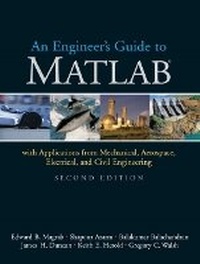
An Engineer's Guide to MATLAB
2nd Edition
Published on 13. January 2005
Book
Paperback/Softback
725 pages
978-0-13-145499-6 (ISBN)
Description
For undergraduate engineering courses in Mechanical, Aeronautical, Civil, and Electrical engineering that require/use MATLAB.
This authoritative text guides students in developing a strong working knowledge of MATLAB to solve a wide range of engineering problems. Since solving these problems usually involves writing relatively short, one-time-use programs, the authors demonstrate how to effectively develop such programs in MATLAB-programs that are compact yet readable, easy to debug, and execute fast. Emphasis is on using MATLAB to obtain solutions to several classes of engineering problems, so technical material is presented in summary form only.
This authoritative text guides students in developing a strong working knowledge of MATLAB to solve a wide range of engineering problems. Since solving these problems usually involves writing relatively short, one-time-use programs, the authors demonstrate how to effectively develop such programs in MATLAB-programs that are compact yet readable, easy to debug, and execute fast. Emphasis is on using MATLAB to obtain solutions to several classes of engineering problems, so technical material is presented in summary form only.
More details
Edition
2nd edition
Language
English
Place of publication
United States
Publishing group
Pearson Education (US)
Target group
College/higher education
Dimensions
Height: 236 mm
Width: 182 mm
Thickness: 41 mm
Weight
1184 gr
ISBN-13
978-0-13-145499-6 (9780131454996)
Copyright in bibliographic data and cover images is held by Nielsen Book Services Limited or by the publishers or by their respective licensors: all rights reserved.
Schweitzer Classification
Other editions
New editions
Edward Magrab | Edward B. Magrab | Shapour Azarm
Engineers Guide to MATLAB, An
Book
02/2010
3rd Edition
Pearson
€208.99
Shipment within 15-20 days
Previous edition
Edward B. Magrab | Shapour Azarm | Balakumar Balachandran
An Engineer's Guide to MATLAB
Book
09/2000
Pearson
€43.39
Article exhausted; check for reprint
Content
(NOTE: Each chapter concludes with Exercises.)
1. Introduction, Edward B. Magrab
1.1. Introduction.
1.2. The MATLAB Environment.
1.3. Ways to Use MATLAB.
1.4. Online Help.
1.5. Some Suggestions on How to Use MATLAB.
1.6. Organization of the Book and its Goals.
1.7. Summary of Functions Introduced in Chapter.
2. Matrices and MATLAB, Edward B. Magrab
2.1. Introduction.
2.2. Matrices and Vectors.
2.3. Creation of Vectors.
2.4. Creation of Matrices.
2.5. Dot Operations.
2.6. Mathematical Operation with Matrices.
2.7. Summary of Functions Introduced in Chapter.
3. Data Input/Output, Edward B. Magrab
3.1. Strings and Annotated Output.
3.3. Input/Output Data Files.
3.4. Cell Arrays.
3.5. Input Microsoft Excel Files.
3.6.Summary of Functions Introduced in Chapter.
4. Program Flow Control, Edward B. Magrab
4.1. Introduction-Logical Operator.
4.2. Control of Program Flow.
4.3. Summary of Functions Introduced in Chapter.
5. Functions, Edward B. Magrab
5.1. Introduction.
5.2. Creating Functions.
5.3. User Defined Functions, Function Handles, and feval.
5.4. MATLAB Functions That Operate on Arrays of Data.
5.5.MATLAB Functions That Require User-Created Functions.
5.6. The Symbolic Toolbox and the Creation of Functions.
5.7. Summary of Functions Introduced in Chapter.
6. 2D Graphics, Edward B. Magrab
6.1. Introduction.
6.2. Basic 2D Plotting Commands.
6.3. Graph Annotation and Visual Enhancement.
6.4. Summary of Functions Introduced in Chapter.
7. 3D Graphics, Edward B. Magrab
7.1. Lines in 3D.
7.2. Surfaces.
7.3. Summary of Functions Introduced in Chapter.
8. Design of Machine Elements, Edward B. Magrab
8.1. Vectors, Forces, and the Equilibrium of Rigid Bodies.
8.2. Stresses and Deflections in Beams, Columns, and Shafts.
8.3. Stresses in Spur Gears.
8.4. Kinematics of a Four-Bar Linkage.
8.5. Cam Profiles and Synthesis.
8.6. Hydrodynamic Bearings.
8.7. PDE Toolbox and the Stress Concentration Factor for Notches in a Thin Plate.
9. Dynamics and Vibrations, Balakumar Balachandran
9.1. Orbital Motions.
9.2. Single-Degree-of-Freedom Systems.
9.3. Multi-Degree-of-Freedom Systems.
9.4. Vibrations of Thin Beams.
10. Control Systems, Gregory C. Walsh
10.1. Introduction to Control System Design.
10.2. Representations of Systems in MATLAB.
10.3. Response of Systems.
10.4. Design Tools.
10.5. Design Examples.
10.6. Summary of Functions Introduced in Chapter.
11. Fluid Mechanics, James H. Duncan
11.1. Hydrostatics.
11.2. Internal Viscous Flow.
11.3. External Flow.
11.4. Joukowski Airfoils.
11.5. Open Channel Flow.
12. Heat Transfer, Keith E. Herold
12.1. Heat Conduction.
12.2. Sizing of Shell and Tube Heat Exchangers.
12.3. Convection Heat Transfer.
12.4. Radiation Heat Transfer.
13. Optimization, Shapour Azarm
13.1. Definition, Formulation, and Graphical Solutions.
13.2. Linear Programming.
13.3. Nonlinear Programming.
13.4. Single-Objective Constrained Methods.
13.5. Multiobjective Optimization.
13.6. Summary of Functions Introduced in Chapter.
14. Engineering Statistics, Edward B. Magrab
14.1. Descriptive Statistical Quantities.
14.2. Probability Distributions.
14.3. Confidence Intervals.
14.4. Hypothesis Testing.
14.5. Linear Regression.
14.6. Design of Experiments.
14.7. Summary of Functions Introduced in Chapter.
Index.
1. Introduction, Edward B. Magrab
1.1. Introduction.
1.2. The MATLAB Environment.
1.3. Ways to Use MATLAB.
1.4. Online Help.
1.5. Some Suggestions on How to Use MATLAB.
1.6. Organization of the Book and its Goals.
1.7. Summary of Functions Introduced in Chapter.
2. Matrices and MATLAB, Edward B. Magrab
2.1. Introduction.
2.2. Matrices and Vectors.
2.3. Creation of Vectors.
2.4. Creation of Matrices.
2.5. Dot Operations.
2.6. Mathematical Operation with Matrices.
2.7. Summary of Functions Introduced in Chapter.
3. Data Input/Output, Edward B. Magrab
3.1. Strings and Annotated Output.
3.3. Input/Output Data Files.
3.4. Cell Arrays.
3.5. Input Microsoft Excel Files.
3.6.Summary of Functions Introduced in Chapter.
4. Program Flow Control, Edward B. Magrab
4.1. Introduction-Logical Operator.
4.2. Control of Program Flow.
4.3. Summary of Functions Introduced in Chapter.
5. Functions, Edward B. Magrab
5.1. Introduction.
5.2. Creating Functions.
5.3. User Defined Functions, Function Handles, and feval.
5.4. MATLAB Functions That Operate on Arrays of Data.
5.5.MATLAB Functions That Require User-Created Functions.
5.6. The Symbolic Toolbox and the Creation of Functions.
5.7. Summary of Functions Introduced in Chapter.
6. 2D Graphics, Edward B. Magrab
6.1. Introduction.
6.2. Basic 2D Plotting Commands.
6.3. Graph Annotation and Visual Enhancement.
6.4. Summary of Functions Introduced in Chapter.
7. 3D Graphics, Edward B. Magrab
7.1. Lines in 3D.
7.2. Surfaces.
7.3. Summary of Functions Introduced in Chapter.
8. Design of Machine Elements, Edward B. Magrab
8.1. Vectors, Forces, and the Equilibrium of Rigid Bodies.
8.2. Stresses and Deflections in Beams, Columns, and Shafts.
8.3. Stresses in Spur Gears.
8.4. Kinematics of a Four-Bar Linkage.
8.5. Cam Profiles and Synthesis.
8.6. Hydrodynamic Bearings.
8.7. PDE Toolbox and the Stress Concentration Factor for Notches in a Thin Plate.
9. Dynamics and Vibrations, Balakumar Balachandran
9.1. Orbital Motions.
9.2. Single-Degree-of-Freedom Systems.
9.3. Multi-Degree-of-Freedom Systems.
9.4. Vibrations of Thin Beams.
10. Control Systems, Gregory C. Walsh
10.1. Introduction to Control System Design.
10.2. Representations of Systems in MATLAB.
10.3. Response of Systems.
10.4. Design Tools.
10.5. Design Examples.
10.6. Summary of Functions Introduced in Chapter.
11. Fluid Mechanics, James H. Duncan
11.1. Hydrostatics.
11.2. Internal Viscous Flow.
11.3. External Flow.
11.4. Joukowski Airfoils.
11.5. Open Channel Flow.
12. Heat Transfer, Keith E. Herold
12.1. Heat Conduction.
12.2. Sizing of Shell and Tube Heat Exchangers.
12.3. Convection Heat Transfer.
12.4. Radiation Heat Transfer.
13. Optimization, Shapour Azarm
13.1. Definition, Formulation, and Graphical Solutions.
13.2. Linear Programming.
13.3. Nonlinear Programming.
13.4. Single-Objective Constrained Methods.
13.5. Multiobjective Optimization.
13.6. Summary of Functions Introduced in Chapter.
14. Engineering Statistics, Edward B. Magrab
14.1. Descriptive Statistical Quantities.
14.2. Probability Distributions.
14.3. Confidence Intervals.
14.4. Hypothesis Testing.
14.5. Linear Regression.
14.6. Design of Experiments.
14.7. Summary of Functions Introduced in Chapter.
Index.