

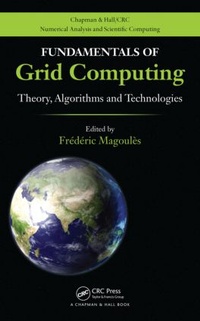
Fundamentals of Grid Computing
Theory, Algorithms and Technologies
1st Edition
Will be published approx. on 23. December 2009
Book
Hardback
322 pages
978-1-4398-0367-7 (ISBN)
Description
The integration and convergence of state-of-the-art technologies in the grid have enabled more flexible, automatic, and complex grid services to fulfill industrial and commercial needs, from the LHC at CERN to meteorological forecasting systems. Fundamentals of Grid Computing: Theory, Algorithms and Technologies discusses how the novel technologies of semantic web and workflow have been integrated into the grid and grid services.
The book explains how distributed mutual exclusion algorithms offer solutions to transmission and control processes. It also addresses the replication problem in data grids with limited replica storage and the problem of data management in grids. After comparing utility, grid, autonomic, and cloud computing, the book presents efficient solutions for the reliable execution of applications in computational grid platforms. It then describes a fault tolerant distributed scheduling algorithm for large-scale distributed applications, along with broadcasting algorithms for institutional grids. The final chapter shows how load balancing is integrated into a real-world scientific application.
Helping readers develop practical skills in grid technology, the appendices introduce user-friendly open source software written in Java. One of the software packages covers strategies for data replication in the grid. The other deals with the implementation of a simulator for distributed scheduling in grid environments.
The various technology presented in this book demonstrates the wide aspects of interest in grid computing as well as the many possibilities and venues that exist in this research area. This interest will only further evolve as numerous exciting developments still await us.
The book explains how distributed mutual exclusion algorithms offer solutions to transmission and control processes. It also addresses the replication problem in data grids with limited replica storage and the problem of data management in grids. After comparing utility, grid, autonomic, and cloud computing, the book presents efficient solutions for the reliable execution of applications in computational grid platforms. It then describes a fault tolerant distributed scheduling algorithm for large-scale distributed applications, along with broadcasting algorithms for institutional grids. The final chapter shows how load balancing is integrated into a real-world scientific application.
Helping readers develop practical skills in grid technology, the appendices introduce user-friendly open source software written in Java. One of the software packages covers strategies for data replication in the grid. The other deals with the implementation of a simulator for distributed scheduling in grid environments.
The various technology presented in this book demonstrates the wide aspects of interest in grid computing as well as the many possibilities and venues that exist in this research area. This interest will only further evolve as numerous exciting developments still await us.
Reviews / Votes
... the common characteristics [of the nine chapters] are the clear exposition and the practical view, especially in what concerns the available implementations of the concepts. ... The introductory chapters as well as the ones referring to recent trends can be useful for graduate students who are interested in distributed computing, while the chapters addressing data management, scheduling, synchronization, fault tolerance or broadcasting provide new solutions for researchers and practitioners already initiated in grid computing techniques. -Zentralblatt MATH, 1191 This book shows, in some sense, the way to the future, where next generation middleware such as those described here will replace in the production infrastructure the more rudimentary ones in use today. Therefore, I am sure that the readers will greatly benefit from this insightful journey in the heart of the grids, a key technology in a very large number of scientific endeavors. -From the Foreword by Guy Wormser, Institut des Grilles, CNRS, Orsay, FranceMore details
Language
English
Place of publication
Oxford
United States
Publishing group
Taylor & Francis Inc
Target group
Professional and scholarly
Professional Practice & Development
Product notice
Paper over boards
Dimensions
Height: 245 mm
Width: 164 mm
Thickness: 19 mm
Weight
592 gr
ISBN-13
978-1-4398-0367-7 (9781439803677)
Copyright in bibliographic data and cover images is held by Nielsen Book Services Limited or by the publishers or by their respective licensors: all rights reserved.
Schweitzer Classification
Other editions
Additional editions
Book
09/2019
1st Edition
Chapman & Hall/CRC
€93.90
Shipment within 15-20 days
E-Book
12/2009
1st Edition
Chapman & Hall/CRC
€86.99
Available for download
E-Book
12/2009
Chapman and Hall
€86.99
Available for download
Person
Frederic Magoules is a professor in the Applied Mathematics and Systems Laboratory at Ecole Centrale Paris in Chatenay-Malabry, France.
Content
Grid Computing Overview. Synchronization Protocols for Sharing Resources in Grid Environments. Data Replication in Grid Environment. Data Management in Grids. Future of Grids Resources Management. Fault Tolerance and Availability Awareness in Computational Grids. Fault Tolerance for Distributed Scheduling in Grids. Broadcasting for Grids. Load Balancing Algorithms for Dynamic Networks. Appendices. Index.